

Commentary
Judy Dempsey
{
  "authors": [
    "Judy Dempsey"
  ],
  "type": "commentary",
  "blog": "Strategic Europe",
  "centerAffiliationAll": "",
  "centers": [
    "Carnegie Endowment for International Peace",
    "Carnegie Europe"
  ],
  "collections": [
    "EU Integration and Enlargement"
  ],
  "englishNewsletterAll": "",
  "nonEnglishNewsletterAll": "",
  "primaryCenter": "Carnegie Europe",
  "programAffiliation": "",
  "programs": [],
  "projects": [],
  "regions": [
    "Europe",
    "Western Europe"
  ],
  "topics": [
    "EU",
    "Migration"
  ]
}
Source: Getty
European governments have a real chance to rescue an EU that never recovered from the end of the Cold War. But which leaders will seize the opportunity?
The run-up to the summit of EU leaders on September 23 showed how the 28-member bloc was fraying.
Several leaders from Central Europe, most notably Hungary’s Prime Minister Viktor Orbán, criticized what he called “moral imperialism.” He was referring to Angela Merkel, the German chancellor, who has consistently told her counterparts why Europe has a moral obligation to help those fleeing wars and conflicts.
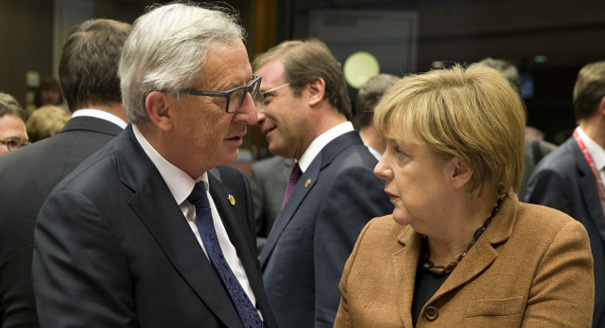
During the summit, the atmosphere had changed for the better. Jean-Claude Juncker, the president of the European Commission, put forward a detailed, short-term proposal to cope with the influx of refugees and to help Turkey, Jordan, and Lebanon, which have taken in millions of refugees.
The EU has reached this state of confusion, insecurity, squabbling, and bureaucratic paralysis because the Cold War is over. Since the reunification of Germany twenty-five years ago, Europe has lost its way. Lost its self-confidence. Lost a clear sense of what it should and could be.
None of that was in question before 1989. The dream and goal then was to make Europe free, peaceful, and reunited. The Yugoslav Wars of the 1990s shook the EU and should have been sufficient warning for the EU of things to come. But the breakup of Yugoslavia was not enough to shake Europe out of its Cold War–era comfort zone, which set the parameters for Europe’s goal and for the transatlantic relationship.
The EU’s enlargement to the East in 2004, when the union admitted eight former Communist countries, came at an immensely exciting time. The expansion ended the divisions between Eastern and Western Europe.
Even then, the EU’s institutions and member states had little idea about how Europe was going to use that enlargement and grapple with its neighborhoods. There was an awareness of the need to make the EU work more efficiently through the Lisbon Treaty, which came into force in 2009. But these were weak attempts to cope with the post–Cold War era—and with globalization.
The eurozone crisis, Russia’s invasion of eastern Ukraine, and the tens of thousands of refugees who have made and will continue to make their way to Europe have now exposed the EU’s inability to cope outside its comfort zone.
A new period of insecurity is now well and truly upon the EU. The Greek financial crisis is far from over. Russia is not going to give up the Donbass region in eastern Ukraine. And Europe’s refugee crisis has become caught up in how to end the war in Syria, with Russia making every diplomatic and military effort to save Syrian President Bashar al-Assad.
The Syrian president’s barrel bombs and sheer brutality were what killed so many people and caused so many to flee the country in the first place—not the self-proclaimed Islamic State, which has become a hugely complicating factor.
The EU and its member states have dealt with these three crises without any putting in place any long-term strategic goals. The union doesn’t have a plan B if Alexis Tsipras, who was reelected as Greek prime minister on September 20, cannot restore the Greek economy to stability and growth. The EU doesn’t have a long-term strategy for Ukraine—not to mention the union’s Eastern neighborhood.
As for the refugee crisis, which Juncker rightly said would not go away, the EU has agreed to apply lots of Band-Aid measures and throw money at the problem. The sticking plasters will peel off very quickly unless the EU recognizes how globalization, digitalization, and social media are impacting the union. The EU no longer has a comfort zone in which it can seek refuge.
That is why Juncker has a better sense than Merkel of Europe’s direction. Merkel’s compassion toward the refugees, which was driven by the German public and her own conviction, lacked strategy. This was confirmed by her unilateral decision to open Germany’s borders to the refugees only to close them after criticism from her own conservative bloc and other EU leaders.
Juncker’s approach is something new for an EU leader. He wants the EU to think and act in terms of politics. In his first annual State of the Union address on September 9, the commission president delivered a hard-nosed and strategic speech that bluntly stated why the EU was in such a bad state.
“I believe the immense challenges Europe is current facing – both internally and externally – leave us no choice to but to address them from a very political perspective, in a very political manner and having the political consequences of our decisions very much in mind,” he said.
“This is not the time for business as usual,” he continued. Juncker’s leitmotiv was clear: more integration. “There is not enough Europe in this Union. There is not enough Union in this Union,” he stated.
The crises over Ukraine, Greece, and the refugees should be enough to give the EU a new direction. But which EU leaders, apart from Juncker, want the EU to act politically and leave behind its comfort zone?
Photo credit: The European Union.

Nonresident Senior Fellow, Carnegie Europe
Judy Dempsey is a nonresident senior fellow at Carnegie Europe
Recent Work
Judy Dempsey
Judy Dempsey
Carnegie does not take institutional positions on public policy issues; the views represented herein are those of the author(s) and do not necessarily reflect the views of Carnegie, its staff, or its trustees.

Russia is testing the waters of NATO’s mutual defense clause. What do strikes in Romanian territorial waters mean for the alliance’s posture toward Moscow?

Dimitar Bechev

With its public finances in shambles, the far right polling at 35 percent ahead of the 2027 presidential election, and a growing protest movement, is France’s crisis a threat to the EU’s geopolitical awakening?

Rym Momtaz, ed.

Ahead of a tough winter for Ukraine, Donald Trump’s swing back toward Russia bodes ill. But instead of panicking, Kyiv’s European allies are focusing on action.
Rym Momtaz

While the EU and European governments are embracing the much-lauded middle-power moment, this entails three difficult conundrums.

Richard Youngs

Much has been said of the changes Brussels is trying to make to the EU enlargement process. Here’s why gradual integration might—or might not—be the answer.
Dimitar Bechev