

Commentary
The European Commissioner for Trade is headed to China. But after President Xi’s bridge-building visit to Washington, can a more isolated EU overcome Beijing’s stranglehold on critical raw materials? Who will blink first?
Rym Momtaz, ed.
{
  "authors": [
    "Ahmad Masa’deh"
  ],
  "type": "commentary",
  "blog": "Strategic Europe",
  "centerAffiliationAll": "",
  "centers": [
    "Carnegie Endowment for International Peace",
    "Carnegie Europe"
  ],
  "collections": [
    "Europe’s Southern Neighborhood"
  ],
  "englishNewsletterAll": "",
  "nonEnglishNewsletterAll": "",
  "primaryCenter": "Carnegie Europe",
  "programAffiliation": "",
  "programs": [],
  "projects": [],
  "regions": [
    "Middle East",
    "Jordan"
  ],
  "topics": [
    "EU",
    "Foreign Policy"
  ]
}
Source: Getty
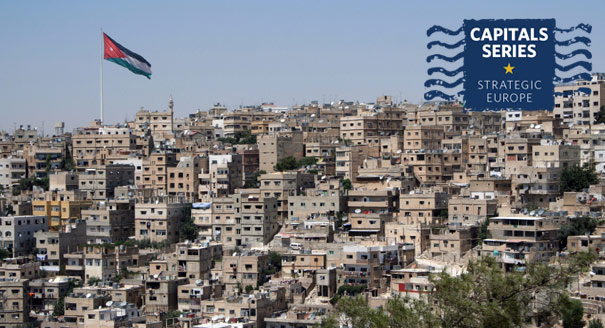
EU initiatives in Jordan should focus on projects that lead to real political development and enhance the welfare and life quality of Jordanian citizens.
Strategic Europe continues its Capitals Series exploring how EU foreign policy is viewed by ten countries in Europe’s Southern neighborhood. We have asked our contributors from each capital to give a candid assessment of the EU’s approach toward their country, with a ranking on a scale from “irrelevant” to “helpful.” This week, the spotlight is on Jordan.
*
Over the past three decades, the EU has dealt with its Southern Mediterranean neighbors either through bilateral instruments of engagement such as political and economic Association Agreements or via multilateral frameworks like the Union for the Mediterranean created in 2008. Some Mediterranean countries such as Jordan have also been accorded a new form of relationship through the EU’s “advanced status” framework. Unfortunately, none of these initiatives has succeeded in reaching its optimal value or in benefiting the EU’s Southern neighbors.

The EU’s approach to Jordan is confused, having been undermined by its inconsistency and by member states’ lack of unanimity. The EU has not pushed for serious structural reforms in its Southern neighbors, to the extent that at some junctures, the union’s involvement feels like no more than lip service. Indeed, the EU’s policy approach toward the Southern Mediterranean has contained a carrot (which has usually ended up financing the budgetary deficits of Arab countries) but never a stick.
The strong bilateral relations between some EU member states and Arab countries, as well as the different natures and interests of North African vis-à-vis Middle Eastern nations, have augmented a divide between the EU’s Southern neighbors. At times, the result has been that these countries have competed against one another to secure more unilateral benefits.

Furthermore, a negative feeling has been created among Jordanian and other Arab societies by the failure of EU donor monies to achieve concrete and quantifiable results on the ground—that is, results that citizens feel directly in the form of lower unemployment and inflation rates and that are reflected in deep structural changes in the receiving states.
Worst of all, the limited impact of large, serious, political and economic EU projects on the southern rim of the Mediterranean played a role in strengthening autocratic regimes and led indirectly to the spread of radical movements in the region. Today, these movements, which are wrongfully branded as rooted in Islam, threaten the whole nationhood of Arab countries as well as the security and social stability of EU member states.
EU initiatives in #Jordan should focus on political development.Tweet This
The challenge around the Mediterranean basin is ideological, educational, and cultural. To combat radicalism, regardless of its format, EU policies should comprise certain features. At the political and socioeconomic levels, EU initiatives in Jordan should focus strategically on projects that lead to proper political development and enhance the welfare and quality of life of Jordanian citizens. Targeted schemes aimed at making deep changes in the bureaucratic structure, philosophy, and ethics of the country’s public sector should take center stage. Projects focusing on the rule of law should play a prominent role as well.
At the technical level, EU policies should ease restrictions on industry, trade, rules of origin, and the provision of services originating from Jordan. This would help provide more opportunities for young Jordanians and achieve more equilibrium in the country’s balance of trade.
At the multilateral level, Jordan and other Arab countries would benefit from a serious EU project addressing strategic regional questions. To this end, the EU and its Southern neighbors need to erect a new multilateral EU-Mediterranean platform. Essential elements in such an exercise should include solving the Israeli-Palestinian conflict, concluding an Arab free-trade agreement, ending civil wars and internal crises, resolving the refugee crisis and paving the way for refugees to return to their homes (especially the 1.2 million Syrians in Jordan, who are heavily consuming the country’s resources), and reviving the original cultural and civil values of the Middle East.
In summary, to overcome past disappointing experiences, the quality, not the quantity, of cooperation should be the focus of EU-Jordanian dealings in the future.
Ahmad Masa’deh is the managing partner of Khalaf Masa’deh & Partners and a former Jordanian minister, ambassador to the EU, and secretary general of the Union for the Mediterranean.
Ahmad Masa’deh
Carnegie does not take institutional positions on public policy issues; the views represented herein are those of the author(s) and do not necessarily reflect the views of Carnegie, its staff, or its trustees.

The European Commissioner for Trade is headed to China. But after President Xi’s bridge-building visit to Washington, can a more isolated EU overcome Beijing’s stranglehold on critical raw materials? Who will blink first?

Rym Momtaz, ed.

The domestic impacts of how long it is taking to end the war in Ukraine have pushed the French electorate to the political extremes and compromised the country’s diplomatic capacity.
Rym Momtaz

Before the next wave of EU enlargement takes place, the union needs to grapple with thorny questions of how power is distributed among its members.


Emil Sondaj Hansen, Ditte Brasso Sørensen

A summer of escalation in the Black Sea has hurt Ukraine economically and is exacerbating world food security. A truce is needed—as is a broader reframing of Europe’s Ukraine strategy.

Thomas de Waal

Are Germany’s economic, industrial, and political struggles becoming a liability for the EU’s ability to rise to the geopolitical moment?
Rym Momtaz, ed.