

Commentary
Europe isn’t as weak in the new geopolitics of power as many would believe. But to leverage its assets and claim a sphere of influence, Brussels must stop undercutting itself.
Dimitar Bechev
{
  "authors": [
    "Jaba Devdariani"
  ],
  "type": "commentary",
  "blog": "Strategic Europe",
  "centerAffiliationAll": "",
  "centers": [
    "Carnegie Endowment for International Peace",
    "Carnegie Europe"
  ],
  "collections": [
    "Europe’s Eastern Neighborhood"
  ],
  "englishNewsletterAll": "",
  "nonEnglishNewsletterAll": "",
  "primaryCenter": "Carnegie Europe",
  "programAffiliation": "",
  "programs": [],
  "projects": [],
  "regions": [
    "Russia",
    "Europe",
    "Eastern Europe",
    "Caucasus",
    "Georgia",
    "Ukraine",
    "Moldova"
  ],
  "topics": [
    "Democracy"
  ]
}
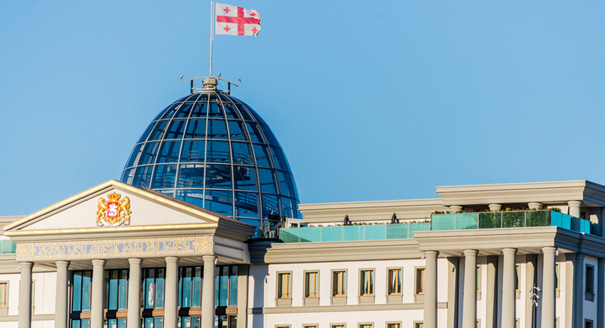
Source: Getty
Despite their appealing promises, oligarchs do not offer a viable form of governance in countries such as Georgia, Moldova, and Ukraine.
Oligarchs might not be anybody’s first pick as rulers, but they emerge as the default choice in the no-man’s-land between the EU and Russia. Experts at navigating a space that is strongly contested but poorly regulated, oligarchs today form a golden bridge of communication between two increasingly opposing camps.
Twenty years ago, voters in Georgia, Moldova, and Ukraine elected either seasoned, lightly rebranded Communist Party apparatchiks or nationalist firebrands. A decade ago, when the EU was more optimistic about its future and seemed within reach for its Eastern neighbors, they opted for smooth-talking, pro-European reformers.
But today, citizens see an increasingly troubled and inward-looking Europe. They are also disillusioned by their own leaders. Turnout figures in recent elections in Georgia and Moldova were low. In Georgia, up to 37 percent of people surveyed in a poll failed to identify with any party in the run-up to the October 2016 parliamentary election. By stepping into the political void and promising stability, oligarchs deploy their experience and resources to capture these countries’ institutions—if not people’s imaginations. Yet despite their allure, oligarchs are not a wise choice for Georgia, Moldova, or Ukraine.
All three post-Soviet states, which have signed Association Agreements with the EU, are either directly governed or indirectly run by oligarchs. In Georgia’s October election, the Georgian Dream party—established and run under the patronage of former prime minister Bidzina Ivanishvili, whose personal wealth is one-third of Georgia’s GDP—won over three-quarters of the seats in the parliament. One month later in Moldova, Igor Dodon, widely seen as a front for the country’s super-rich businessman Vladimir Plahotniuc, became president. And Petro Poroshenko, a wealthy man increasingly accused of channeling the interests of other super-rich individuals, is the president of Ukraine.
These men all have different pasts and aspirations. But in these uncertain times, oligarchs share a competitive advantage: intimate familiarity with Russia’s dominant political system, combined with the financial resources to adjust to the EU’s modus operandi.
Ivanishvili is the most archetypal of oligarchs linked to Russia, including in terms of his preferred way of doing politics. Twenty years ago, when he was aligned with Russia’s most influential bankers, Ivanishvili sponsored Alexander Lebed as a decoy candidate in Russia’s 1996 presidential election to siphon off votes from the front-runner. This maneuver played an important part in the reelection of the hugely unpopular Boris Yeltsin on behalf of the Semibankirshchina, an oligarch conclave of which Ivanishvili was a member.
Ivanishvili understands Russian rules, because he once helped shape them. By employing investment bankers and lawyers, he and his colleagues can also adapt to European laws and practices. Oligarchs’ children, if not they themselves, are usually well integrated in Europe or the United States.
It is a sign of the dismal state of the EU’s normative space and its poor capacity for strategic projection that a progressive European might find some positive sides to oligarchic rule in Georgia, Moldova, and Ukraine. Three such advantages seem to stand out.
First, oligarchs are not only good at managing ambiguity but also conscious of their assets and therefore unlikely to generate unnecessary conflicts, either internally or externally. This contrasts positively with another ascendant political character in Europe: the firebrand illiberal populist. The extent of the damage that the two types do to democracy might be comparable, but illiberal populists hurt Europe’s self-perception more.
Second, although oligarchs do not bring rapid progress, relative internal stability is good for their businesses. Europe’s periphery benefits from that stability, too.
And third, despite not being committed, values-based Europeans, oligarchs are likely to resist a full-scale Russian takeover of their new fiefdoms, out of sheer self-interest.
Yet oligarchs are not a blessing in disguise for the countries they rule, but rather a slow-blow fuse lit under their nations’ statehood.
It would be mistaken to caricature oligarchs as Bond villains. They may well be patriots, and they may want to help the countries they identify with, if they see their political engagement as a form of charity. But even if their motives are pure, the disproportional financial power oligarchs command hinders the already-stunted development of democratic institutions. Even mature democracies struggle to bring the super-rich within the framework of the rule of law. If oligarchs’ monetary power is combined with political influence, then institutional checks and balances crumble. Things worsen further when an oligarch holds no elected public office—as in Georgia and Moldova.
If oligarchs’ motives are less than pure, their rule is akin to a hostile takeover of a struggling company. Oligarchs take all the trappings of political power—diplomatic immunity, access to international forums, the ability to divert state finances to pet projects with near impunity—and contract out or ignore less profitable parts, such as citizens’ welfare. The spectacular swindle of the century in Moldova, where over €1 billion ($1.1 billion) was stolen from three banks in 2014, has damaged Moldovans’ confidence in their politicians, tainting pro-Western leaders in the process.
But above all, oligarchs fail to inspire and drive their countries toward progress. By the nature of their business, they hold a dim, often-cynical view of human nature. They are rarely enlightened men, and their views are an eclectic mix of undergraduate philosophy curricula and pop-culture references. People might identify with them—Ivanishvili started out as a poor village boy and went on to gather a spectacular wealth of $4.8 billion—but in politics, oligarchs’ supporters often transfer their post-Soviet fondness for the nanny state to the shoulders of a rich benefactor.
Then there is the Russian connection. Oligarchs are not the Kremlin’s puppets—their relative wealth and geographic distance from Moscow afford them certain freedoms. But Moscow’s way of doing things is close to their hearts. They might have withdrawn their assets from Russia, but not their names from the volumes of kompromat, or compromising material, that is likely to be gathering dust in the headquarters of the Russian Federal Security Service (FSB), making oligarchs vulnerable to pressure.
How oligarchic rule turns out in each of the countries concerned depends on a complex combination of internal and external factors. The EU should engage with oligarchs who hold an accountable public office but should also continue to invest in the political classes and democratic processes of its Eastern neighbors. The core mistake for Western partners would be to choose stability over democracy and avert their eyes from oligarchs’ attempts to capture state institutions.
Yet the EU’s ability to gauge the real extent to which unelected oligarchs exercise control over state institutions is limited, because such influence is wielded behind closed doors through the leveraging of ties of money and loyalty. Reliably tracing those links requires in-depth political information and analysis. The findings of such analysis should inform the EU’s governance support programs for its Eastern neighbors.
Oligarchs might not set the house on fire as populists do, but they may just as surely bring it down by eroding its foundations.
Jaba Devdariani is the editor of the Clarion.
Jaba Devdariani
Europe isn’t as weak in the new geopolitics of power as many would believe. But to leverage its assets and claim a sphere of influence, Brussels must stop undercutting itself.

Dimitar Bechev
Europe’s reaction to the war in Iran has been disunited and meek, a far cry from its previously leading role in diplomacy with Tehran. To avoid being condemned to the sidelines while escalation continues, Brussels needs to stand up for international law.

Pierre Vimont
France and Germany’s failure to agree on the Future Combat Air System (FCAS) raises questions about European defense. Amid industrial rivalries and competing strategic cultures, what does the future of European military industrial projects look like?

Rym Momtaz, ed.
France has stopped clinging to notions of being a great power and is embracing the middle power moment. But Emmanuel Macron has his work cut out if he is to secure his country’s global standing before his term in office ends.
Rym Momtaz
Integrating AI into the workplace will increase job insecurity, fundamentally reshaping labor markets. To anticipate and manage this transition, the EU must build public trust, provide training infrastructures, and establish social protections.
Amanda Coakley