

Commentary
Gwendolyn Sasse
{
  "authors": [
    "Gwendolyn Sasse"
  ],
  "type": "commentary",
  "blog": "Strategic Europe",
  "centerAffiliationAll": "",
  "centers": [
    "Carnegie Endowment for International Peace",
    "Carnegie Europe"
  ],
  "collections": [
    "Europe’s Eastern Neighborhood"
  ],
  "englishNewsletterAll": "",
  "nonEnglishNewsletterAll": "",
  "primaryCenter": "Carnegie Europe",
  "programAffiliation": "",
  "programs": [],
  "projects": [],
  "regions": [
    "Europe",
    "Eastern Europe",
    "Ukraine"
  ],
  "topics": []
}
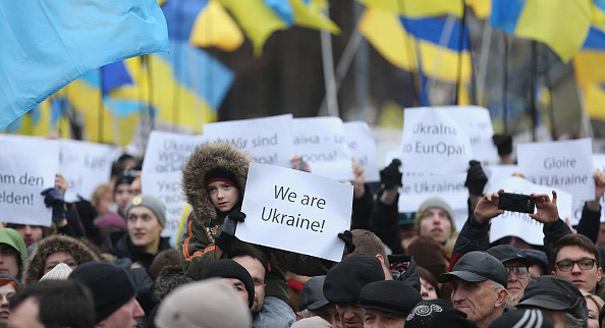
Source: Getty
There is a paucity of Ukrainian opinion poll data at a time when this should be vital information for anybody interested in helping Ukraine’s reform process.
The war in eastern Ukraine is no longer headline news in Western media. These days, Ukraine gets an occasional mention in projections about the wider geopolitical developments that lie ahead. But here, Ukraine’s role is little more than that of a political football kicked across the world stage. A potential rapprochement between U.S. President-elect Donald Trump and Russian President Vladimir Putin would sideline Ukraine further. And if France and Germany turn inward during their respective election years, there will be no international actor left trying to keep up the momentum behind the Minsk agreement, which aims to resolve the conflict in Ukraine.
Projections like these reduce Ukraine’s agency and, even more importantly, completely ignore the views, fears, and hopes of Ukrainian citizens. Current publicly available snapshots of Ukrainian opinions are rare, despite the valuable information they can provide in the context of Ukraine’s reform efforts. Such findings therefore deserve close attention.
According to a poll conducted jointly by the Ilko Kucheriv Democratic Initiatives Foundation and the Razumkov Center and publicized in early January, only 3 percent of Ukrainians think that the overall situation in Ukraine has improved. Moreover, these improvements are mostly associated with the country’s national defense capabilities.
The results of the poll were more readily available, at least in summary form, in Ukrainian than in English. Continuing a long-lasting trend, this poll confirms that not a single Ukrainian politician or political institution can count on citizens’ trust. The most trusted institutions are the army and patrol units, including voluntary formations. Interestingly, trust in local councils is higher than in national institutions.
According to this poll, for 44 percent of the respondents, visa-free travel to the EU was important, while 50 percent said it was not. This divide is probably best interpreted not as opposition to visa-free travel in general but as a reflection of who can realistically make use of this right, which is expected to be introduced in 2017. Some Ukrainian experts have interpreted this poll as a sign of growing Euroskepticism in Ukraine in response to slow progress on visa liberalization and the April 2016 Dutch referendum result that rejected the EU-Ukraine Association Agreement.
The latest survey is in line with regular Razumkov Center polls that show that already in early 2016, over 70 percent of Ukrainians thought that the country was heading in the wrong direction. Even at the height of the 2013–2014 Euromaidan antigovernment protests, about 55 percent considered their country to be on the wrong track. Only immediately after the 2004 Orange Revolution and around Viktor Yanukovych’s election as president in 2010 did the share of those considering Ukraine’s path to be the wrong one drop to or below 30 percent.
The latest five-year poll of the Kiev International Institute of Sociology (KIIS) established that the perceived well-being of society at large continues to be much lower than perceived individual well-being. The latter recorded a slight increase in the second half of 2016 but is still at such a low level (and below the level of 2012) that it does not alter the overall assessment. Thus, the latest survey results should not come as a surprise. But they capture the proportions of a worrying downward trend in Ukrainians’ perceptions of their personal and their country’s political and economic prospects.
In view of the possibility that Ukraine could face an early parliamentary election in 2017–2018, the KIIS poll of December 2016 about electoral preferences carries weight. Of those surveyed, 8.6 percent said they would vote for former prime minister Yulia Tymoshenko’s Fatherland party, followed by the Opposition Bloc (5.7 percent) and the president’s Petro Poroshenko Bloc (5.6 percent). The calculation is that given the high share of undecided (24 percent) and abstaining respondents (21.9 percent), the actual party shares would look as follows: Fatherland would obtain about 18 percent of the vote, the Opposition Bloc and the Petro Poroshenko Bloc about 12 percent each.
Similarly, Tymoshenko would score the highest number of votes in a presidential election (about 18 percent), followed by Petro Poroshenko (12.5 percent) and former vice prime minister Yuriy Boyko (about 12 percent).
Too few people outside Ukraine take note of the mood in the country. Moreover, even if one wants to go beyond the common focus on the elites and find out about Ukrainians’ views, this is not a straightforward matter. Opinion poll data are often not publicly available—or at least, not immediately. The list of readily available results on the websites of institutions like the Razumkov Center or the Democratic Initiatives Foundation does not include much fresh data from 2016. KIIS offers more regular updates on a range of surveys in Ukrainian and Russian, and some in English.
Dependence on external money for commissioned research seems to crowd out publicly available data at a time when this should be vital information for anybody inside or outside Ukraine interested in helping the country’s reform process. Western scholars frequently commission detailed surveys and some produce significant studies in due course, but the delay inherent in this type of research cannot fill the gap of reliable, regular short-term information on what Ukrainians actually think.
Gwendolyn Sasse is a nonresident senior fellow at Carnegie Europe and the director of the Center for East European and International Studies (ZOiS) in Berlin.
Nonresident Senior Fellow, Carnegie Europe
Gwendolyn Sasse is a nonresident senior fellow at Carnegie Europe. Her research focuses on Eastern Europe, with a particular focus on Ukrainian politics and society, EU enlargement, and comparative democratization.
Recent Work
Gwendolyn Sasse
Gwendolyn Sasse
Carnegie does not take institutional positions on public policy issues; the views represented herein are those of the author(s) and do not necessarily reflect the views of Carnegie, its staff, or its trustees.

Before the next wave of EU enlargement takes place, the union needs to grapple with thorny questions of how power is distributed among its members.


Emil Sondaj Hansen, Ditte Brasso Sørensen

A summer of escalation in the Black Sea has hurt Ukraine economically and is exacerbating world food security. A truce is needed—as is a broader reframing of Europe’s Ukraine strategy.

Thomas de Waal

Are Germany’s economic, industrial, and political struggles becoming a liability for the EU’s ability to rise to the geopolitical moment?

Rym Momtaz, ed.

European Commission President Ursula von der Leyen is about to give her annual address on the state of the EU. Here’s what she won’t—but should—say.
Rym Momtaz

The aftermath of the Ceuta crisis shows Europe has drawn the wrong lessons. Rather than doubling down on failed migration policies, the EU needs to address the underlying roots of such episodes.

Richard Youngs