

Commentary
Peter Kellner
{
  "authors": [
    "Peter Kellner"
  ],
  "type": "commentary",
  "blog": "Strategic Europe",
  "centerAffiliationAll": "",
  "centers": [
    "Carnegie Endowment for International Peace",
    "Carnegie Europe"
  ],
  "collections": [
    "Brexit and UK Politics"
  ],
  "englishNewsletterAll": "",
  "nonEnglishNewsletterAll": "",
  "primaryCenter": "Carnegie Endowment for International Peace",
  "programAffiliation": "",
  "programs": [],
  "projects": [],
  "regions": [
    "Western Europe",
    "United Kingdom",
    "Europe"
  ],
  "topics": [
    "Political Reform",
    "EU"
  ]
}
Source: Getty
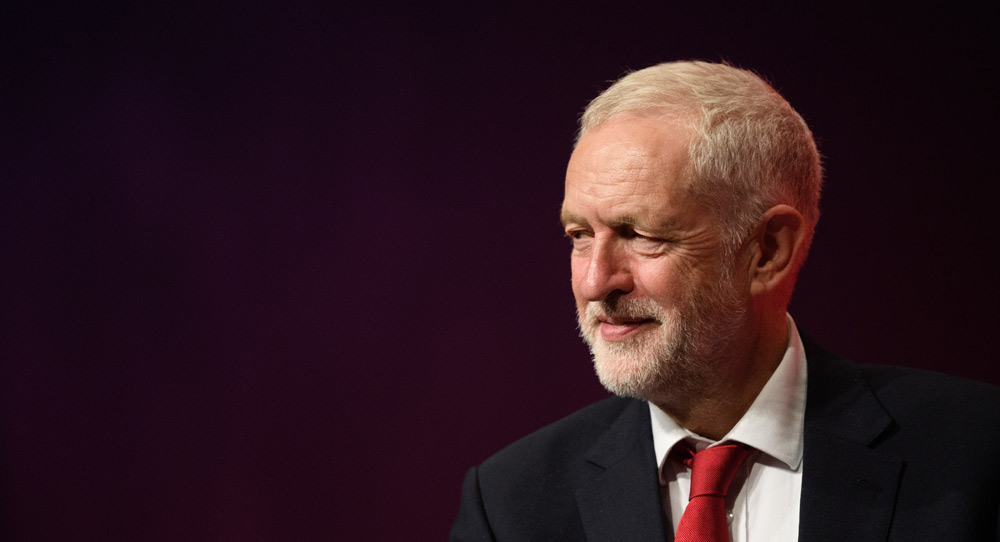
If Theresa May’s government falls and Jeremy Corbyn becomes the UK’s next prime minister, he could face a binary choice between hard Brexit or no Brexit at all.
It remains improbable but it is no longer impossible: Theresa May’s government could collapse before Brexit takes effect. The United Kingdom could end up with a Labour government led by Jeremy Corbyn. We are no longer undertaking an exercise in fantasy to ask what he would do.
The answer is not simple. Throughout his career, Corbyn has been a consistent opponent of “Europe.” He is a left-wing socialist who has always regarded Brussels as the headquarters of a capitalist conspiracy against the workers. In 1975, he campaigned for the UK to leave the Common Market, as the EU was then called. He voted against the Maastricht Treaty in 1993, saying that it “takes away from national parliaments the power to set economic policy and hands it over to an unelected set of bankers who will impose the economic policies of price stability, deflation, and high unemployment throughout the European Community.” He also opposed the Lisbon Treaty in 2008 on the grounds that the EU had “always suffered a serious democratic deficit.”
In last year’s Brexit referendum, however, Corbyn grudgingly accepted that, as the leader of an overwhelmingly pro-EU party, he had to recommend a vote for Remain. But he did so half-heartedly. When one interviewer asked him to rate the merits of the EU on a scale of one to ten, he awarded them a lukewarm “seven.” It was scarcely a ringing endorsement of EU membership; and he refused to play an active part in the cross-party Remain campaign. He did not sound distraught, as many Labour politicians did, when the referendum result was announced.
Since then, Labour’s overall policy has been much the same as the government’s—for the UK to have its cake and eat it: that is, to accept the referendum verdict but seek a deal with the other 27 EU member states that maintains as many of the benefits of membership as possible while shedding the costs and responsibilities.
One does not need a master’s degree in negotiation theory to see that such a deal is unlikely. Indeed, if May’s government collapses, it may well be because the talks break down, or lead to a deal that Britain’s parliament does not accept. An incoming Corbyn government may be faced with a binary choice: hard Brexit, without a deal—or no Brexit at all.
(We should note, in passing, that May has refused to confirm or deny that ministers have received legal advice that the UK could rescind its decision to leave the EU at any time up to March 2019. And Lord Kerr, who drafted Article 50, says that the UK has every legal right to change its mind.)
So: which way would Corbyn jump? The clues from this year suggest that he would end up keeping the UK in the EU. The Labour Party manifesto for the June general election went far further than the Conservatives’ in spelling out the benefits of membership that it would like to keep: the single market; the customs union; cooperation on climate change, refugees, and terrorism; Horizon 2020; Euratom; Erasmus; the European Medicines Agency; the European Arrest Warrant; and all EU rules on workers’ rights, consumer rights, and environmental protection.
There has been some confusion among leading Labour MPs since the election about whether the party wants these institutional arrangements to remain—or would accept new arrangements that simply happen to look like the old ones. If the latter were the case the UK would, for example, no longer be in the single market, but would trade with the EU for all practical purposes as if it were.
Increasingly that confusion is being dispelled. Keir Starmer, Labour’s highly respected shadow minister for Brexit, has been edging the party’s formal position toward wanting the UK to remain in the single market and customs union, not just seeking a relationship that looks like them. The logic of Starmer’s position is clear. If the UK does end up facing a binary choice, “No Brexit” would be vastly preferable to “Hard Brexit.”
However, do not expect him, even less Corbyn, to say that anytime soon. While Labour MPs and rank-and-file party members overwhelmingly want the UK to remain in the EU, many Labour voters, especially in the party’s traditional heartlands in the Midlands and the North of England, voted Leave last year. And Corbyn himself is torn between two small groups of people close to him: those in his office who remain anti-Brussels hardline socialists, and trade union leaders who helped him become party leader and who fear that Brexit would be bad for their members’ jobs.
For the time being, then, Labour’s formal position is intellectually incoherent. At the same time, it is turning out to be politically useful. The leadership is biding its time while internal arguments are thrashed out behind closed doors. It is also waiting to see how the current Brexit negotiations in Brussels play out.
Which brings us back to the point that Labour’s policy will become relevant if, and only if, Theresa May’s government loses control of parliament. If that happens, it will mean that the talks have gone badly—in which case, Labour can complete its journey toward keeping the UK in the EU. Labour could blame the Conservatives for causing a crisis and proclaim a partisan slogan that might be highly effective: “No to Tory Brexit.”
Peter Kellner is a journalist, political commentator, and former president of YouGov.

Former Nonresident Scholar, Carnegie Europe
Kellner was a nonresident scholar at Carnegie Europe, where his research focused on Brexit, populism, and electoral democracy.
Recent Work
Peter Kellner
Peter Kellner
Carnegie does not take institutional positions on public policy issues; the views represented herein are those of the author(s) and do not necessarily reflect the views of Carnegie, its staff, or its trustees.
Preparing candidate countries for EU membership is no longer enough. As the enlargement process becomes a reality, the union must also prepare its own societies.

Iliriana Gjoni
Five countries staged the biggest political boycott in Eurovision history over Israel’s participation. With the FIFA World Cup and other sporting or cultural touchstones on the horizon, are boycotts effective?

Rym Momtaz, ed.
The full list of humiliations Europe has endured since Donald Trump returned to the White House makes for grim reading. But Washington’s adversarial approach to its allies undermines its own power base.
Rym Momtaz
The closure of the Strait of Hormuz has triggered a global energy crisis, but Europe is stuck in reaction mode. Without more strategic foresight, the EU will remain dependent on fossil fuels and will never be truly secure.


Milo McBride, Pauline Gerard
After spending much of 2025 trying to placate Donald Trump, some European leaders are starting to change posture. But is even a hostile Washington still so important to Europe that the U.S. president’s outbursts are worth putting up with?
Rym Momtaz, ed.