

Commentary
Judy Dempsey
{
  "authors": [
    "Judy Dempsey"
  ],
  "type": "commentary",
  "blog": "Strategic Europe",
  "centerAffiliationAll": "",
  "centers": [
    "Carnegie Endowment for International Peace",
    "Carnegie Europe"
  ],
  "collections": [
    "Coronavirus"
  ],
  "englishNewsletterAll": "",
  "nonEnglishNewsletterAll": "",
  "primaryCenter": "Carnegie Europe",
  "programAffiliation": "",
  "programs": [],
  "projects": [],
  "regions": [
    "Asia",
    "Europe",
    "Western Europe",
    "Germany"
  ],
  "topics": [
    "Foreign Policy",
    "EU"
  ]
}
Source: Getty
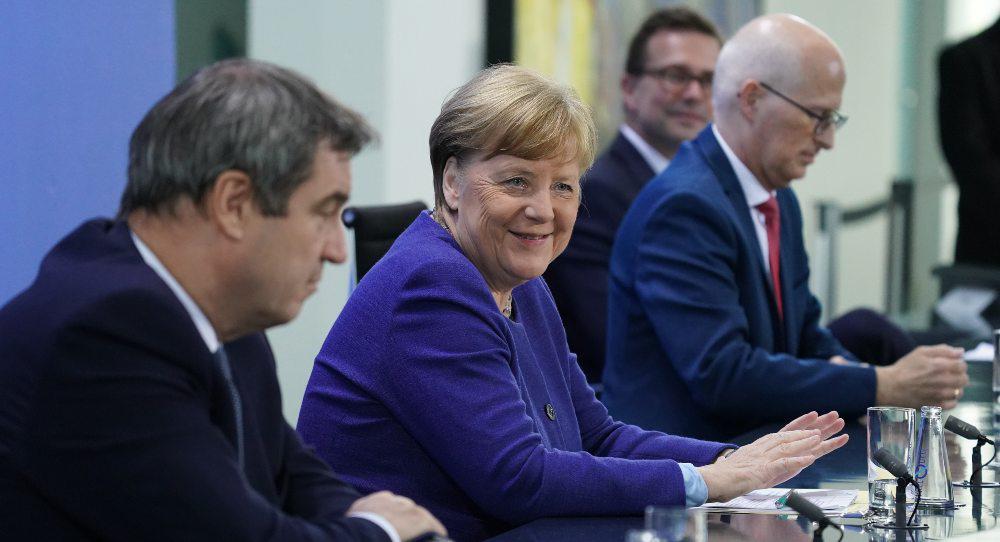
The fight against the coronavirus has sparked a political revival for Angela Merkel. Now, the German chancellor must also adopt a coherent foreign policy strategy for how to deal with China.
Back in January 2020, the German chancellor was written off as a lame duck. Angela Merkel didn’t have much to say.
She kept quiet as three men began competing for her job after her designated successor, Defense Minister Annegret Kramp-Karrenbauer, quit the race in February to run for chancellor in 2021. The infighting was just too much for the minister. The slump in opinion polls for the governing conservative bloc didn’t help either.
Then came the new coronavirus. Merkel was a bit slow out of the starting blocks. But the way the virus engulfed parts of northern Italy in February—and at speed—changed this risk-averse politician. She took charge.
It’s not easy for any leader, regardless of their political hew, to steer a country through this pandemic. For Merkel, it was particularly difficult. Germany works under a federal system. The leaders of the sixteen states have immense powers ranging from education to health.And while some European leaders dithered—even playing down the virus (UK Prime Minister Boris Johnson) or using the virus to accrue more powers (Hungarian Prime Minister Viktor Orbán) or trying to be a bit gung ho in their approach (French President Emmanuel Macron)—Merkel, a scientist by training, adopted a different approach.
Unusually for a leader that rarely gives interviews and shuns cameras, she reached out to the German public. Her state of the nation television address on March 18 was memorable for the way she combined her pragmatic outlook with an emotional appeal.
“Since German unification—no, since the Second World War—there has been no challenge to our nation that has demanded such a degree of common and united action,” she said. Germany, similar to other countries, went into lockdown.
Merkel also brought in experts. The German public has been briefed daily by virologists, the health minister, and especially by the Robert Koch Institute, the country’s top public health institute, which advises the government.
The restrictions are now being slowly lifted, with each state premier deciding how far to return to normal. But that is the big question. Is a return to the status quo ante really possible?
Merkel is in a bind. She is far from pleased with pandemic restrictions being lifted. Indeed, she has repeatedly warned of a so-called second wave of infections. But she is under immense pressure to end the lockdown from the manufacturing industries, the service sector, and families with children, among others.
Before the pandemic swept across Europe, Germany was in an enviable but also vulnerable situation. Its economy was so export-driven that it acquired a huge trade surplus. But partly because of that strength and its fiscal prowess, it was criticized by some EU leaders for opposing more economic integration and for opposing calls to issue bonds to Italy in order to stave off financial collapse as Rome struggles to contain the coronavirus.
Just to complicate matters for the eurozone and add to the criticism of Berlin’s economic policies, Germany’s highest court, the Constitutional Court, on May 5 questioned the European Central Bank’s (ECB) right to buy bonds for quantitative easing—something it has been doing for several years. Essentially, the ruling pitted a national court against the European Court of Justice, which had legally supported the ECB’s decision.
Unlike other German politicians who lambasted the Constitutional Court’s decision, Merkel said a compromise could be found. Neither Berlin nor any other eurozone country can afford a crisis that could destroy Europe’s currency and ultimately the credibility of the EU.
But while the fight against the coronavirus has sparked a political revival for Merkel at home, the same cannot be said of Berlin’s foreign policy, which sorely lacks a coherent strategy.
Merkel has come up with no ideas on how to reshape transatlantic relations or deal with the growing global influence of China. The chancellor opines often about American protectionism. But she has done little to reach out to like-minded countries to preserve or indeed reshape the multilateral system established after 1945—which U.S. President Donald Trump is doing his best to dismantle. And now there is the pandemic.
And she is under pressure to take a hard look at her policy toward China.
It’s not just the continuing controversy over whether Germany should sign up to integrating Huawei into its 5G telecommunications network. It’s about how Germany and Europe are going to deal with China now and in a post-coronavirus era. In this regard, Merkel has been more than cautious, if not silent. Yes, coping with the coronavirus and keeping the population safe are her priorities. But how to deal with China’s future role globally needs a strategy from Berlin and the EU.
This relationship with China is not just about trade, economic ties, or supply chains. It is about the kind of system Europeans want to live under. That system is already changing as governments use apps to monitor citizens’ health and impose restrictions on movement, work, and schools. Civil rights organizations warn that European governments must be held accountable for the use of these surveillance tools. It’s a system that by definition has to be politically and socially inclusive—unlike the system of surveillance pursued by Beijing.
This is Merkel’s challenge—and Europe’s; Berlin needs a coherent foreign policy. Sooner rather than later, the populists, who have been in their own kind of political quarantine, will reappear and try to erode the huge support Merkel has garnered since March. It’s already happening in some towns in Germany where there are calls to end all restrictions—and Merkel’s government.
This is another test to her political revival. It will be under even more scrutiny as Germany prepares to take over the rotating presidency of the Council of the EU in July.

Nonresident Senior Fellow, Carnegie Europe
Judy Dempsey is a nonresident senior fellow at Carnegie Europe
Recent Work
Judy Dempsey
Judy Dempsey
Carnegie does not take institutional positions on public policy issues; the views represented herein are those of the author(s) and do not necessarily reflect the views of Carnegie, its staff, or its trustees.

Are Germany’s economic, industrial, and political struggles becoming a liability for the EU’s ability to rise to the geopolitical moment?

Rym Momtaz, ed.

European Commission President Ursula von der Leyen is about to give her annual address on the state of the EU. Here’s what she won’t—but should—say.
Rym Momtaz

The aftermath of the Ceuta crisis shows Europe has drawn the wrong lessons. Rather than doubling down on failed migration policies, the EU needs to address the underlying roots of such episodes.

Richard Youngs

An overwhelming victory by a far-right-wing party in a small state in eastern Germany will have major repercussions for Chancellor Friedrich Merz’s coalition.
Judy Dempsey

Canadian Prime Minister Mark Carney has twice inspired praise for standing up to U.S. President Donald Trump: at the 2026 World Economic Forum in Davos and on Canada-U.S. trade negotiations. Is Carney showing a third way better than the EU has in dealing with the Trump administration?
Rym Momtaz, ed.