

Commentary
Dimitar Bechev
{
  "authors": [
    "Dimitar Bechev"
  ],
  "type": "commentary",
  "blog": "Strategic Europe",
  "centerAffiliationAll": "",
  "centers": [
    "Carnegie Endowment for International Peace",
    "Carnegie Europe"
  ],
  "collections": [
    "EU Integration and Enlargement"
  ],
  "englishNewsletterAll": "",
  "nonEnglishNewsletterAll": "",
  "primaryCenter": "Carnegie Europe",
  "programAffiliation": "",
  "programs": [],
  "projects": [],
  "regions": [
    "Georgia",
    "Eastern Europe",
    "Western Balkans"
  ],
  "topics": [
    "EU",
    "Political Reform",
    "Foreign Policy"
  ]
}
Source: Getty
Being pro-EU does not win politicians many votes in the Western Balkans and the Caucasus. There, Viktor Orbán’s version of an illiberal Europe appears to be the union’s top-rated political export.
It is election season in Europe.
Starting today and until June 9, voters in twenty-seven EU member states will be heading to the polls to elect the next European Parliament. Much hangs in the balance, including the top jobs in Brussels and, to an extent, the policies the union will pursue in the remainder of this decade.
As in previous cycles, the main story making headlines is the rise of the far right. Pundits already count the number of seats the likes of France’s National Front or AUR in Romania will win. There is also speculation over whether National Front leader Marine Le Pen and Italy’s Prime Minister Giorgia Meloni will set aside differences and form a large European Parliament caucus to rival the hitherto dominant center-right European People’s Party.
Whether all that happens or not, one thing is undeniable: electoral politics in the EU are becoming increasingly Europeanized. That voters would make a choice motivated by national issues used to be a self-evident truth in the European Parliament polls. To an extent, that’s still the case. Among other things, the current elections come as an interim litmus test ahead of national contests and actors battle out issues which are closer to home.
However, it is also true that pan-European matters have gone up the pecking order. Witness the zeal with which the far-right, traditionally Euroskeptic parties are joining forces to argue for stronger borders keeping illegal migration at bay. Or indeed the backlash across many a member state against the European Green Deal, a common theme in this year’s campaign in many corners of the EU.
But while parties and elections in the EU are becoming Europeanized, the opposite trend—de-Europeanization—is visible in countries that are queueing to join the union. The past month has provided us with examples in both the Western Balkans and the EU’s Eastern neighborhood.
Last weekend, the governing Serbian Progressive Party won comfortable majorities in the repeat elections in the capital Belgrade and the city of Novi Sad. The vote took place because of irregularities in December 2023, which triggered opposition protest. The outcome cements President Aleksandar Vučić’s power, including his narrative that Serbia has a wide array of options in today’s world beyond EU membership. On May 8, he welcomed Xi Jinping in Belgrade to trumpet China and Serbia’s “shared future” amid talk of strategic investment pouring in.
Although Serbia’s notoriously disunited opposition did not make Europe its campaign slogan to counter Vučić’s narrative, an electoral breakthrough in Belgrade would have punctured the latter. At the minimum, the anti-Vučić camp wants European-style democracy with checks and balances. Sadly, they are not getting it.
In neighboring North Macedonia, the incumbent Social Democrats lost badly to the right-wing Internal Macedonian Revolutionary Organization – Democratic Party for Macedonian National Unity (VMRO-DPMNE) in the double parliamentary and presidential elections on May 8.
VMRO-DPMNE rallied voters against the compromises North Macedonia struck with neighboring Greece, the famed Prespa Agreement of 2018, and Bulgaria. The newly elected President Gordana Siljanovska-Davkova ruffled feathers when she called the country “Republic of Macedonia,” dropping “North,” at her swearing-in ceremony. Observers are fearing that Skopje will get stuck again on its EU path, as it did under the premiership of VMRO-DPMNE’s Nikola Gruevski between 2006-2016.
The incoming Prime Minister Hristijan Mickovski is an ally of Euroskeptics such as Vučić and Hungary’s Viktor Orbán, who has provided exile to Gruevski escaping a prison sentence on corruption charges in his native land. All in all, chances are North Macedonia, which formally launched EU membership talks in 2022, will not be moving onto the substantive stage of the negotiations. It will decline to amend its constitution as the previous government and parliament promised the EU, accepting a deal France brokered to resolve the historical dispute with Bulgaria.
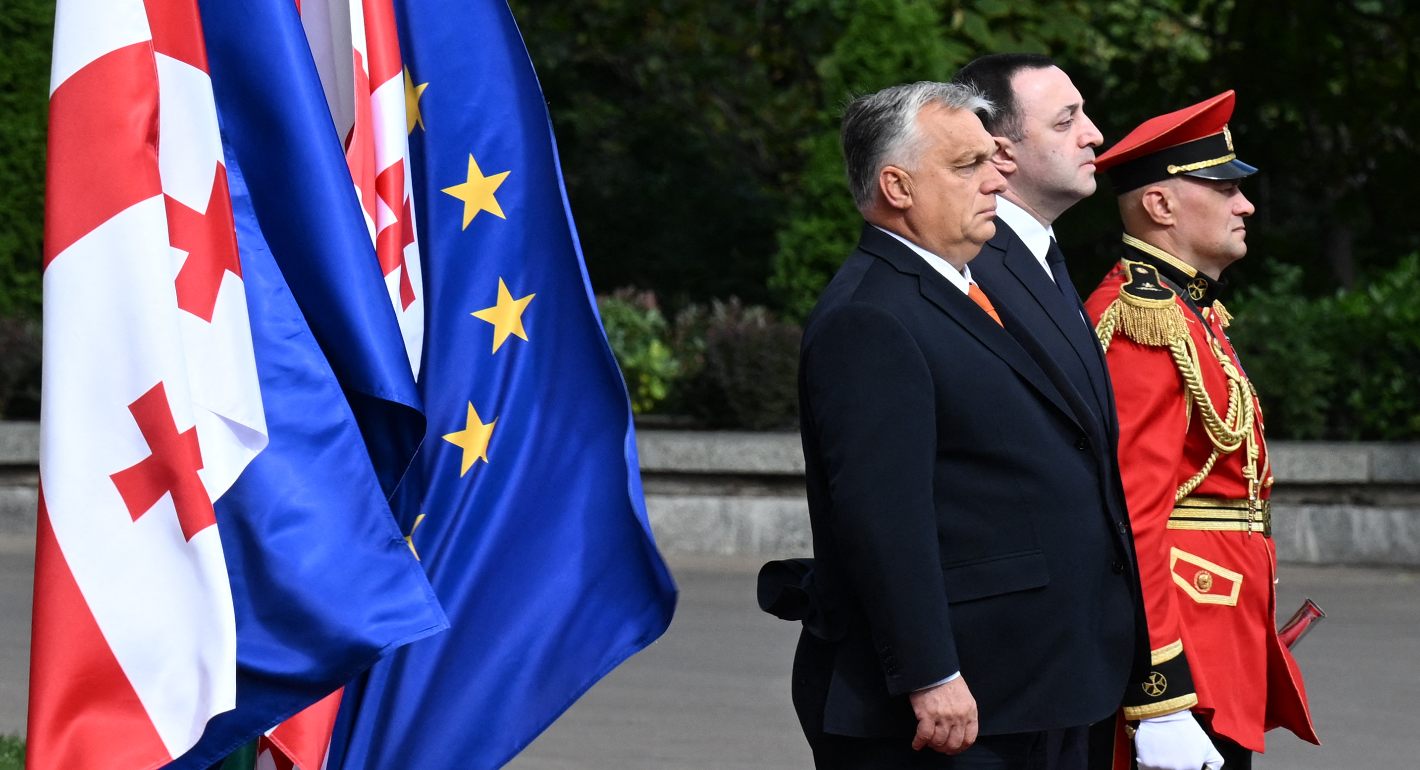
Orbanization rather than EU-ization is the trend in Georgia, another membership hopeful, too. The governing Georgian Dream party has defied pro-Western protests, pressure from the EU alongside a veto by President Salome Zorabichvili and went ahead in adopting a Russia-style “foreign agents” law threatening to clampdown on civil society. Shockingly, parliament toughened the restrictions between the second and third reading of the bill, ignoring EU pleas.
Now a new draft law on “family values and the protection of minors” targeting the LGBTQ+ community has been tabled, too. Georgian Dream pays lip service to the goal of joining the EU. In practice, it is muti-vectoring between the West and Russia—as well as China. And it will likely win another term in power at the forthcoming election in October.
This electoral cycle will no doubt furnish proof that the EU is contested internally. Yet the trend toward deeper integration is clear too. Outside EU borders, however, there is the opposite move. More and more countries are cherry-picking the bits of Europe they like—market integration, trade, investment—and ignoring the ones they do not, including liberal democracy and the rule of law.
Being pro-EU does not seem to win many votes in the Western Balkans and Georgia. Worse still, the slow pace of enlargement reinforces state capture and erodes the union’s appeal. Orbán’s version of Europe appears to be the EU’s top-rated political export these days.

Senior Fellow, Carnegie Europe
Dimitar Bechev is a senior fellow at Carnegie Europe, where he focuses on EU enlargement, the Western Balkans, and Eastern Europe.
Recent Work
Dimitar Bechev
Carnegie does not take institutional positions on public policy issues; the views represented herein are those of the author(s) and do not necessarily reflect the views of Carnegie, its staff, or its trustees.

The EU can impose sanctions but struggles to enforce them without the United States. With Washington increasingly disinterested in backing European interests, the bloc must now fend for itself.


Nicu Popescu, Tiago Antunes

Russia is testing the waters of NATO’s mutual defense clause. What do strikes in Romanian territorial waters mean for the alliance’s posture toward Moscow?
Dimitar Bechev

With its public finances in shambles, the far right polling at 35 percent ahead of the 2027 presidential election, and a growing protest movement, is France’s crisis a threat to the EU’s geopolitical awakening?

Rym Momtaz, ed.

Ahead of a tough winter for Ukraine, Donald Trump’s swing back toward Russia bodes ill. But instead of panicking, Kyiv’s European allies are focusing on action.
Rym Momtaz

While the EU and European governments are embracing the much-lauded middle-power moment, this entails three difficult conundrums.

Richard Youngs