

Commentary
- +1
Miloš Pavković, Fitim Gashi, Iliriana Gjoni, …
{
  "authors": [
    "Iliriana Gjoni"
  ],
  "type": "commentary",
  "blog": "Strategic Europe",
  "centerAffiliationAll": "",
  "centers": [
    "Carnegie Endowment for International Peace",
    "Carnegie Europe"
  ],
  "collections": [
    "EU Integration and Enlargement"
  ],
  "englishNewsletterAll": "",
  "nonEnglishNewsletterAll": "",
  "primaryCenter": "Carnegie Europe",
  "programAffiliation": "",
  "programs": [],
  "projects": [],
  "regions": [
    "Western Balkans",
    "Europe",
    "United Arab Emirates"
  ],
  "topics": [
    "EU Enlargement",
    "EU",
    "Foreign Policy"
  ]
}
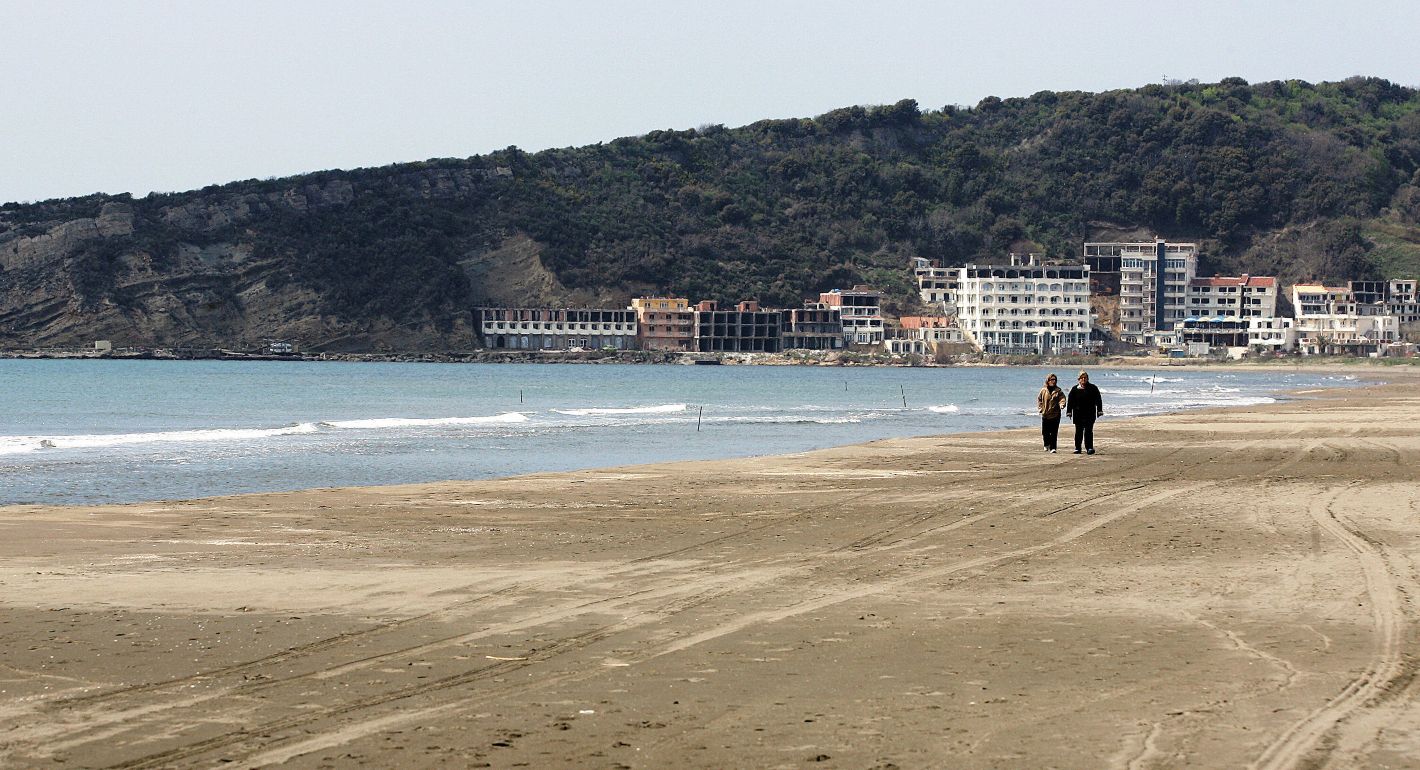
Source: Getty
The agreement allowing the UAE to invest in Montenegro’s coastline has triggered local protests. The EU must rethink how it engages with enlargement, and step in with alternative investments that promote EU values.
The EU has a problem. Leaner, faster, and better-funded players like the UAE—after China and Russia—are expanding their influence in Europe’s immediate neighborhood—not through statements or diplomacy, but through concrete deals, immediate capital injections, and high-visibility development projects.
While the EU speaks in terms of painstaking and slow reforms and benchmarks, others are acting with speed and ambition, reshaping the political and economic landscapes on the ground.
Montenegro is now a case in point, and a telling one.
In March 2025, Prime Minister Milojko Spajić signed a far-reaching agreement on cooperation in tourism and real estate development with the UAE. The Burj Khalifa lit up in the colors of the Montenegrin flag and the prime minister announced a transformative moment for the country’s economy, initially floating a €30–35 billion ($33,8–39,4 billion) investment.
The flagship project would be a massive tourism and infrastructure development at Velika Plaža (Albanian: Plazhi i Madh) in Ulcinj (Albanian: Ulqin)—one of the Adriatic’s last undeveloped stretches of coastline. The deal quickly unraveled under public scrutiny: the numbers were walked back, the terms questioned, and the method—opaque, centralized, and rushed—triggered backlash from citizens, local leaders, and civil society.
The protests that broke out were not just expressions of anger. They were evidence of civic maturity and democratic expectation. People mobilized, not against foreign investment per se, but against its concentration in the hands of a few, against the sidelining of public interest, and against a model of development that leaves them invisible. These voices deserve more than acknowledgment: They deserve a political and financial response.
The EU could have immediately jumped on this civic and political mobilization, but it did not. It is not too late, though it requires an overhaul of the European Commission’s enlargement approach and its relationship with aspirant countries during the candidacy process, as well as how it wields its economic and development power.
Montenegro’s president, Jakov Milatović, has since refused to sign the agreement into law despite parliamentary ratification, citing issues related to transparency, potential environmental impacts, and alignment with the country's strategic interests. The draft has now been returned to parliament, leaving the project in limbo. But this opens a strategic window of opportunity for the EU to step in, not merely to critique from the sidelines, but to offer meaningful alternatives rooted in democratic processes, environmental protection, and community empowerment.
Velika Plaža is not just any plot of land. It lies at the heart of Ulcinj, a majority-Albanian municipality with deep cultural heritage and a long history of exclusion from national development strategies. The region depends heavily on seasonal tourism, and the area in question—public coastal land—has long served as a shared economic and cultural space. The proposal to transform it into a luxury resort destination, driven by a single preselected foreign investor and negotiated behind closed doors, poses an existential threat not only to local livelihoods, but to the sense of identity and place held by the people who live there. Displacement does not always come at gunpoint; Sometimes, it arrives in the shape of a beachfront villa.
The ecological stakes are no less significant. The Velika Plaža coastline sits at the mouth of the Bojana river delta, a cross-border ecological corridor shared with Albania and home to over half of Montenegro’s bird species. Nearby, the Ulcinj Salina represents one of the most important habitats for migratory birds in the Mediterranean Sea. These are not marginal spaces; They are central to the region’s biodiversity and Montenegro’s EU commitments.
The problem with the UAE deal lies not only in its environmental impact, but in its procedural and structural flaws. The agreement, now circulated in both Montenegrin and English, appears to grant broad exemptions from public procurement rules and to favor a preselected investor. It exemplifies a model of development that prioritizes elite access, speed, and spectacle over transparency, competitive fairness, or public oversight. For a country actively negotiating the closure of Chapter 5 of the EU acquis on public procurement, such a move undermines both legal alignment and political credibility.
This also reinforces a broader regional pattern of so-called corrosive capital: foreign investment that appears beneficial on the surface but which, in practice, weakens institutional resilience, centralizes power, and creates long-term dependencies. These investments are attractive precisely because they are fast and uncomplicated—but they come at the cost of sovereignty.
This is where the EU has an opportunity, not just to push back, but to lead.
Ulcinj could become a pilot site for the EU to demonstrate what meaningful membership looks like—long before formal accession. The EU could actively support alternative models of development there, including investment in ecotourism infrastructure. It could also help pilot participatory urban planning models that involve local residents, municipalities, and civil society, as a demonstration of EU membership in tangible terms.
Such actions would not only reflect European values; They would embody them. Ulcinj is also ideal because it is geographically positioned to serve as a bridge between Montenegro and Albania, the current EU accession frontrunners. Cross-border cooperation on tourism, cultural routes that connect shared heritage sites, and environmental preservation could transform the regulatory reform burden on candidate countries into joint opportunities.
Montenegro does need investment, and for some, the UAE offer may seem like a fast win. But strategic autonomy is not about saying yes to the highest bidder; It is about building legitimacy, resilience, and trust from the ground up. Velika Plaža is not only an ecological treasure, it is a fault line between two futures.
The Montenegrin parliament will hold its final vote on the agreement on May 29. The EU doesn’t need to build a tower in Dubai to compete. It needs to act in its own immediate neighborhood—swiftly, savvily, and visibly—before someone else builds the future in its place.

Research Analyst, Carnegie Europe
Iliriana Gjoni is a research analyst at Carnegie Europe, where she focuses on EU enlargement and Western Balkan politics.
Recent Work

Miloš Pavković, Fitim Gashi, Iliriana Gjoni, …
Iliriana Gjoni
Carnegie does not take institutional positions on public policy issues; the views represented herein are those of the author(s) and do not necessarily reflect the views of Carnegie, its staff, or its trustees.

While the EU and European governments are embracing the much-lauded middle-power moment, this entails three difficult conundrums.

Richard Youngs

Much has been said of the changes Brussels is trying to make to the EU enlargement process. Here’s why gradual integration might—or might not—be the answer.

Dimitar Bechev

The European Commissioner for Trade is headed to China. But after President Xi’s bridge-building visit to Washington, can a more isolated EU overcome Beijing’s stranglehold on critical raw materials? Who will blink first?

Rym Momtaz, ed.

The domestic impacts of how long it is taking to end the war in Ukraine have pushed the French electorate to the political extremes and compromised the country’s diplomatic capacity.
Rym Momtaz

Before the next wave of EU enlargement takes place, the union needs to grapple with thorny questions of how power is distributed among its members.


Emil Sondaj Hansen, Ditte Brasso Sørensen