

Paper
Yezid Sayigh
{
  "authors": [
    "Yezid Sayigh"
  ],
  "type": "legacyinthemedia",
  "centerAffiliationAll": "dc",
  "centers": [
    "Carnegie Endowment for International Peace",
    "Malcolm H. Kerr Carnegie Middle East Center"
  ],
  "collections": [
    "Arab Awakening"
  ],
  "englishNewsletterAll": "menaTransitions",
  "nonEnglishNewsletterAll": "",
  "primaryCenter": "Malcolm H. Kerr Carnegie Middle East Center",
  "programAffiliation": "MEP",
  "programs": [
    "Middle East"
  ],
  "projects": [],
  "regions": [
    "Egypt",
    "Gulf",
    "Levant",
    "Maghreb",
    "Middle East",
    "North Africa",
    "Syria"
  ],
  "topics": [
    "Political Reform",
    "Security"
  ]
}
Source: Getty
An unprecedented number of Arab countries are in the midst of large-scale armed conflict. The patterns of these Arab wars are revealing new dynamics and impacts.
Source: Al-Hayat
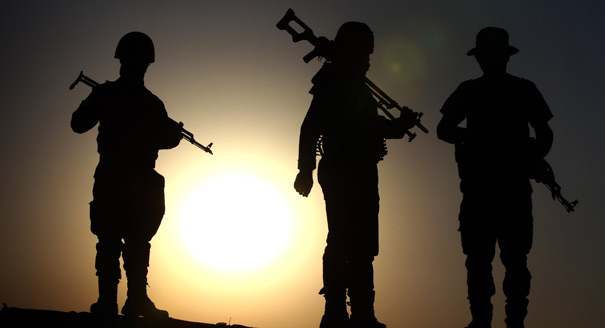
An unprecedented number of Arab countries are in the midst of one kind or another of large-scale armed conflict. War has reached the capitals of Iraq, Syria, Libya, and Yemen, and covers much of their territory. Gaza lives in a constant armed truce in between sharp, brief bouts of violence, while Lebanon has been drawn heavily into waging the Syrian civil war, which recently encroached onto Lebanese soil. The flow of jihadist recruits from Jordan and several North African and Gulf states to Iraq and Syria since 2003, and the intention of several Arab governments to send expeditionary forces to intervene against the Islamic State in Iraq, represent yet another significant form of war.
The pattern of Arab wars in the early 21st century reveals new dynamics and impacts. Governments that were previously able to maintain authoritarian rule through military means have been unmaking their own, formerly powerful states by waging war on their societies. In several cases this has led to the dismantling of their national armed forces. But the opposite is also true: war is not just a disintegrative process. New types of armed non-state actors are also waging war in ways that not only reorder existing nation-states, but also construct alternative political entities based on fundamentally different socio-cultural bonds and sub- or supra-state identities, whether real or imagined.This marks a reversal of the patterns established in the course of the 20th century, during which war generated Arab state-building and state consolidation—what some scholars have called a “hardening” of states—whether directly or indirectly. The First and Second World Wars established the core system of Arab states, albeit through an external process driven by the Great Powers, rather than by local rulers and their rivals. The Arab states system evolved and expanded through a long series of further wars: 1948, 1956, 1967, 1973, and 1982 with Israel, 1980-1988 with Iran, and two Gulf wars with U.S.-led coalitions, besides border wars involving North and South Yemen, Egypt and Libya, Libya and Chad, Morocco and Algeria.
National liberation and protracted civil wars also made some Arab states, or reshaped their constitutional foundations: Algeria, the Palestinian Authority, and South Yemen belong to the first category; Iraq, Lebanon, Oman, Sudan, and North Yemen to the second. And by declaring themselves in a permanent state of war or confrontation with external enemies, governments in many countries – most notably including Egypt, Libya, Syria, Iraq, and, to a more moderate degree, Jordan – justified repression of domestic dissent, state control of the economy, and authoritarian centralized bureaucracies.
The new trends that have become so apparent since the start of the 21st century are the consequence of the failure of a majority of Arab states to open up their political systems to wider participation and to institutionalize pluralism. Most have been unwilling even to “upgrade” or “modernize” authoritarian structures, improving administrative performance, key public services, and regulatory functions even as they allowed privatization to deepen socio-economic disparities. As a result, applying force to resolve social problems and meet political challenges has taken a growing number of ossified systems to breaking point, releasing or activating new societal actors and agendas.
New patterns of military organization have appeared in parallel, both in regular armies and in non-state militias. A major shift has been from national organizations to local ones. Through much of the 1970s and 1980s, for example, a few militias or irregular armies predominated in Lebanon and the Palestine Liberation Organization, which recruited and operated on a national scale. But what is most striking about Libyan militias and Syrian rebel groups today is their extreme proliferation and fragmentation, revealing their very localized social base (and recruitment pool) and weak national structures. The same may be said, to a lesser degree, about Syrian pro-regime militias and Sunni insurgent groups in Iraq—ironically with only the Islamic State now appearing as a more “national” force.
This reflects the erosion of national constitutional frameworks and social pacts, accentuating societal cleavages—whether based on kinship, sect, region, ethnicity, or class—and in turn narrowing the sociological profile of armed movements. In the absence of assured and equal access to police and justice systems and of effective political representation through structures such as parliament or elected local government, communities have increasingly resorted to “auto-security”—policing and protecting themselves. These societal responses have easily become militarized under conditions of acute political crisis in Iraq, Syria, Libya, and Yemen.
But this is more than a familiar response to what commonly became known as “state failure” in the 1990s. Armed jihadist groups such as the Islamic State, Jabhat al-Nusra, and many smaller ones conceive of an encompassing Sunni space that cut across the borders of Levantine nation-states and into the Arabian Peninsula. They are countered increasingly by a rival conception of a Shia space that connects specific geographic localities and religious-historical reference points from Iraq through Syria to Lebanon. And as the re-emergence of a Barqa sub-nationalism in eastern Libya shows, this is not only a sectarian, Sunni-Shia phenomenon, nor exclusively Levantine.
Even where national armies have been rebuilt since the start of the 21st century, or where this is being attempted, they embody a fusion of past legacies with new forms. The post-2003 Iraqi army and police, for example, expanded into a bloated force of one million, rivaling their peak strength under Saddam Hussein but now structured and operating instead on a mixed sectarian and ethnic logic. The same can be said of efforts to rebuild a post-2011 revolutionary army in Libya, which have both reproduced Mu’ammar Qaddhafi’s tribal-regional logic and multiplied it. Military restructuring in Yemen struggles with similar tensions, and will eventually also reflect new realities imposed by the southern and Houthi challenges. And whatever the outcome of the Syrian conflict, the army will differ radically from its past form and composition, whether it is rebuilt as a national force or a federal one.
These new military fusions or hybrids are no more likely to stabilize or solidify than the new political entities imagined by Sunni or Shia jihadists or by federalists in Yemen and eastern Libya. But those who wish to resist the forms of state building that are emerging from the new Arab wars must work just as hard to end the use of organized military force against Arab societies, as this is what drives the unmaking of existing states. The trends of socio-economic transformation are already in motion; the political challenges they pose can only be met with political solutions.
This article was originally published in Arabic by Al-Hayat.

Senior Fellow, Malcolm H. Kerr Carnegie Middle East Center
Yezid Sayigh is a senior fellow at the Malcolm H. Kerr Carnegie Middle East Center in Beirut, where he leads the program on Civil-Military Relations in Arab States (CMRAS). His work focuses on the comparative political and economic roles of Arab armed forces, the impact of war on states and societies, the politics of postconflict reconstruction and security sector transformation in Arab transitions, and authoritarian resurgence.
Recent Work
Yezid Sayigh
Yezid Sayigh
Carnegie India does not take institutional positions on public policy issues; the views represented herein are those of the author(s) and do not necessarily reflect the views of Carnegie, its staff, or its trustees.

In any defense establishment, change is an ongoing process. However, despite the best of intentions, existing bureaucracies, bound by habit and years of socialization, have their limits in implementing transformative change.

Anit Mukherjee

After the chill in ties between 2020 and 2024 that brought India–China relations to their lowest point in several decades, the two countries have engaged each other afresh. This paper argues that there are predominantly four imperatives guiding India’s approach to China, and they exist in an order of priority.

Saheb Singh Chadha

A partnership between India, a country of subcontinental size, and Africa, a continent of fifty-four countries, may seem asymmetric until one notes that both are home to nearly the same number of people—1.4 billion. This essay spells out the existing challenges to the partnership, its optimal potential, and the possible pathways to realize it over the next quarter-century.

Rajiv Bhatia

This piece argues that the present Indian strategy, based on opportunistic diversification and utilization of limited strategic reserves, remains inadequate when confronting supply disruptions. It evaluates India’s options in the short, medium, and long terms.

Vrinda Sahai

This piece examines India’s response to U.S. sanctions and tariffs, specifically assessing the immediate market consequences, such as alterations in import costs, and the broader strategic implications for India’s energy security and foreign policy orientation.
Vrinda Sahai