

President Kais Saied has won a second term in office, but his country is facing a host of problems that necessitate urgent reforms, above all preventing the possibility of a financial meltdown.
Ishac Diwan, Hachemi Alaya, Hamza Meddeb
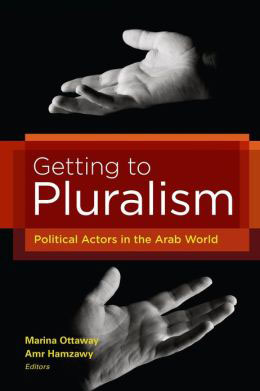
This volume examines the Arab world’s major political actors, assesses the weaknesses of secular parties, and evaluates how incumbent regimes have maintained their grip on power in spite of reform-oriented claims.
Source: Washington

Getting to Pluralism: Political Actors in the Arab World explores the balance of power between the disparate political forces of the Arab world. The essays in this volume examine the characteristics of the major political actors in great detail and assess the weaknesses of the secular parties. They also illustrate the complexities of Islamist participation in the political processes of several Arab countries—pointing out both similarities and differences. Finally, the authors evaluate how incumbent Arab regimes have been able to maintain their grip on power in spite of their claims that they support political and social reform.
Included in this volume:
"A first-rate think tank should produce work whose conclusions are directly useful to policy makers with insights equally valuable to scholars. This volume more than meets that test."
—Jessica T. Mathews, President, Carnegie Endowment for International Peace
Former Senior Associate, Middle East Program
Before joining the Endowment, Ottaway carried out research in Africa and in the Middle East for many years and taught at the University of Addis Ababa, the University of Zambia, the American University in Cairo, and the University of the Witwatersrand in South Africa.
Director, Middle East Program
Amr Hamzawy is a senior fellow and the director of the Carnegie Middle East Program. His research and writings focus on governance in the Middle East and North Africa, social vulnerability, and the different roles of governments and civil societies in the region.
Carnegie India does not take institutional positions on public policy issues; the views represented herein are those of the author(s) and do not necessarily reflect the views of Carnegie, its staff, or its trustees.
President Kais Saied has won a second term in office, but his country is facing a host of problems that necessitate urgent reforms, above all preventing the possibility of a financial meltdown.
Ishac Diwan, Hachemi Alaya, Hamza Meddeb
An Israeli response to Iran’s October 1 attack is imminent. The key question is of its intensity and potential fallout, both within Iran, in terms of nuclear security policy changes, and across the broader region. The coming days are likely to reshape West Asia irreversibly.
Gaddam Dharmendra
As India’s economy recovers from the coronavirus pandemic, Indian businesses need efficient financial structures to regain their ground. Key reforms to India’s Insolvency and Bankruptcy Code could fill these gaps.
Anirudh Burman
Access to cross-border data is an integral piece of the law enforcement puzzle. India is well placed to lead the discussions on international data agreements subject to undertaking necessary surveillance reforms.
Smriti Parsheera, Prateek Jha
After the coronavirus pandemic wanes, how will China’s reorientation of the Belt and Road Initiative to address global health concerns influence its relationships with South Asian countries?
Deep Pal, Rahul Bhatia