

• Research
  • About
  • Experts
Carnegie India logoCarnegie lettermark logo
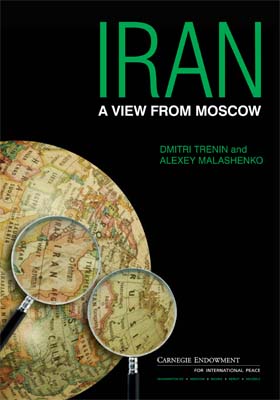
Iran: A View From Moscow
Report
Carnegie Russia Eurasia Center

Iran: A View From Moscow

Although Iran and Russia have substantial economic and military ties, Moscow is increasingly wary of Tehran’s growing nuclear ambitions, which have the potential to threaten Russia.

Link Copied
By Dmitri Trenin and Alexey Malashenko
Published on Oct 25, 2010

Additional Links

Full Text

Although Iran and Russia have substantial economic and military ties, Moscow is increasingly wary of Tehran’s growing ambitions. Dmitri Trenin and Alexey Malashenko offer a view from Moscow and detail how Iran’s desire to develop nuclear weapons and long-range missiles—while refusing to compromise with the international community—threaten Russia.

Key Policy Recommendations:

  • Russia should lead. Using its business and security links with Tehran, Moscow can help lead international efforts to dissuade Iran from acquiring nuclear weapons.
     
  • Appeal to moderates. By working with moderate pragmatists in Tehran, Russia can encourage constructive dialogue with Iran and help spur a compromise with the West on the nuclear issue.
     
  • Avoid a military strike. A military attack against Iran would divide the international community, destabilize the Middle East, and virtually ensure that hardliners turn Iran into a nuclear weapons state.

“Moscow does not have enough sway to directly alter Tehran’s policies and it does not want to be an intermediary between Iran and the United States,” the authors write. “But as Iran’s neighbor, economic and military partner, and as a permanent member of the Security Council, Russia can encourage moderate forces in Iran to compromise with the West on the nuclear issue instead of confronting Washington.”

About the Authors

Dmitri Trenin

Former Director, Carnegie Moscow Center

Trenin was director of the Carnegie Moscow Center from 2008 to early 2022.

Alexey Malashenko

Former Scholar in Residence, Religion, Society, and Security Program

Malashenko is a former chair of the Carnegie Moscow Center’s Religion, Society, and Security Program.

Authors

Dmitri Trenin
Former Director, Carnegie Moscow Center
Alexey Malashenko
Former Scholar in Residence, Religion, Society, and Security Program
Alexey Malashenko
GulfMiddle EastIranCaucasusRussiaSecurityForeign PolicyPolitical ReformNuclear Policy

Carnegie India does not take institutional positions on public policy issues; the views represented herein are those of the author(s) and do not necessarily reflect the views of Carnegie, its staff, or its trustees.

More Work from Carnegie India

  • Commentary
    The Impact of U.S. Sanctions and Tariffs on India’s Russian Oil Imports

    This piece examines India’s response to U.S. sanctions and tariffs, specifically assessing the immediate market consequences, such as alterations in import costs, and the broader strategic implications for India’s energy security and foreign policy orientation.

      Vrinda Sahai

  • Article
    Military Lessons from Operation Sindoor

    The India-Pakistan conflict that played out between May 6 and May 10, 2025, offers several military lessons. This article presents key takeaways from Operation Sindoor and breaks down how India’s preparations shaped the outcome and what more is needed to strengthen future readiness.

      Dinakar Peri

  • Book
    India and the Sovereignty Principle: The Disaggregation Imperative

    This book offers a comprehensive analysis of India's evolving relationship with sovereignty in a complex global order. Moving beyond conventional narratives, it examines how the sovereignty principle shapes India's behavior across four critical domains—from traditional military power to contemporary data governance.

      Rudra Chaudhuri, Nabarun Roy

  • Commentary
    NISAR Soars While India-U.S. Tariff Tensions Simmer

    On July 30, 2025, the United States announced 25 percent tariffs on Indian goods. While diplomatic tensions simmered on the trade front, a cosmic calm prevailed at the Sriharikota launch range. Officials from NASA and ISRO were preparing to launch an engineering marvel into space—the NASA-ISRO Synthetic Aperture Radar (NISAR), marking a significant milestone in the India-U.S. bilateral partnership.

      Tejas Bharadwaj

  • Article
    Hidden Tides: IUU Fishing and Regional Security Dynamics for India

    This article examines the scale and impact of Chinese IUU fishing operations globally and identifies the nature of the challenge posed by IUU fishing in the Indian Ocean Region (IOR). It also investigates why existing maritime law and international frameworks have struggled to address this growing threat.

      Ajay Kumar, Charukeshi Bhatt

Get more news and analysis from
Carnegie India
Carnegie India logo, white
Unit C-4, 5, 6, EdenparkShaheed Jeet Singh MargNew Delhi – 110016, IndiaPhone: 011-40078687
  • Research
  • About
  • Experts
  • Projects
  • Events
  • Contact
  • Careers
  • Privacy
  • For Media
Get more news and analysis from
Carnegie India
© 2026 Carnegie Endowment for International Peace. All rights reserved.





