

Commentary
In an interview, Ian Lustick and Eli Clifton discuss their new book on why a prominent ally has so much influence in America.
Michael Young
{
  "authors": [],
  "type": "pressRelease",
  "centerAffiliationAll": "dc",
  "centers": [
    "Carnegie Endowment for International Peace"
  ],
  "collections": [],
  "englishNewsletterAll": "ctw",
  "nonEnglishNewsletterAll": "",
  "primaryCenter": "Carnegie Endowment for International Peace",
  "programAffiliation": "russia",
  "programs": [
    "Russia and Eurasia"
  ],
  "projects": [],
  "regions": [
    "Caucasus",
    "Russia"
  ],
  "topics": [
    "Economy",
    "Foreign Policy",
    "Nuclear Policy"
  ]
}
REQUIRED IMAGE
For Immediate Release: June 27, 2006
Contact: Jennifer Linker, +1 (202) 939-2372, jlinker@CarnegieEndowment.org
The latest briefing by Carnegie Moscow Center scholar Lilia Shevtsova, Putin’s Legacy: How the Russian Elite is Coping with Russia’s Challenges, offers keen analysis of how the current governing elite under Vladimir Putin has shaped domestic and foreign politics and the potential consequences of its policies for international relations and for Russian state affairs. She expounds on the conditions needed for modernization in Russia, and delineates how Western counterparts can contribute to achieving the “benevolent transformation of the Russian state.”
Shevtsova posits that Putin’s type of personified power has led to a bureaucratic-authoritarian regime through which the governing elite has emerged, consolidated power and governed. Shevtsova claims that “the bureaucratic corporation has succeeded not only in using the presidency as its instrument, but in presenting its own interests as those of the Russian state.” She believes that the governing elite has taken the country in a worrisome direction which undermines the potential for the future progress of Russia.
This newly emboldened bureaucracy influences the economy in visible ways. According to Shevtsova, redistribution of assets from the oligarchs to the bureaucracy enabled members to also sit on corporate boards thereby giving the bureaucratic corporation greater means of controlling state assets. The expected increase of the bureaucracy’s control of economic assets is sure to jeopardize the economy. Russia’s economy is losing steam; interventionist state policies scare off investors and Russian money is leaving the country.
Shevtsova cautions that the elite is bringing Russia dangerously close to resembling a nuclear-petrostate. Telltale signs include the union of business and government, corruption, large monopolies, and the broad gap between rich and poor. The elite manipulates resource capacity so as to promote Russia as an “energy superpower,” but such reliance also undercuts the prospect of developing a competitive, high-tech market economy.
Direct link to briefing: www.carnegie.ru/en/pubs/briefings/Briefing-2006-04-web_en.pdf
Lilia Shevtsova is one of Russia’s most astute political analysts and a regular commentator on Russian domestic and foreign policies in both Russian and international media. She is a prolific author of books, articles, and opinion pieces, including the highly acclaimed book Putin’s Russia.
Carnegie Moscow Center (CMC) was established in 1993 by Carnegie Endowment for International Peace. CMC conducts a wide range of political and socio-economic research, hosts open forums, and carries out publishing activities. CMC’s mission is to promote intellectual cooperation among researchers and policy experts; to provide independent analysis of public policy issues; and to serve as an independent forum for discussions of the most important questions facing Russia, Eurasia, and international security.
Press Contacts:
Jennifer Linker (Washington)
+1 (202) 939-2372
jlinker@CarnegieEndowment.org
Natalia Bubnova (Moscow)
+7 (495) 935-8904, ext. 230
Natalia.Bubnova@carnegie.ru
If you have received this message in error, send a message to info@CarnegieEndowment.org
###
Carnegie does not take institutional positions on public policy issues; the views represented herein are those of the author(s) and do not necessarily reflect the views of Carnegie, its staff, or its trustees.

In an interview, Ian Lustick and Eli Clifton discuss their new book on why a prominent ally has so much influence in America.

Michael Young

By failing to address Palestinian representation, the current process is bound to lead to just another temporary arrangement.

Nathan J. Brown

The armed forces champion a form of capitalism that is generating revenue, but its reliance on rent faces diminishing returns, leaving the country with massive sunk costs and deferred returns, deepening dependency on external borrowing.

Yezid Sayigh

In an interview, Marc Lynch discusses his new book decrying the post-1990 U.S.-dominated order in the Middle East.
Michael Young
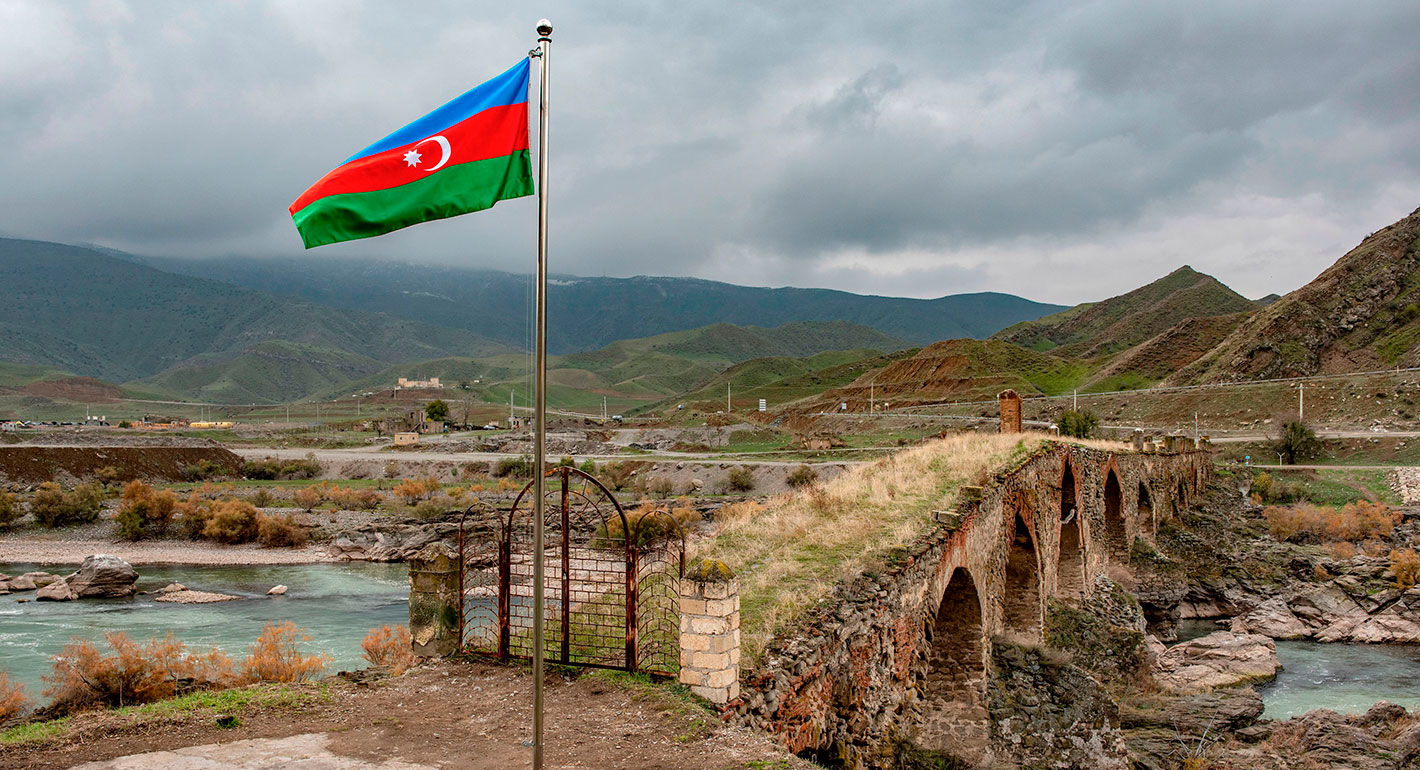
In an interview, Sergei Melkonian discusses Armenia’s and Azerbaijan’s careful balancing act among the United States, Israel, and Iran.

Armenak Tokmajyan