

Article
James F. Collins
{
  "authors": [
    "James F. Collins"
  ],
  "type": "legacyinthemedia",
  "centerAffiliationAll": "dc",
  "centers": [
    "Carnegie Endowment for International Peace",
    "Carnegie Russia Eurasia Center"
  ],
  "collections": [],
  "englishNewsletterAll": "ctw",
  "nonEnglishNewsletterAll": "",
  "primaryCenter": "Carnegie Endowment for International Peace",
  "programAffiliation": "russia",
  "programs": [
    "Russia and Eurasia"
  ],
  "projects": [],
  "regions": [
    "Caucasus",
    "Russia"
  ],
  "topics": [
    "Political Reform",
    "Security"
  ]
}
Source: Getty
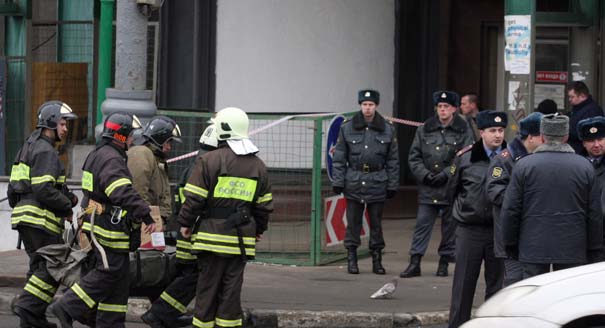
In spite of terrorist acts like the Moscow metro bombings, the Russian people continue to show strong support for their leaders, who are credited with having prevented a total economic collapse.
Source: The New York Times

Even the present debate about police abuses of power and misconduct have failed to erode significantly the base of support for Prime Minister Putin and President Medvedev, and polls continue to show their support at levels most political leaders could only envy.
The reason the terrorist acts like those in Moscow have limited impact can be explained by the Russian public’s evaluation of their leadership on criteria broader than their reaction to isolated terrorist acts. First and foremost, Russia’s population — even with the dramatically negative effects of the financial and economic crisis — is still living better and with more choices than it was a decade ago.
Moreover, after the chaotic and traumatic 1990’s, the return of greater predictability and stability in daily life for most citizens is associated with Putin’s presidency and the systems he put in place. This support has probably only strengthened as a result of the economic crisis. As the country weathers the crisis, the present leadership has retained an image of competent management and is credited with preventing a feared total collapse.
In addition, while the security problems Moscow faces in the North Caucasus remain severe, their impact has largely been kept inside the region, and its most unpredictable conflict, the one in Chechnya, has seemingly been brought under control through the Chechen president’s iron-fisted rule.
At the same time, it is also true that over recent months Russians have begun to question the status quo and to ask where Russia is going as the country emerges from the worst of the economic crisis. Many are speaking out openly for change and calling for an end to the corruption, bureaucratic abuse and lack of respect for individuals.
Likewise the open criticism of police corruption has indicated readiness on the part of Russian citizens to challenge the authorities in new ways and demand greater accountability.
The authorities’ response to the bombings in Moscow will be judged in this context, and there will be pressure to demonstrate competence and capability. While it is unlikely that these bombings will intimidate the Russian people any more than they have in the past, they may bring about stronger demand for police accountability and effectiveness and a broader base of support for positive change.
Nonresident Senior Fellow, Russia and Eurasia Program; Diplomat in Residence
Ambassador Collins was the U.S. ambassador to the Russian Federation from 1997 to 2001 and is an expert on the former Soviet Union, its successor states, and the Middle East.
Recent Work
James F. Collins
Dmitri Trenin, James F. Collins
Carnegie does not take institutional positions on public policy issues; the views represented herein are those of the author(s) and do not necessarily reflect the views of Carnegie, its staff, or its trustees.
In an interview, Sergei Melkonian discusses Armenia’s and Azerbaijan’s careful balancing act among the United States, Israel, and Iran.

Armenak Tokmajyan

Just look at Iraq in 1991.

Marwan Muasher

Baku may allow radical nationalists to publicly discuss “reunification” with Azeri Iranians, but the president and key officials prefer not to comment publicly on the protests in Iran.

Bashir Kitachaev
The country’s leadership is increasingly uneasy about multiple challenges from the Levant to the South Caucasus.
Armenak Tokmajyan
In an interview, Daniela Richterova speaks about her book on Czechoslovakia’s Cold War ties to Palestinian groups and others.

Michael Young