

Commentary
Thomas de Waal
{
  "authors": [
    "Thomas de Waal"
  ],
  "type": "legacyinthemedia",
  "centerAffiliationAll": "dc",
  "centers": [
    "Carnegie Endowment for International Peace",
    "Carnegie Europe",
    "Carnegie Russia Eurasia Center"
  ],
  "collections": [],
  "englishNewsletterAll": "ctw",
  "nonEnglishNewsletterAll": "",
  "primaryCenter": "Carnegie Europe",
  "programAffiliation": "russia",
  "programs": [
    "Russia and Eurasia"
  ],
  "projects": [],
  "regions": [
    "Russia",
    "Europe",
    "Eastern Europe",
    "Caucasus",
    "Azerbaijan",
    "Armenia",
    "Georgia",
    "Ukraine",
    "Belarus",
    "Moldova"
  ],
  "topics": [
    "Political Reform",
    "Democracy"
  ]
}
Source: Getty
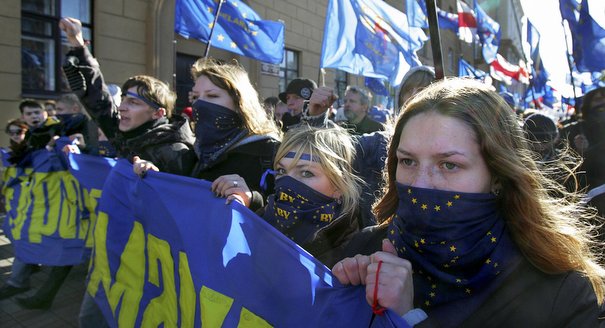
Promoting democracy in the six post-Soviet countries in Eastern Europe that were designated by the European Union as deserving special attention will require the EU to offer incentives for implementing reforms.
Source: National Interest

Brussels, like Washington, is not good at handling more than one big foreign policy issue at a time. The second Eastern Partnership summit, due to be held in May, has just been postponed till the fall, technically because it clashed with the G8 summit, more probably because there was insufficient interest in the meeting from Europe’s leaders in turning up, caught up with their own ongoing financial crisis and with events in North Africa. If the August 2008 war in Georgia was the catalyst for the creation of the Eastern Partnership, the Arab Spring is re-vitalizing the corresponding southern neighborhood project, the Union of the Mediterranean. Already French, Italians and Spanish politicians are muttering that if Ukrainians or Armenians aren’t so keen on European-style democracy, then EU money earmarked for them should be reallocated to Egyptians or Tunisians, who are.
Needless to say, that’s a short-sighted view. The North African countries need the EU, but so do the eastern neighbors. Much of the population in these countries is more pro-European than their governments. They are still loci of poverty and four smoldering conflicts. Brussels has far more to offer them to fix all that than Washington does.
So what chance of stopping the Eastern Partnership of becoming a paper project?
There are problems on both sides. The founding statement of the Eastern Partnership in Prague in 2009, “[T]he Eastern Partnership will seek to support political and socio-economic reforms of the partner countries, facilitating approximation towards the European Union. This serves the shared commitment to stability, security and prosperity of the European Union, the partner countries and indeed the entire European continent.”
But what if they don’t want approximation with the EU? If you are a leader in the east, European approximation could be the Trojan Horse that will destroy your rule from within. If maintaining your power is the first priority, why ruin it with European democratic accountability and economic integration?
This is already proving to be a problem in the Western Balkans. Look at the map and you now see an enclave of countries surrounded by EU Member States, yet their inevitable absorption into the EU is proving much more difficult than was anticipated several years ago. Besides EU enlargement has hit the brakes. Many are saying that Bulgaria and Romania were taken in too quickly. Croatia will probably make it over the line, but everyone else will have to make a much stronger case than they would have done a few years ago.
Given these constraints, Polish foreign minister Radek Sikorski is proposing—wisely in my view—a diet of diced carrots. Last month in Brussels, he said,
Well, I believe that we’ve run out of steam on the model that brought us in Central Europe into the EU. And the model was this: we give you a very large carrot—membership—at the end of a grueling period of reform, which requires a sort of national obsession on the part of the candidate countries. Since we are not prepared to give that big promise to the Eastern Partnership countries, we should create a system of small carrots spaced out in synch with their political calendars, so that particular governments are incentivized to make reforms from which they themselves can benefit.
The first incentives are being offered to Moldova, Ukraine and Georgia, in the form of visa liberalization. That is a particular tasty slice of carrot because it reaches past government to ordinary people. Ordinary Belarussians are being offered better visa terms as well, even as sanctions tighten on the government.
The weighted approach, also dubbed “more for more” is turning up a surprising leader at the front of the line for talks with Brussels: Moldova. Behind it come Ukraine and Georgia, then Armenia, then the laggards, Belarus and Azerbaijan. Moldova, the poorest of the six countries, currently has the most pro-European government. Prime minister Vladimir Filat is currently a favorite in Brussels, even though his words are not yet matched by many actions.
The Eastern Partnership needs a success story, an example to spur on the doubters. Expect to see a lot more EU leaders visiting Moldova this year. They may even hint at that most prized notion, possible EU membership—a long time in the future. In that regard, it helps that Moldova is also small and therefore easier for the EU to absorb.

Senior Fellow, Carnegie Europe
Thomas de Waal is a senior fellow at Carnegie Europe, specializing in Eastern Europe and the Caucasus.
Recent Work
Thomas de Waal

Thomas de Waal, Areg Kochinyan, Zaur Shiriyev
Carnegie does not take institutional positions on public policy issues; the views represented herein are those of the author(s) and do not necessarily reflect the views of Carnegie, its staff, or its trustees.
In an interview, Sergei Melkonian discusses Armenia’s and Azerbaijan’s careful balancing act among the United States, Israel, and Iran.

Armenak Tokmajyan

Baku may allow radical nationalists to publicly discuss “reunification” with Azeri Iranians, but the president and key officials prefer not to comment publicly on the protests in Iran.

Bashir Kitachaev
The country’s leadership is increasingly uneasy about multiple challenges from the Levant to the South Caucasus.
Armenak Tokmajyan
In an interview, Daniela Richterova speaks about her book on Czechoslovakia’s Cold War ties to Palestinian groups and others.

Michael Young
The community’s contributions to Armenia should encourage greater assistance from Yerevan.
Araz Bedross, Karni Keushgerian