

Paper
Ashley J. Tellis
{
  "authors": [
    "Ashley J. Tellis"
  ],
  "type": "legacyinthemedia",
  "centerAffiliationAll": "dc",
  "centers": [
    "Carnegie Endowment for International Peace"
  ],
  "collections": [],
  "englishNewsletterAll": "ctw",
  "nonEnglishNewsletterAll": "",
  "primaryCenter": "Carnegie Endowment for International Peace",
  "programAffiliation": "SAP",
  "programs": [
    "South Asia"
  ],
  "projects": [],
  "regions": [
    "South Asia",
    "Afghanistan",
    "Pakistan"
  ],
  "topics": [
    "Security",
    "Military",
    "Foreign Policy"
  ]
}
Source: Getty
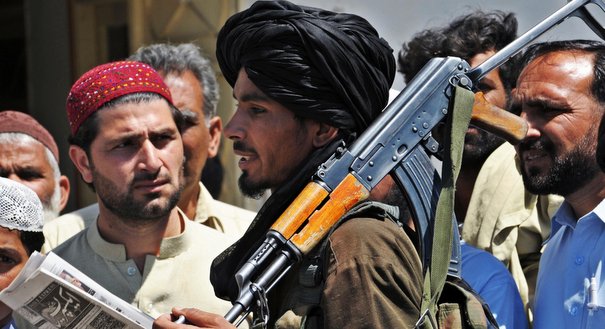
Military pressure still plays a critical role in convincing the Taliban and those who support them in Pakistan to abandon their current strategy and negotiate a peaceful settlement in Afghanistan.
Source: The Hill

Afghanistan’s President Hamid Karzai has trumpeted reconciliation with greater vigor since President Obama announced that the United States would pull out combat troops from Afghanistan starting this summer. Karzai read this development as indicating that the U.S. will have weakened, and so Washington was looking for a respectable way out.
Accordingly, he has sought to reach out to the Taliban leadership in order to conclude a deal to bring the insurgency to an end, hopefully while the United States is still around in strength and he still has some bargaining power.
For the Pakistani military leadership in Rawalpindi, the reconciliation now sought by Kabul and Washington represents perfect compensation for the ignominious ejection of their Taliban proxies from Afghanistan. Because Washington ignored the pleas of Pakistani President Pervez Musharraf to leave the Taliban in power, the generals in Rawalpindi successfully pursued a deceitful policy of protecting their acolytes in exile even as they milked Washington of financial aid for supposedly combating them.
Today, not only have the Taliban survived, they are seen even by their enemies as vital to peace. Hence, Rawalpindi has redoubled its advocacy of reconciliation because it allows Pakistan to rehabilitate its clients and restore them to influence through a “power sharing” scheme that would pacify its western frontier.
For the United States, reconciliation offers the Obama administration the hope of producing a cheaper — and hopefully more dignified — retrenchment from what is now viewed as an unnecessary and burdensome war.
Each of the three principal parties to the conflict — for its own reasons — thus finds common ground in seeking reconciliation with the Taliban. The desire for compromise by itself, however, is insufficient because the sine qua non for success is most conspicuous by its absence: the Quetta Shura’s commitment to peace.
In fact, most of the evidence points to the contrary. Because the ring-leaders have somewhat different views than the West about what constitutes success in Afghanistan, they have few incentives to reconcile presently.
And why should it be otherwise? Although they have been hammered by Gen. David Petraeus during the last year, they are far from being defeated. Their sanctuaries in Pakistan remain safe and they are still protected by the Pakistani military. Their financial resources and their war materiel are relatively intact and their power to intimidate has not decreased. Above all else, they remain convinced that the international coalition is headed for the exit — hence, the necessity for compromise appears less urgent.
Having resisted the United States for close to a decade, holding out for another three years would only bestow greater gains. Even if their Pakistani protectors prefer that they negotiate — in order to realize quick geopolitical advantages — Rawalpindi will not compel them to do so without first securing those compensations that both Kabul and Washington would find most difficult to concede.
The only way to break this logjam is to convince the Shura that the failure to reconcile will be costlier for them than the alternative of resisting. This aim will be achieved less by talking — though that has its uses — and more by increasing the pain that Petraeus has successfully begun to apply, while stepping up the pressure on Pakistan. Clearly, enabling a conversation to begin is useful, but any measures towards this end, such as removing Taliban leaders from the United Nations blacklist, should be conditional for now.
More importantly, however, the military campaign against the Taliban, the Afghan government’s efforts at reintegration and the build-up of Afghan security forces must be pursued vigorously. That requires, among other things, Obama to leave the International Security Assistance Force with the troops it needs until 2014 even as he presses Rawalpindi to make good on its old counter-terrorism promises.
Until both the Taliban and their Pakistani patrons conclude that their current strategies will be neutralized by the United States, a negotiated exit from the war in Afghanistan will prove elusive — unless, of course, Washington is prepared to end the conflict on its adversaries’ terms, in which case it should brace itself for another long decade of terrorism, turmoil and disaster in southern Asia.
Former Senior Fellow
Ashley J. Tellis was a senior fellow at the Carnegie Endowment for International Peace.
Recent Work
Ashley J. Tellis
Ashley J. Tellis
Carnegie does not take institutional positions on public policy issues; the views represented herein are those of the author(s) and do not necessarily reflect the views of Carnegie, its staff, or its trustees.

By failing to address Palestinian representation, the current process is bound to lead to just another temporary arrangement.

Nathan J. Brown

The armed forces champion a form of capitalism that is generating revenue, but its reliance on rent faces diminishing returns, leaving the country with massive sunk costs and deferred returns, deepening dependency on external borrowing.

Yezid Sayigh

Just look at Iraq in 1991.

Marwan Muasher

A coalition of states is seeking to avert a U.S. attack, and Israel is in the forefront of their mind.

Michael Young

Baku may allow radical nationalists to publicly discuss “reunification” with Azeri Iranians, but the president and key officials prefer not to comment publicly on the protests in Iran.

Bashir Kitachaev