

Article
C. Raja Mohan, Darshana M. Baruah
{
  "authors": [
    "C. Raja Mohan"
  ],
  "type": "legacyinthemedia",
  "centerAffiliationAll": "dc",
  "centers": [
    "Carnegie Endowment for International Peace",
    "Carnegie China",
    "Carnegie India"
  ],
  "collections": [
    "China’s Foreign Relations"
  ],
  "englishNewsletterAll": "ctw",
  "nonEnglishNewsletterAll": "",
  "primaryCenter": "Carnegie India",
  "programAffiliation": "SAP",
  "programs": [
    "South Asia"
  ],
  "projects": [],
  "regions": [
    "South Asia",
    "India",
    "Pakistan",
    "East Asia",
    "China"
  ],
  "topics": [
    "Economy",
    "Foreign Policy"
  ]
}
Source: Getty
Infrastructure development along India’s borders with China and Pakistan can be cooperative, not competitive.
Source: Indian Express
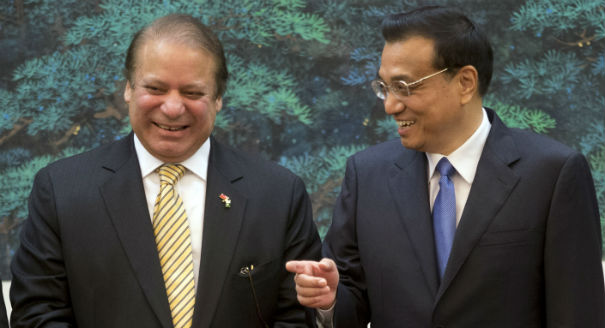
Pakistan Prime Minister Nawaz Sharif's just-concluded visit to China has brought together two separate issues that have long bothered India. One is China's growing presence in Pakistan Occupied Kashmir (PoK), and the other is Beijing's construction of a port at Gwadar on Balochistan's Makran coast.
India's objections to Chinese activity in PoK go back to the 1970s, when the People's Liberation Army built the Karakoram Highway that connected China's far-western province of Xinjiang with northern Pakistan. More recently, China has begun to undertake an expansive range of development projects in PoK. Further south, New Delhi watched warily as China financed and built a Greenfield port in Gwadar over the last decade. For many in India, Chinese interest in Gwadar, located close to the Persian Gulf, is part of a larger strategy to build up Beijing's strategic presence in the Indian Ocean.There was some relief, however, when a Singapore firm won the bid to run the port. Earlier this year, Pakistan terminated the contract with Singapore and handed over operational control to a Chinese company called China Overseas Port Holding Co.
Nawaz Sharif's visit to China this week saw the formalisation of a plan to connect Kashgar in Xinjiang to Gwadar. The construction of this economic corridor is expected to cost around $18 billion, and will be fast-tracked for completion within five years. China has already begun to modernize the Karakoram Highway. Under the corridor project, Beijing is expected to add a railway line, optic fibre link and a petroleum pipeline across the mighty Karakorams. It would also involve the development of industrial projects all along the corridor and the construction of a massive special economic zone in Gwadar.
For Sharif, who loves big commercial projects, the new corridor is akin to the Lahore-Islamabad motorway he built in the 1990s. He called it a "game changer" for the whole region. Indeed, for Pakistan as a whole, it involves a second commercial artery running parallel to the current one between Karachi port in the Sindh province and the heartland of Punjab.
For China, the project offers a reliable link between its landlocked western regions and the Indian Ocean. The Gwadar project, along with Hambantota in Sri Lanka and Kyaukphyu in Myanmar, will raise China's strategic profile in the Indian Ocean. On the flip side, what about the security situation in Balochistan and northern areas of Pakistan, where Chinese personnel have been victims of terror attacks?
Sharif is reaching out to the nationalist elements in Balochistan and trying to draw the militants into a dialogue elsewhere. Like the Chinese, Sharif believes economic activism can transform the ground situation over a period of time.
India has three choices in responding to the Gwadar-Kashgar corridor. One, Delhi can continue to object to the Chinese projects in PoK and Balochistan. But Indian protests are not going to stop or slow the construction of the corridor.
Two, India can try and match China's transformative infrastructure projects on its periphery. India's own rail link to Kashmir has finally begun to advance. It is talking to the Iranians about developing the Chabahar port further west of Gwadar on the Makran coast. But India's pace of implementing such projects is painfully slow.
Three, in parallel to the second option, India can reach out to Pakistan and China and propose trilateral collaboration on mega infrastructure projects. For its part, Beijing has been eager to involve India in developing overland connectivity between China and the subcontinent. It has also offered to invest in the Chabahar project in Iran.
Through his visit to China, Sharif was careful to project the Gwadar-Kashgar corridor as an economic project that would benefit the entire region, including India. Delhi must test the intentions of both China and Pakistan by offering to join them in the development of the corridor.
Delhi must also show interest in investing in the Gwadar Special Economic Zone. India can also propose new connectivity projects across the current lines of control in J&K with Pakistan and China. Instead of treating trans-border infrastructure projects as competitive, Delhi can see them as part of a wider regional economic cooperation. The joint projects in J&K can be undertaken without a reference to the competing territorial claims of Delhi, Islamabad and Beijing.
Former Nonresident Senior Fellow, Carnegie India
A leading analyst of India’s foreign policy, Mohan is also an expert on South Asian security, great-power relations in Asia, and arms control.
Recent Work

C. Raja Mohan, Darshana M. Baruah


Alexander Gabuev, Paul Haenle, C. Raja Mohan, …
Carnegie does not take institutional positions on public policy issues; the views represented herein are those of the author(s) and do not necessarily reflect the views of Carnegie, its staff, or its trustees.

Just look at Iraq in 1991.

Marwan Muasher

A coalition of states is seeking to avert a U.S. attack, and Israel is in the forefront of their mind.

Michael Young

Baku may allow radical nationalists to publicly discuss “reunification” with Azeri Iranians, but the president and key officials prefer not to comment publicly on the protests in Iran.

Bashir Kitachaev
The country’s leadership is increasingly uneasy about multiple challenges from the Levant to the South Caucasus.

Armenak Tokmajyan
In an interview, Ishac Diwan looks at the merits and flaws in the draft legislation distributing losses from the financial collapse.
Michael Young