

Commentary
In an interview, Ian Lustick and Eli Clifton discuss their new book on why a prominent ally has so much influence in America.
Michael Young
{
  "authors": [
    "Joseph Cheng",
    "Dmitri Trenin"
  ],
  "type": "legacyinthemedia",
  "centerAffiliationAll": "dc",
  "centers": [
    "Carnegie Endowment for International Peace",
    "Carnegie China",
    "Carnegie Russia Eurasia Center"
  ],
  "collections": [
    "China’s Foreign Relations"
  ],
  "englishNewsletterAll": "ctw",
  "nonEnglishNewsletterAll": "",
  "primaryCenter": "Carnegie Russia Eurasia Center",
  "programAffiliation": "russia",
  "programs": [
    "Russia and Eurasia"
  ],
  "projects": [],
  "regions": [
    "East Asia",
    "China",
    "Russia"
  ],
  "topics": [
    "Economy",
    "Foreign Policy"
  ]
}
Source: Getty
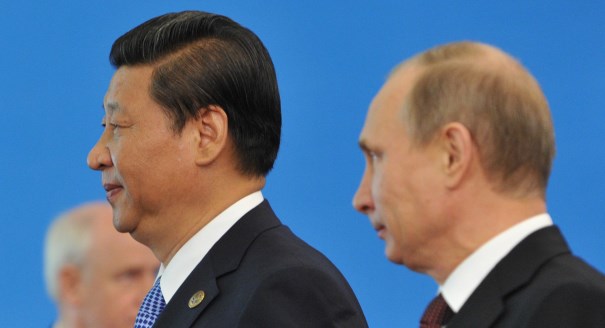
The current state of the affairs between Russia and China is most positive in their history. This relationship is built primarily on an economic pragmatism.
Source: China Radio International’s People In the Know
When Chinese President Xi Jinping went to Moscow in his first overseas visit after being elected China's president, it became quite clear that China-Russian relations are in high gear. The Chinese President is going to Russia again this week, attending the G20 Summit in St. Petersburg and meet with Russian President Putin on the sideline of the global event.
On the China Radio International, Carnegie Moscow Center’s Dmitri Trenin discussed Russia-China relations with Zheng Chenguang. He was joined by Joseph Cheng, chair professor of the department of political science at the City University of Hong Kong.Trenin said he is optimistic about the current state of the affairs between the two powers, which were described as most positive they've shared in their histories. According to Trenin, a relationship built primarily on an economic pragmatism has seen trade rise dramatically to $80 billion per year, and despite some uncertainties the two countries are expected to sign a major gas agreement improving Russia's access to Chinese markets and China's to Russian energy.
Trenin also discussed the extension of Sino-Russian cooperation into the military sphere. Joint exercises, such as the largest joint-naval event staged in the Sea of Japan this July, go a long way toward boosting confidence and trust between the two countries and their militaries. A military alliance, however, remains both unrealistic and unnecessary for both powers, Trenin said.
Despite the partnership-like relationship between Russia and China, Trenin stressed the continuing importance of Russia's investment in its own economic development and modernization given China's larger, growing, and more globally integrated economy. This reality will continue to contextual Russia-China relations and indeed developments in organizations such as the G20 or BRICS.
This interview was originally broadcast on China Radio International.
Joseph Cheng
Former Director, Carnegie Moscow Center
Trenin was director of the Carnegie Moscow Center from 2008 to early 2022.
Carnegie does not take institutional positions on public policy issues; the views represented herein are those of the author(s) and do not necessarily reflect the views of Carnegie, its staff, or its trustees.

In an interview, Ian Lustick and Eli Clifton discuss their new book on why a prominent ally has so much influence in America.

Michael Young

By failing to address Palestinian representation, the current process is bound to lead to just another temporary arrangement.

Nathan J. Brown

The armed forces champion a form of capitalism that is generating revenue, but its reliance on rent faces diminishing returns, leaving the country with massive sunk costs and deferred returns, deepening dependency on external borrowing.

Yezid Sayigh

Just look at Iraq in 1991.

Marwan Muasher

A coalition of states is seeking to avert a U.S. attack, and Israel is in the forefront of their mind.
Michael Young