

Commentary
Thomas de Waal
{
  "authors": [
    "Thomas de Waal"
  ],
  "type": "legacyinthemedia",
  "centerAffiliationAll": "dc",
  "centers": [
    "Carnegie Endowment for International Peace",
    "Carnegie Europe",
    "Malcolm H. Kerr Carnegie Middle East Center"
  ],
  "collections": [],
  "englishNewsletterAll": "ctw",
  "nonEnglishNewsletterAll": "",
  "primaryCenter": "Carnegie Europe",
  "programAffiliation": "russia",
  "programs": [
    "Russia and Eurasia"
  ],
  "projects": [],
  "regions": [
    "Middle East",
    "Türkiye",
    "Caucasus",
    "Armenia"
  ],
  "topics": [
    "Political Reform",
    "Foreign Policy"
  ]
}
Source: Getty
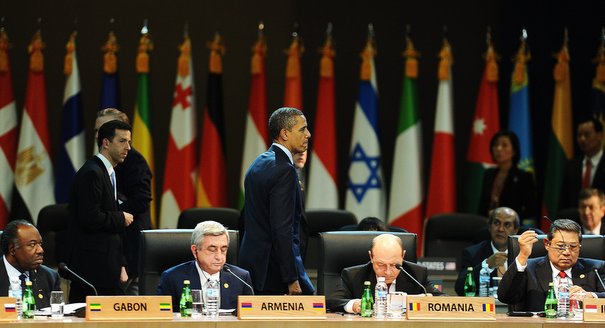
Friday marks the 100th anniversary of the mass killing of 1.5 million Armenians at the hands of the Ottoman Turks, but President Obama won’t be using the term ‘genocide’ to describe them.
Source: KPCC AirTalk
Friday marks the 100th anniversary of the mass killing of 1.5 million Armenians at the hands of the Ottoman Turks, but President Obama won’t be using the term ‘genocide’ to describe them.
The White House broke the news Tuesday in meetings with Armenian American groups, contradicting a promise then-Senator Obama made while campaigning for president in 2008 to “recognize the Armenian Genocide.”
Maybe nowhere in the U.S. does this news hit harder than in Los Angeles, which is home to the largest Armenian population outside of Armenia or Russia. The White House says the decision was made in order to keep relations with Turkey, a NATO ally, stable in the hopes of cooperation on Middle Eastern conflicts.
Did the White House make the right decision, politically, in not using the word ‘genocide?’ What would the impact be on U.S.-Turkish relations if he did? What does this decision mean for U.S. foreign policy?

Senior Fellow, Carnegie Europe
Thomas de Waal is a senior fellow at Carnegie Europe, specializing in Eastern Europe and the Caucasus.
Recent Work
Thomas de Waal
Thomas de Waal
Carnegie does not take institutional positions on public policy issues; the views represented herein are those of the author(s) and do not necessarily reflect the views of Carnegie, its staff, or its trustees.

As the U.S. stumbles in its war with Iran, we are likely to see an acceleration of its disengagement from the region.

Michael Young

Huawei pushed hard to enter the Egyptian data centers market, until the Americans made a better offer.

Angie Omar

The accord represents a pivotal moment in the region to avert a security vacuum in the Gulf.


Azeema Cheema, Mohanad Hage Ali

In an interview, Jason Burke discusses his sweeping account of the “revolutionists” who so shaped the 1970s and early 1980s.
Michael Young

By failing to address Palestinian representation, the current process is bound to lead to just another temporary arrangement.

Nathan J. Brown