

Article
Frederic Wehrey, Charles H. Johnson
{
  "authors": [
    "Frederic Wehrey"
  ],
  "type": "legacyinthemedia",
  "centerAffiliationAll": "dc",
  "centers": [
    "Carnegie Endowment for International Peace",
    "Malcolm H. Kerr Carnegie Middle East Center"
  ],
  "collections": [
    "Arab Awakening"
  ],
  "englishNewsletterAll": "menaTransitions",
  "nonEnglishNewsletterAll": "",
  "primaryCenter": "Carnegie Endowment for International Peace",
  "programAffiliation": "MEP",
  "programs": [
    "Middle East"
  ],
  "projects": [],
  "regions": [
    "North Africa",
    "Libya",
    "Maghreb"
  ],
  "topics": [
    "Political Reform",
    "Security",
    "Military"
  ]
}
Source: Getty
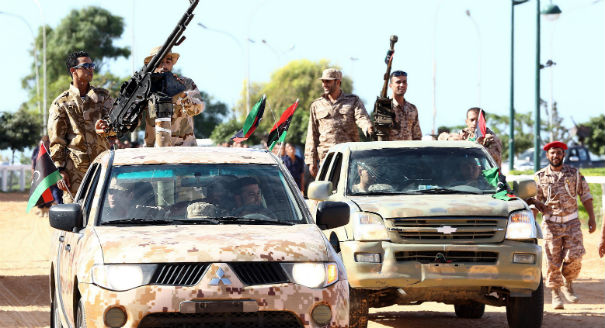
The rise of General Khalifa Hifter, Libya’s most powerful and polarizing force, raises doubts about the future of democracy in Libya.
Source: New York Times
Benghazi, Libya — In the crowded trauma room of a threadbare hospital, a procession of bedraggled soldiers files in, bearing a grim catalogue of wounds: shrapnel in the neck, gunshots to the chest, burned legs. Fierce fighting erupted here last week as a coalition of army, police, tribal militias and neighborhood volunteer forces launched a campaign dubbed “Operation Doom” to evict jihadist and Islamic State forces from their strongholds.
It is a battle that many residents say has been largely forgotten and misconstrued by the international community. As Libya’s rival governments — an internationally recognized one based in the eastern city in Tobruk and another in the western capital of Tripoli — debate the final draft of a United Nations-brokered peace plan, the mood in Benghazi is one of skepticism and distrust. People here believe the U.N. talks are meant to legitimize Islamists in Tripoli, whom they accuse of supporting Benghazi’s jihadist forces.
At a rally I attended for two slain activists, the eastern government’s minister for culture and media struck a defiant note, lambasting the United States Navy for waiting offshore but doing nothing against the Islamic State, and accusing Israel of supplying weapons to the jihadists. The audience roared with applause when he mentioned the name of Operation Doom’s architect: Gen. Khalifa Hifter.
General Hifter is Libya’s most powerful and polarizing figure. A former confidante of Muammar el-Qaddafi and longtime army officer who defected in the 1980s, he launched “Operation Dignity” in 2014 — an unsanctioned military operation to drive Islamist militias from Benghazi and end a wave of violence and assassinations that had plagued the city.
But he didn’t stop there. General Hifter tried to bring the war to Tripoli and topple the government and its Islamist factions. It was a threat that contributed to the division of the country. Supporters questioned if he had gone too far by labeling more moderate militias as terrorists. When I met General Hifter last year, his contempt for political Islamists of all stripes was clear. “There are three options for them,” he said “in the ground, in prison, or out of the country.”
On Benghazi’s frontlines, some commanders quietly bemoan his political ambitions and military incompetence even if they grudgingly participate in the campaign. “He’s Qaddafi. He’s trying to build his own militia,” one told me, before radioing for strikes from General Hifter’s aging air force to relieve his own besieged troops.
General Hifter’s war has brought some visible changes to Benghazi. The number of assassinations has dropped dramatically; it is now relatively safe to drive at night; young men throng the outdoor cafes to smoke hookahs while others play soccer under floodlights; and shops sell athletic gear and chandeliers.
Privately, however, people are nervous about the toll this is taking on democracy. Last week, a militia loyal to General Hifter stopped the prime minister from leaving the country. The launch of Operation Doom on the eve of the United Nations deadline for a unity government seemed timed to sabotage the talks. Some fear that if there is no unity government, the Tobruk-based parliament’s mandate will expire in late October and General Hifter will establish a military council to rule the east or exert greater power behind the scenes.
Others are resigned to accepting the grip of a strongman, so long as they can live in peace. “I will cut off my finger before I vote in another election,” a friend’s mother said.
Meanwhile, the fighting continues. Rockets and artillery rounds crash into the suburbs near the airport while jets streak across the sky. Schools and universities are shuttered, their classrooms packed with displaced families instead of students. Electricity outages are common. The army says it is facing a fanatical and cunning enemy, fortified by foreign fighters and weapons shipments delivered by boat from Misrata, a western city allied with the Tripoli government.
But there is another dynamic at work. Many of the pro-Hifter forces — their leaders say anywhere from 40 to 80 percent — are in fact neighborhood militias. The struggle in some areas has taken on a vicious familial and even ethnic quality, marked by the settling of ancient scores, between the east’s Bedouin Arab tribes and families from western Libya, some of whom have distant ties to Turkey. “This is about fighting the Turks and Freemasons,” the leader of one tribal militia told me. Another described children as young as 14 or 15 fighting in his ranks. I heard stories of summary executions of prisoners, forcible eviction of families and destruction of property.
Ultraconservative Salafists are said to be among the most competent fighters in General Hifter’s ranks; they too fight out of local and sometimes tribal solidarity, confounding the notion that this is a purely ideological war between secularists and Islamists.
On the other side, the composition is equally murky. To be sure, the Islamic State is present and growing. But one military critic of General Hifter, who wishes to remain anonymous, estimates that many of the opposing fighters are not hardened jihadists, but youths from Benghazi’s marginalized families who got caught up with Islamist militias and are now looking for a way to stop fighting.
The United States has wisely abstained from inserting itself into this multisided conflict, maintaining instead that the best way to help Libya fight the Islamic State is through a unified government that can coordinate disparate fighters. Any military aid right now would only add fuel to the civil war.
But time is running out. The delegates from both the eastern and western factions are meeting at the United Nations General Assembly in New York for talks on Thursday and Friday to decide on a new government. If there is no government produced by these talks, Libya will be torn between two equally disastrous currents: fragmentation and jihadism, or a drift to authoritarianism.
American officials have suggested privately that the United States may then shift to a policy of containment and carefully targeted counterterrorism operations. While that may slow the Islamic State’s expansion in Libya in the short-term, it will do little to build the sustainable future that Benghazi’s beleaguered residents and their fellow Libyans deserve.
Senior Fellow, Middle East Program
Frederic Wehrey is a senior fellow in the Middle East Program at the Carnegie Endowment for International Peace, where his research focuses on governance, conflict, and security in Libya, North Africa, and the Persian Gulf.
Recent Work
Frederic Wehrey, Charles H. Johnson
Frederic Wehrey, Charles H. Johnson
Carnegie does not take institutional positions on public policy issues; the views represented herein are those of the author(s) and do not necessarily reflect the views of Carnegie, its staff, or its trustees.
In Egypt’s dense cities, the disappearance of foliage has health implications and punishes daily commuters.

Angie Omar

The armed forces champion a form of capitalism that is generating revenue, but its reliance on rent faces diminishing returns, leaving the country with massive sunk costs and deferred returns, deepening dependency on external borrowing.

Yezid Sayigh

Morocco and Algeria, each in its own way, are having to navigate the global economic fallout of the U.S.-Israeli military campaign against Iran.

Yasmine Zarhloule
Understanding how farmers in the Oued Sahel-Soummam Valley grapple with climate change is essential for addressing the paradoxes through which adaptation, operating at both individual and institutional levels, deepens the region’s vulnerability and erodes the social fabric and agrarian identity that once defined life.
Ilyssa Yahmi
Unless the European Union-led energy transition provides economic development to Algeria, Morocco, and Tunisia, the process may be perceived as a new form of extraction.
Yasmine Zarhloule