

Commentary
Alexey Malashenko
{
  "authors": [
    "Alexey Malashenko"
  ],
  "type": "legacyinthemedia",
  "centerAffiliationAll": "",
  "centers": [
    "Carnegie Endowment for International Peace",
    "Carnegie Russia Eurasia Center"
  ],
  "collections": [],
  "englishNewsletterAll": "",
  "nonEnglishNewsletterAll": "",
  "primaryCenter": "Carnegie Russia Eurasia Center",
  "programAffiliation": "",
  "programs": [],
  "projects": [],
  "regions": [
    "Middle East",
    "Caucasus",
    "Russia"
  ],
  "topics": [
    "Security"
  ]
}
Source: Getty
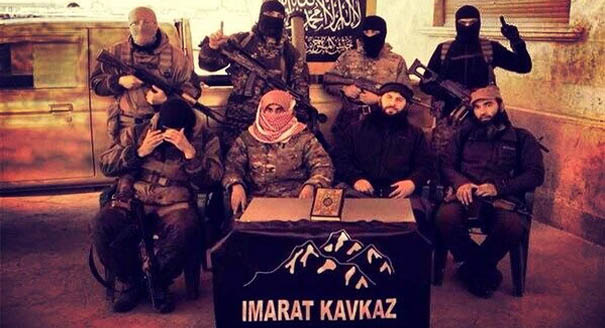
The North Caucasus Islamists’ wish to join ISIS makes some sense. By joining, they would cast themselves not just as regional players but worldwide jihadists. The relations between ISIS and the Caucasus Emirate, however, have been fraught with difficulties.
Source: Cipher Brief
The situation in the Russian North Caucasus has been complex for over 25 years now. A host of economic and social reasons, as well as the relations between this region and the federal authorities, and the mistakes made by both federal and regional politicians, have all contributed to the problem.
Although most experts consider the current situation in Russia relatively stable, it’s to a large extent contingent upon the Islamic factor—particularly upon the actions carried out by Islamic radicals, many of whom pledged their allegiance to the Islamic State.ISIS has tried to gain control of Russian Islamists. While the insurgency organization didn’t have sufficient resources to intervene in Russia’s domestic affairs, its leaders hoped to bridge that gap with the help of local religious opposition. ISIS is especially active in Kabardino-Balkaria, and, to a lesser extent, in Chechnya. The Caucasus Emirate (CE) has been operating there since 2007 and remains the most prominent local Islamist organization till this day...
This article was originally published on The Cipher Brief website.
Former Scholar in Residence, Religion, Society, and Security Program
Malashenko is a former chair of the Carnegie Moscow Center’s Religion, Society, and Security Program.
Recent Work
Alexey Malashenko
Alexey Malashenko
Carnegie does not take institutional positions on public policy issues; the views represented herein are those of the author(s) and do not necessarily reflect the views of Carnegie, its staff, or its trustees.

Huawei pushed hard to enter the Egyptian data centers market, until the Americans made a better offer.

Angie Omar

The accord represents a pivotal moment in the region to avert a security vacuum in the Gulf.


Azeema Cheema, Mohanad Hage Ali

In an interview, Jason Burke discusses his sweeping account of the “revolutionists” who so shaped the 1970s and early 1980s.

Michael Young
There is a disturbing structural parallel between the old global energy economy and the new green transition.
Angie Omar
In an interview, Sergei Melkonian discusses Armenia’s and Azerbaijan’s careful balancing act among the United States, Israel, and Iran.

Armenak Tokmajyan