

Commentary
Alexander Gabuev
{
  "authors": [
    "Alexander Gabuev"
  ],
  "type": "legacyinthemedia",
  "centerAffiliationAll": "",
  "centers": [
    "Carnegie Endowment for International Peace",
    "Carnegie China",
    "Carnegie Russia Eurasia Center"
  ],
  "collections": [
    "China’s Foreign Relations"
  ],
  "englishNewsletterAll": "",
  "nonEnglishNewsletterAll": "",
  "primaryCenter": "Carnegie Endowment for International Peace",
  "programAffiliation": "",
  "programs": [],
  "projects": [],
  "regions": [
    "East Asia",
    "China",
    "Russia",
    "North Korea"
  ],
  "topics": [
    "Foreign Policy"
  ]
}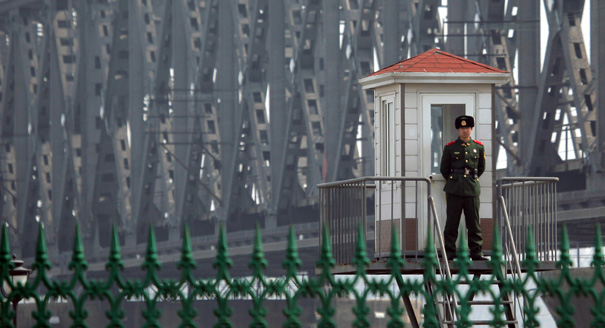
Source: Getty
The “turn to the East” has dramatically changed Russia’s strategy towards China and many underlying assumptions. It has also dramatically influenced the mainstream analysis of Chinese security intentions in Northeast Asia. The influence of this major shift in national policy, as well as policymakers’ and scholars’ perceptions of China, was felt throughout 2015.
Source: Korea Economic Institute
With its 4,000 km border to the Russian Far East and Siberia, growing economic potential and military capabilities, rising China has been on the minds of the Russian elite for a long time – at least since the 18th century when the Romanov and Qing empires established borders. Since the fall of the Soviet Union in 1991, the new Russia has observed its once poor and backward neighbor’s accession to the global stage with mixed feelings. Some people have welcomed China’s rise. Beijing, they argued, has wisely preserved the party’s monopoly on power, while advancing market reforms, and, thus, has avoided the mistakes under Mikhail Gorbachev’s leadership during perestroika. A stronger PRC will be a good balance to U.S. global dominance, thus giving Russia more breathing space internationally. The mainstream, however, had a different view. Members of the new elites were enjoying the newly discovered partnership with the West and had tasted the first fruits of democracy and market capitalism. With the Communist Party’s grip on power, its towering state sector, and growing military capabilities, China was seen through Western optics with mistrust and suspicion. Fueling these fears was booming cross-border trade. It brought a measure of development to the Russian Far East, abandoned by the federal government, but at the same time was seen by many in Moscow and locally as a prelude to an influx of Chinese migrants and “yellow colonization.”
Debates on China’s broader security intentions throughout the last 20 years have evolved along these lines. The official mainstream under Vladimir Putin has heralded China’s peaceful rise and strategic partnership between Moscow and Beijing, which has become increasingly anti-American (at least rhetorically) after the U.S. invasion of Iraq and “color revolutions” in the post-Soviet space. At the same time, in private, many Kremlin officials had deep suspicions about China’s security intentions in Northeast Asia, most notably in the Russian Far East. This has resulted in a two-faced approach to many practical issues. On the one hand, Moscow has sided with Beijing’s position on North Korea, was silent on any Chinese moves regarding the Senkaku/Diaoyu Islands, and has joined hands with Chinese voicing concerns about U.S. plans to install components of the American missile defense system in Northeast Asia. At the same time, Moscow has refrained from directly supporting China’s territorial claims in the East China Sea, was cautious about selling Russia’s most advanced weapon systems to the PLA, and has invested a significant effort in upgrading its military posture on the eastern flank.The crisis over Ukraine—followed by European and American sanctions against Russian individuals, companies, and whole sectors of the national economy—marked a major schism between Moscow and the West. One result of growing conflict between the West and Russia was a redoubling of Moscow’s “turn to the East” (povorot na Vostok) policy, centered around China. The “turn to the East” has dramatically changed Russia’s strategy towards China and many underlying assumptions. It has also dramatically influenced the mainstream analysis of Chinese security intentions in Northeast Asia. The influence of this major shift in national policy, as well as policymakers’ and scholars’ perceptions of China, was felt throughout 2015.
This article originally appeared on the Korea Economic Institute site.

Director, Carnegie Russia Eurasia Center
Alexander Gabuev is director of the Carnegie Russia Eurasia Center. Gabuev’s research is focused on Russian foreign policy with particular focus on the impact of the war in Ukraine and the Sino-Russia relationship. Since joining Carnegie in 2015, Gabuev has contributed commentary and analysis to a wide range of publications, including the Financial Times, the New York Times, the Wall Street Journal, and the Economist.
Recent Work
Alexander Gabuev
Alexander Gabuev
Carnegie does not take institutional positions on public policy issues; the views represented herein are those of the author(s) and do not necessarily reflect the views of Carnegie, its staff, or its trustees.

Huawei pushed hard to enter the Egyptian data centers market, until the Americans made a better offer.

Angie Omar

By failing to address Palestinian representation, the current process is bound to lead to just another temporary arrangement.

Nathan J. Brown

Just look at Iraq in 1991.

Marwan Muasher

A coalition of states is seeking to avert a U.S. attack, and Israel is in the forefront of their mind.

Michael Young
Baku may allow radical nationalists to publicly discuss “reunification” with Azeri Iranians, but the president and key officials prefer not to comment publicly on the protests in Iran.

Bashir Kitachaev