

Q&A
Darshana M. Baruah, Satyendra Prasad, Denghua Zhang
{
  "authors": [
    "Darshana M. Baruah"
  ],
  "type": "legacyinthemedia",
  "centerAffiliationAll": "",
  "centers": [
    "Carnegie Endowment for International Peace",
    "Carnegie India"
  ],
  "collections": [],
  "englishNewsletterAll": "",
  "nonEnglishNewsletterAll": "",
  "primaryCenter": "Carnegie India",
  "programAffiliation": "",
  "programs": [],
  "projects": [],
  "regions": [
    "Asia",
    "South Asia",
    "India",
    "East Asia",
    "Japan"
  ],
  "topics": [
    "Foreign Policy"
  ]
}
Source: Getty
Going beyond bilateral commitments, India and Japan are now eager to collaborate on areas of common interest at the regional level.
Source: East Asia Forum
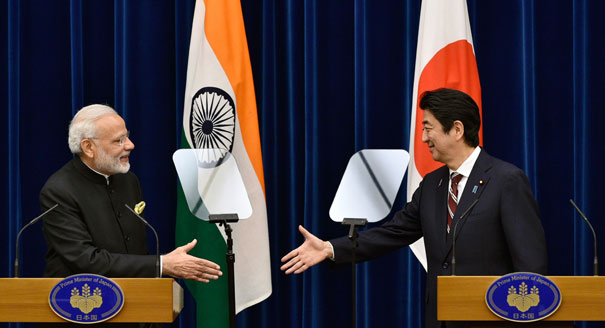
The third annual meeting between Japanese Prime Minister Shinzo Abe and his Indian counterpart Narendra Modi is scheduled for 11–12 November 2016 with high expectations of its outcome. There is a new sense of momentum in the relationship. Going beyond bilateral commitments, India and Japan are now eager to collaborate on areas of common interest at the regional level.
This summit is also significant in light of a new US president and a sense of uncertainty regarding his Asia policies. As the world makes sense of Donald Trump as the 45th US president, Japan and India might find a greater convergence in their concerns and vision for Asia.
This transition from a bilateral to a regional focus can be traced through the first two summit outcomes. The first meeting in 2014 resulted in a ‘special strategic and global partnership’ and the second in 2015 outlined a vision for ‘peace and prosperity in the Indo-Pacific region and the world’.
Maritime security is a priority area in the relationship. The idea of the Indo-Pacific binds India and Japan into one single theatre with a common security architecture. New Delhi has a tendency to separate its maritime interest areas into the Asia-Pacific and Indian Ocean regions, except when dealing with Japan.
India’s statement with Japan on the Indo-Pacific reflects a greater sense of trust between the two Asian players working together on a shared vision. But while the current Indian leadership has used the term in some speeches and remarks, there is no coherent policy on India’s concept of the Indo-Pacific.
This concept was first voiced by Abe during his speech to the Indian parliament in 2007. Abe spoke of the ‘confluence of the two seas’ and a broader Asia without borders, emphasising a need to keep these seas open and transparent.
The idea failed to gain traction in 2007 given India’s then limited engagement in the Pacific. But the geopolitical situation today is very different.
India and Japan’s strategic interests have largely converged. Both are concerned about the rise of China and its expanding strategic influence across maritime Asia. But Japan is interested in collaborating in both the Western Pacific and the Indian Oceans, while India’s interest beyond the Indian Ocean is limited.
The joint statement from the upcoming summit is expected to voice India and Japan’s support for UNCLOS (United Nations Convention on the Law of the Sea) and freedom of navigation in international waters, without any commitment from India challenging Chinese assertiveness in the South China Sea. India does not see any strategic sense in collaborating with a third party to counter Chinese actions in those waters. The Indo-Pacific idea, however, does provide the Indian Navy a wider theatre for engagement on areas of interest as it steps up its international engagements. The Indian Navy has made efforts to engage regularly with Japan, Australia, and Indonesia while deepening its existing ties with the US, ASEAN nations and Indian Ocean islands. The level of engagements range from institutionalised bilateral exercises to capacity building efforts. The current outlook is based on the 2015 maritime security strategy outlining international cooperation as key to creating a favourable maritime environment.
A growing area of interest on both sides is infrastructure development and building regional connectivity. A regular feature in the Modi–Abe summit has been a commitment to boost India’s infrastructure needs as well as improve connectivity between India and Southeast Asia. A key development is Japan’s investment in building infrastructure in India’s northeastern border region, home to one of the states claimed by China and a region that has been traditionally underdeveloped. Japanese investments are seen as a strategic move given that this area has been cut off from foreign investments due to territorial disputes.
Modi and Abe are now keen on extending this partnership at the regional level. At the summit they are expected to announce further projects outside of India, in South Asia and beyond. In an effort to balance China’s One Belt One Road initiative building roads through disputed Kashmir and ports in Pakistan, Sri Lanka and Myanmar, India is likely to announce a Pacific–Indian Ocean corridor project with Japan.
On defence, India is expected to confirm the purchase of 12 Japanese US-2 aircraft after two years of negotiations. The deal follows Japan losing out on the Australian submarines contract and will mark the beginning of its defence exports after World War II. The US-2 is an amphibian aircraft that the Indian Navy and Coast Guard will use for search and rescue operations. This will enhance India’s humanitarian assistance and disaster relief capabilities in the Indian Ocean region.
Another anticipated agreement is the India–Japan civil nuclear deal, which will allow Japan to share its nuclear plant technology with India. If successful, this will be Japan’s first agreement on nuclear technology with a country not signatory to the non-proliferation treaty.
It is important to note the China factor in India–Japan relations. While growing Chinese expansion in the maritime domain is a shared concern, India’s approach is not that of containment. There is no denying growing Sino–Indian competition from their shared borders to the Indian Ocean, but India is not closed off to ideas coming from Beijing. New Delhi has participated in ventures where it sees opportunity, and continues to engage in the Bangladesh–China–India–Myanmar economic corridor project and the Asian Infrastructure Investment Bank.
India is opportunistic, and ready to engage with different states on areas of common interests. While there is a fine line between balancing and countering, New Delhi so far has been able to walk it. In its endeavour to emerge as a global power, India has found a reliable and credible partner in Japan and will continue to broaden engagement and deepen its bilateral special strategic partnership.

Former Nonresident Scholar, South Asia Program
Darshana M. Baruah was a nonresident scholar with the South Asia Program at the Carnegie Endowment for International Peace where she directs the Indian Ocean Initiative.
Recent Work

Darshana M. Baruah, Satyendra Prasad, Denghua Zhang
Darshana M. Baruah
Carnegie does not take institutional positions on public policy issues; the views represented herein are those of the author(s) and do not necessarily reflect the views of Carnegie, its staff, or its trustees.

Just look at Iraq in 1991.

Marwan Muasher

A coalition of states is seeking to avert a U.S. attack, and Israel is in the forefront of their mind.

Michael Young

Baku may allow radical nationalists to publicly discuss “reunification” with Azeri Iranians, but the president and key officials prefer not to comment publicly on the protests in Iran.

Bashir Kitachaev
The country’s leadership is increasingly uneasy about multiple challenges from the Levant to the South Caucasus.

Armenak Tokmajyan
The countries of the region have engaged in sustained competition that has tested their capacities and limitations, while resisting domination by rivals. Can a more stable order emerge from this maelstrom, and what would it require?

Hamza Meddeb, Mohamed Ali Adraoui