

Q&A
Eugene Rumer
{
  "authors": [
    "Eugene Rumer"
  ],
  "type": "other",
  "centerAffiliationAll": "dc",
  "centers": [
    "Carnegie Endowment for International Peace",
    "Carnegie China"
  ],
  "collections": [
    "China’s Foreign Relations"
  ],
  "englishNewsletterAll": "ctw",
  "nonEnglishNewsletterAll": "",
  "primaryCenter": "Carnegie Endowment for International Peace",
  "programAffiliation": "russia",
  "programs": [
    "Russia and Eurasia"
  ],
  "projects": [],
  "regions": [
    "East Asia",
    "China",
    "Russia"
  ],
  "topics": [
    "Foreign Policy"
  ]
}
Source: Getty
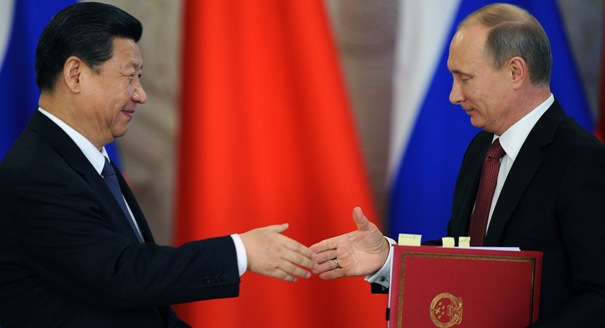
Russia’s relations with China have undergone a complete transformation in the past quarter century and have developed into a genuine strategic partnership, despite the Kremlin’s junior partner status.
Source: National Bureau of Asian Research
This essay considers Russian-Chinese relations from the perspective of Russia, challenges some of the widely held assumptions about Russian foreign policy and its goals, examines the key drivers of Russian policy toward China, and concludes with implications for U.S. interests.
Russia’s relations with China have undergone a complete transformation in the past quarter century and have developed into a genuine strategic partnership. Although the Kremlin no doubt is aware of its junior partner status vis-à-vis Beijing, this relationship is truly without an alternative for Russia’s leaders. Russian foreign policy is controlled exclusively by a narrow circle of the country’s elite, whose chief preoccupation is with preserving domestic stability and the security of the ruling regime. The West’s insistence on domestic change in Russia makes it an incompatible partner for the Kremlin. Beijing, by contrast, does not confront Moscow with such demands and, moreover, partners with it to oppose the West’s pursuit of democratic change worldwide. These domestic considerations largely offset potential sources of friction in relations with China.
This piece was originally published by the National Bureau of Asian Research.
Director and Senior Fellow, Russia and Eurasia Program
Rumer, a former national intelligence officer for Russia and Eurasia at the U.S. National Intelligence Council, is a senior fellow and the director of Carnegie’s Russia and Eurasia Program.
Recent Work
Eugene Rumer
Eugene Rumer
Carnegie does not take institutional positions on public policy issues; the views represented herein are those of the author(s) and do not necessarily reflect the views of Carnegie, its staff, or its trustees.

In an interview, Ian Lustick and Eli Clifton discuss their new book on why a prominent ally has so much influence in America.

Michael Young

By failing to address Palestinian representation, the current process is bound to lead to just another temporary arrangement.

Nathan J. Brown

Just look at Iraq in 1991.

Marwan Muasher

A coalition of states is seeking to avert a U.S. attack, and Israel is in the forefront of their mind.
Michael Young

Baku may allow radical nationalists to publicly discuss “reunification” with Azeri Iranians, but the president and key officials prefer not to comment publicly on the protests in Iran.

Bashir Kitachaev