

Paper
Eugene Rumer, Richard Sokolsky
{
  "authors": [
    "Richard Sokolsky"
  ],
  "type": "other",
  "centerAffiliationAll": "",
  "centers": [
    "Carnegie Endowment for International Peace"
  ],
  "collections": [],
  "englishNewsletterAll": "",
  "nonEnglishNewsletterAll": "",
  "primaryCenter": "Carnegie Endowment for International Peace",
  "programAffiliation": "",
  "programs": [],
  "projects": [],
  "regions": [
    "East Asia",
    "South Korea",
    "North Korea"
  ],
  "topics": [
    "Political Reform",
    "Foreign Policy",
    "Nuclear Policy",
    "Arms Control"
  ]
}
Source: Getty
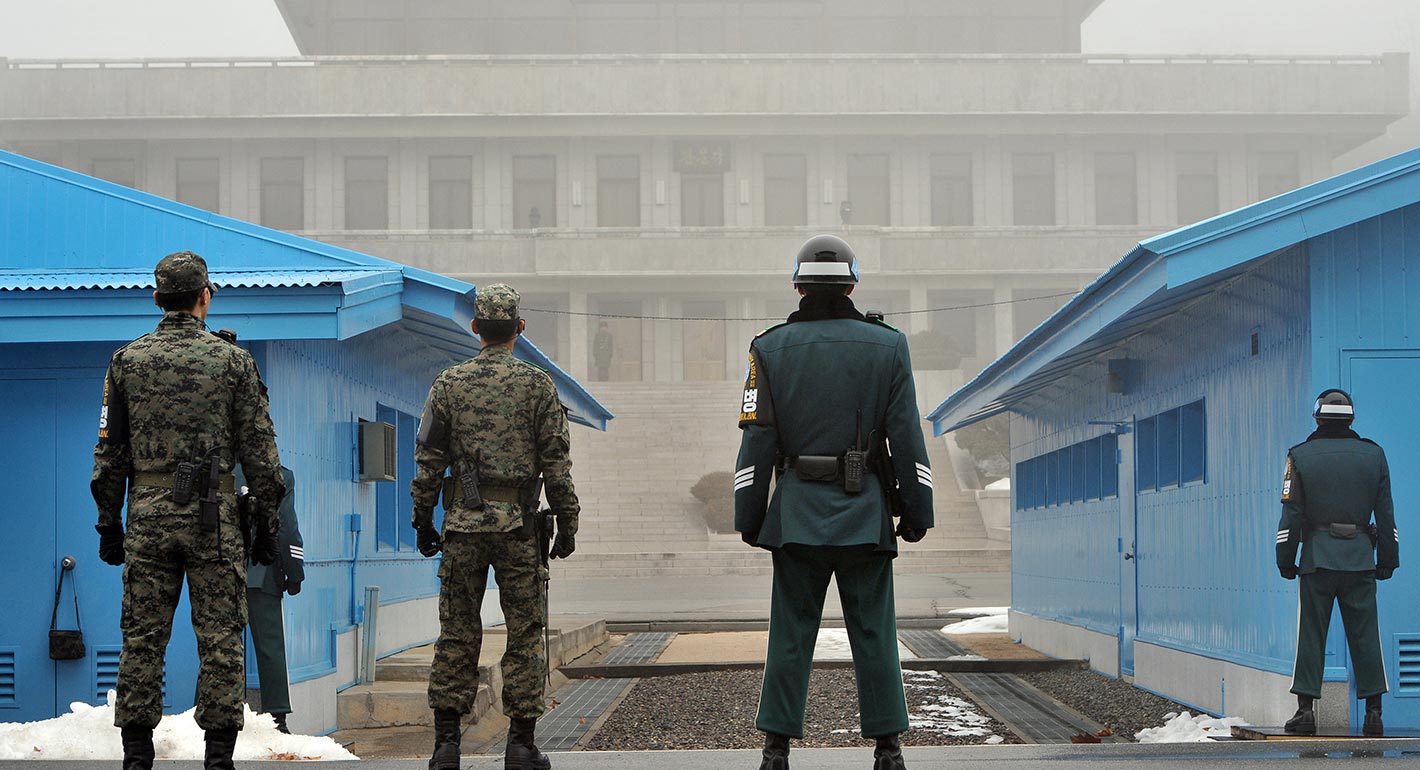
It is hard to visualize an enduring peace between North and South Korea that does not include robust measures to reduce the threat of conventional war.
Source: 38 North
The failure of US President Donald Trump and North Korean leader Kim Jong Un at last week’s summit to reach an agreement on denuclearization and steps to build a “lasting and stable peace regime” between the two Koreas, as called for in last June’s Singapore Summit declaration, heightens the importance of North and South Korea making further progress in their efforts to create a comprehensive peace and security regime on the Korean Peninsula. Unfortunately, the Trump administration has sought to slow down this initiative, so it would not get in front of stalled US-DPRK denuclearization negotiations. With the prospect that these negotiations could be on a slow track for some time, the two Koreas, with the support of the US, should shift to a higher gear in their discussions on confidence building measures (CBMs) and launch a dialogue on conventional force reductions to further reduce the risk of war....

Nonresident Senior Fellow, Russia and Eurasia Program
Richard Sokolsky is a nonresident senior fellow in Carnegie’s Russia and Eurasia Program. His work focuses on U.S. policy toward Russia in the wake of the Ukraine crisis.
Recent Work
Eugene Rumer, Richard Sokolsky
Eugene Rumer, Richard Sokolsky
Carnegie does not take institutional positions on public policy issues; the views represented herein are those of the author(s) and do not necessarily reflect the views of Carnegie, its staff, or its trustees.

In an interview, Ian Lustick and Eli Clifton discuss their new book on why a prominent ally has so much influence in America.

Michael Young

By failing to address Palestinian representation, the current process is bound to lead to just another temporary arrangement.

Nathan J. Brown
In an interview, Marc Lynch discusses his new book decrying the post-1990 U.S.-dominated order in the Middle East.
Michael Young

Just look at Iraq in 1991.

Marwan Muasher

A coalition of states is seeking to avert a U.S. attack, and Israel is in the forefront of their mind.
Michael Young