

Commentary
In an interview, Ian Lustick and Eli Clifton discuss their new book on why a prominent ally has so much influence in America.
Michael Young
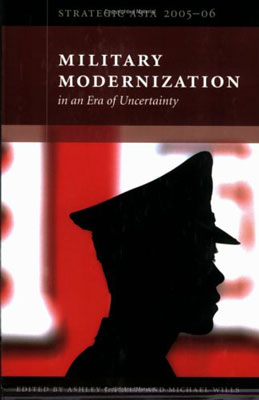
Through a combination of country, regional, and topical studies, Strategic Asia 2005–06: Military Modernization in an Era of Uncertainty assesses how Asian states are modernizing their military programs in response to China's rise as a regional power, the war on terrorism, changes in U.S. force posture, the revolution in military affairs, and local security dilemmas.
Source: The National Bureau of Asian Research

Through a combination of country, regional, and topical studies, Strategic Asia 2005–06: Military Modernization in an Era of Uncertainty assesses how Asian states are modernizing their military programs in response to China's rise as a regional power, the war on terrorism, changes in U.S. force posture, the revolution in military affairs, and local security dilemmas. In addition to this central theme, each chapter examines the changing balance of power in Asia and identifies likely threats and opportunities that may arise in the next five years.
Order this book, or read the introduction by Ashley J. Tellis for free.
About the Authors
Ashley J. Tellis, senior associate at the Carnegie Endowment for International Peace, served in the U.S. Department of State as senior advisor to the Ambassador at the U.S. embassy in India and on the National Security Council staff as special assistant to the president and senior director, strategic planning and Southwest Asia. He is the author of India’s Emerging Nuclear Posture and co-author of Interpreting China’s Grand Strategy. He has co-edited Strategic Asia 2004-05: Confronting Terrorism in the Pursuit of Power.
Michael Wills is the Strategic Asia program director at the National Bureau of Asian Research.
Former Senior Fellow
Ashley J. Tellis was a senior fellow at the Carnegie Endowment for International Peace.
Michael Wills
National Bureau of Asian Research
Michael Wills is senior vice president for strategy and finance at NBR.
Carnegie does not take institutional positions on public policy issues; the views represented herein are those of the author(s) and do not necessarily reflect the views of Carnegie, its staff, or its trustees.

In an interview, Ian Lustick and Eli Clifton discuss their new book on why a prominent ally has so much influence in America.

Michael Young

Huawei pushed hard to enter the Egyptian data centers market, until the Americans made a better offer.

Angie Omar

By failing to address Palestinian representation, the current process is bound to lead to just another temporary arrangement.

Nathan J. Brown

The armed forces champion a form of capitalism that is generating revenue, but its reliance on rent faces diminishing returns, leaving the country with massive sunk costs and deferred returns, deepening dependency on external borrowing.

Yezid Sayigh

Just look at Iraq in 1991.

Marwan Muasher