

In The Media
Josh Kurlantzick
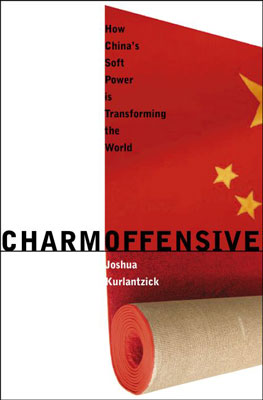
At the beginning of the twenty-first century, China is poised to become a major global power. And though much has been written of China’s rise, a crucial aspect of this transformation has gone largely unnoticed: the way that China is using soft power to appeal to its neighbors and to distant countries alike.
Source: Yale University Press

This book is the first to examine the significance of China’s recent reliance on soft power—diplomacy, trade incentives, cultural and educational exchange opportunities, and other techniques—to project a benign national image, position itself as a model of social and economic success, and develop stronger international alliances. Drawing on years of experience tracking China’s policies in Southeast Asia, Latin America, and Africa, Joshua Kurlantzick reveals how China has wooed the world with a "charm offensive" that has largely escaped the attention of American policy makers.
Beijing’s new diplomacy has altered the political landscape in Southeast Asia and far beyond, changing the dynamics of China’s relationships with other countries. China also has worked to take advantage of American policy mistakes, Kurlantzick contends. In a provocative conclusion, he considers a future in which China may be the first nation since the Soviet Union to rival the United States in international influence.
Nominated for the 2008 Arthur Ross Book Award.
This book is available from Yale University Press.
To order the book from Yale University Press, please click here.
Joshua Kurlantzick is special correspondent for the New Republic and visiting scholar at the Carnegie Endowment for International Peace. He has covered Southeast Asia and China as a correspondent for U.S. News and World Report and The Economist, and his writings on Asia have appeared in Foreign Affairs, the New York Times Magazine, and many other publications.

Former Visiting Scholar, China Program
A special correspondent for The New Republic, a columnist for Time, and a senior correspondent for The American Prospect, Kurlantzick assesses China’s relationship with the developing world, including Southeast Asia, Africa, and Latin America.
Recent Work
Josh Kurlantzick
Carnegie does not take institutional positions on public policy issues; the views represented herein are those of the author(s) and do not necessarily reflect the views of Carnegie, its staff, or its trustees.

In an interview, Ian Lustick and Eli Clifton discuss their new book on why a prominent ally has so much influence in America.

Michael Young

By failing to address Palestinian representation, the current process is bound to lead to just another temporary arrangement.

Nathan J. Brown

The armed forces champion a form of capitalism that is generating revenue, but its reliance on rent faces diminishing returns, leaving the country with massive sunk costs and deferred returns, deepening dependency on external borrowing.

Yezid Sayigh

Morocco and Algeria, each in its own way, are having to navigate the global economic fallout of the U.S.-Israeli military campaign against Iran.

Yasmine Zarhloule

Just look at Iraq in 1991.

Marwan Muasher