• Research
  • Diwan
  • About
  • Experts
Carnegie Middle East logoCarnegie lettermark logo
LebanonIran
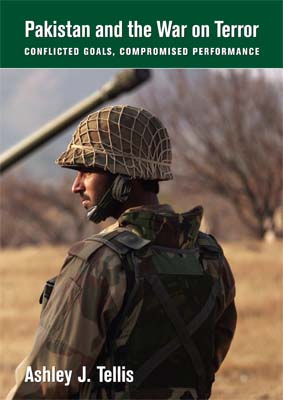
Pakistan and the War on Terror: Conflicted Goals, Compromised Performance
Report

Pakistan and the War on Terror: Conflicted Goals, Compromised Performance

The United States must shift its counterterrorism policy towards Pakistan away from a reciprocal approach—requiring Islamabad to perform desirable actions to receive support—towards one encouraging Pakistan to enact effective counterterrorism policies, not for an immediate payoff, but to strengthen institutionalized trust with the U.S. over time,

Link Copied
By Ashley J. Tellis
Published on Jan 18, 2008

Additional Links

Full Text

The United States must shift its counterterrorism policy towards Pakistan away from a reciprocal approach—requiring Islamabad to perform desirable actions to receive support—towards one encouraging Pakistan to enact effective counterterrorism policies, not for an immediate payoff, but to strengthen institutionalized trust with the U.S. over time, according to a new report from the Carnegie Endowment.

In Pakistan and the War on Terror: Conflicted Goals, Compromised Performance, Carnegie Senior Associate Ashley J. Tellis points to growing dissatisfaction in the United States with the Musharraf regime’s commitment to counterterrorism operations, given the influx of U.S. aid. But while Pakistan’s performance in the “war on terror” has fallen short of expectations, Islamabad’s inability to defeat terrorist groups cannot simply be explained by neglect or lack of motivation. U.S. policy makers must take into account the specific and complex counterterrorism challenges facing Pakistan and move away from their current unsustainable policies.

Nine strategies for more effective U.S. counterterrorism policies towards Pakistan:

  1. Speak clearly and forcefully to Musharraf in private about U.S. frustrations with Pakistan’s counterterrorism performance to outline the prospective consequences inaction will have on the U.S.-Pakistan relationship.

  2. Continue to encourage Pakistan’s border control efforts, but prioritize the targeting of Taliban leadership operating in Pakistan as part of the current counterterrorism concept of operations.

  3. Restructure the intelligence relationship between the U.S. and Pakistan to allow both the CIA and coalition forces in Afghanistan to acquire greater insight into existing terrorist networks inside Pakistan.

  4. Continue to assist Pakistan with technology and training to prosecute small-unit counterterrorism operations more effectively.

  5. Reform accounting practices to ensure effective oversight and auditing of coalition funds disbursed to Pakistan for counterterrorism operations.

  6. The reestablishment of stable democratic order is essential to stop Pakistan’s spiraling descent into extremism and disorder. The United States must integrate the ongoing political transition in Pakistan, including a return to democracy and rule of law, into the larger war on terrorism.

  7. Commit to long-term assistance for the Karzai government in Afghanistan to address the vacuum of governance, particularly with regards to security, economic development, and narcotics production.

  8. Commit more manpower and material contributions to help NATO live up to its security obligations in Afghanistan.

  9. Accelerate the raising of the Afghan National Army (ANA) as a hedge against the possible failure of NATO to restructure the International Security Assistance Force (ISAF) to effectively fight and win the war in Afghanistan.

“The Bush administration ought to persist with its current emphasis on the noncoercive engagement of Pakistan at least so long as there is a reasonable hope that the transformation of Pakistan into a moderate Muslim state is not a lost cause, that the Musharraf regime can be persuaded to expand its counterterrorism operations to those groups that have thus far remained beyond reach, and that the United States will have sufficient opportunity to switch to an alternative strategy before the present attempt at engagement is judged to have failed irremediably.”

A limited number of print copies are available.
Request a copy

About the Author

Ashley J. Tellis

Former Senior Fellow

Ashley J. Tellis was a senior fellow at the Carnegie Endowment for International Peace.

    Recent Work

  • Paper
    Multipolar Dreams, Bipolar Realities: India’s Great Power Future

      Ashley J. Tellis

  • Commentary
    India Sees Opportunity in Trump’s Global Turbulence. That Could Backfire.

      Ashley J. Tellis

Ashley J. Tellis
Former Senior Fellow
South AsiaPakistanSecurityMilitaryForeign Policy

Carnegie does not take institutional positions on public policy issues; the views represented herein are those of the author(s) and do not necessarily reflect the views of Carnegie, its staff, or its trustees.

More Work from Malcolm H. Kerr Carnegie Middle East Center

  • people watching smoke rising at sunrise from rooftops
    Commentary
    Emissary
    Bombing Campaigns Do Not Bring About Democracy. Nor Does Regime Change Without a Plan.

    Just look at Iraq in 1991.

      Marwan Muasher

  • Commentary
    Diwan
    Iran and the New Geopolitical Moment

    A coalition of states is seeking to avert a U.S. attack, and Israel is in the forefront of their mind.

      Michael Young

  • Commentary
    Carnegie Politika
    Baku Proceeds With Caution as Ethnic Azeris Join Protests in Neighboring Iran

    Baku may allow radical nationalists to publicly discuss “reunification” with Azeri Iranians, but the president and key officials prefer not to comment publicly on the protests in Iran.

      Bashir Kitachaev

  • Commentary
    Diwan
    Iran’s Woes Aren’t Only Domestic

    The country’s leadership is increasingly uneasy about multiple challenges from the Levant to the South Caucasus.

      Armenak Tokmajyan

  • A municipal employee raises the US flag among those of other nations in Sharm el-Sheikh, as the Egyptian Red Sea resort town gets ready to receive international leaders, following a Gaza ceasefire agreement, on October 11, 2025.
    Article
    The Tragedy of Middle Eastern Politics

    The countries of the region have engaged in sustained competition that has tested their capacities and limitations, while resisting domination by rivals. Can a more stable order emerge from this maelstrom, and what would it require?

      • Mohamed Ali Adraoui

      Hamza Meddeb, Mohamed Ali Adraoui

Get more news and analysis from
Malcolm H. Kerr Carnegie Middle East Center
Carnegie Middle East logo, white
  • Research
  • Diwan
  • About
  • Experts
  • Projects
  • Events
  • Contact
  • Careers
  • Privacy
  • For Media
Get more news and analysis from
Malcolm H. Kerr Carnegie Middle East Center
© 2026 Carnegie Endowment for International Peace. All rights reserved.