

Commentary
Tatiana Stanovaya
{
  "authors": [
    "Tatiana Stanovaya"
  ],
  "type": "commentary",
  "blog": "Carnegie Politika",
  "centerAffiliationAll": "dc",
  "centers": [
    "Carnegie Endowment for International Peace",
    "Carnegie Russia Eurasia Center"
  ],
  "collections": [],
  "englishNewsletterAll": "ctw",
  "nonEnglishNewsletterAll": "",
  "primaryCenter": "Carnegie Russia Eurasia Center",
  "programAffiliation": "russia",
  "programs": [
    "Russia and Eurasia"
  ],
  "projects": [],
  "regions": [
    "Russia",
    "Caucasus"
  ],
  "topics": [
    "Political Reform",
    "Foreign Policy",
    "Economy",
    "Domestic Politics"
  ]
}
Source: Getty
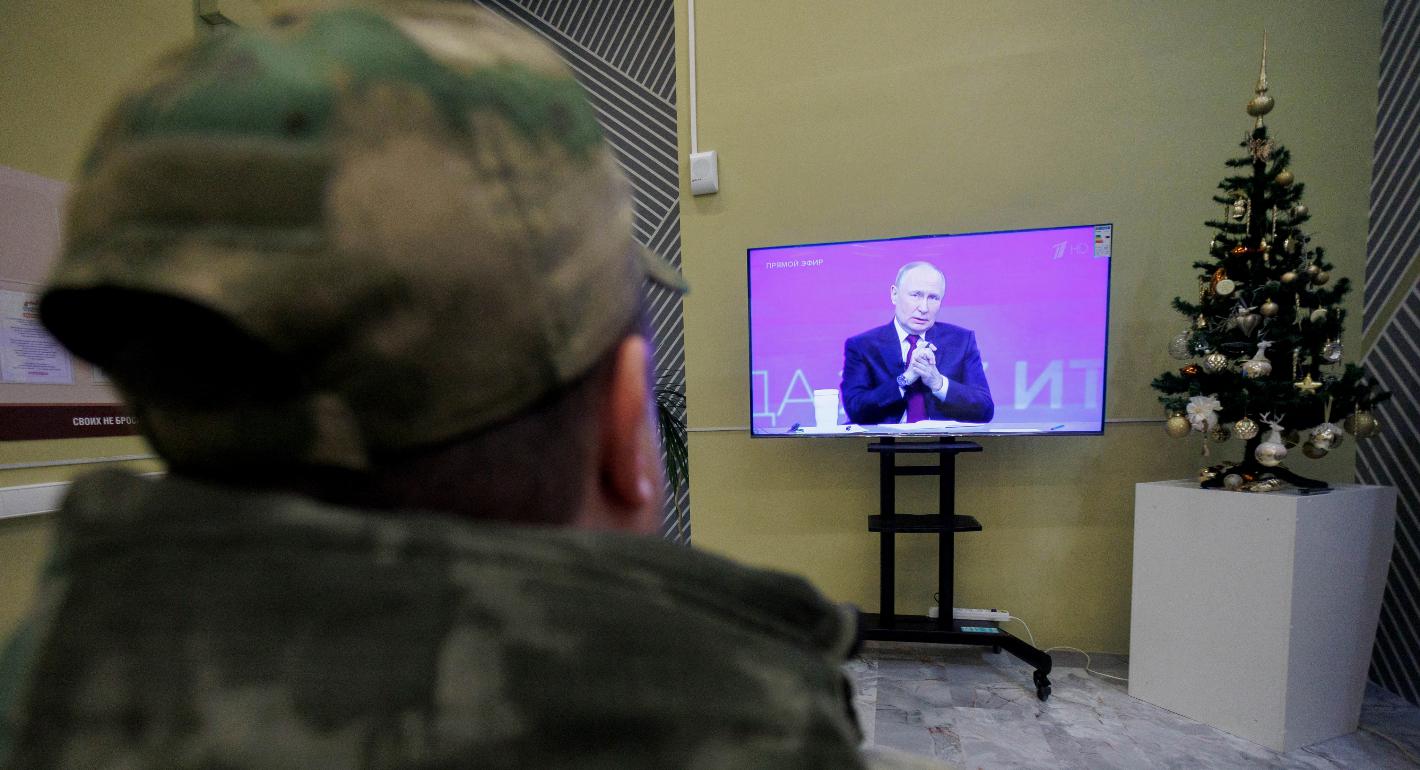
Putin is waiting for the West to reconsider its policy and start looking for opportunities for an inclusive dialogue. Sending out the signal that Russia is ready for such a dialogue was one of the main aims of the phone-in and press conference.
Russian President Vladimir Putin’s first marathon Q&A session with the Russian public and journalists since the full-scale invasion of Ukraine focused less on March’s presidential election than it did the ongoing war. As far as the Russian leadership is concerned, the confrontation with the West has reached a turning point: the Ukrainian counteroffensive has failed, Russia is more confident than ever, and the cracks in Western solidarity are spreading.
Putin has been striking a far more optimistic tone ever since the summer, damping down the nuclear rhetoric and threats. He used his Direct Line phone-in show not so much to score points ahead of the election as to present the global community with a “new” Russia, and make it clear to the West that it is time to rethink its policy.
The president certainly has plenty of reasons to be optimistic. Ukraine’s counteroffensive has virtually collapsed, and Russia is once again attacking across a broad front, even if no major territorial gains are in sight. Nor is there any sign that it is running out of men willing to go and fight: Putin said during the Q&A that no new mobilization is needed since nearly half a million soldiers have signed contracts.
The Russian leader’s uncharacteristically pacific rhetoric was designed to underscore confidence in his advantage over the enemy: military superiority over Ukraine, and moral, historical, and geopolitical superiority over the West. Putin apparently believes that the West has hit a dead end and is looking for a new strategy, opening a window of opportunity to talk about ways out of the situation.
Putin tried to convey to the West that Russia will in any case achieve all of its goals: not just the capitulation of the Ukrainian armed forces, but also the installation of a pro-Russian regime in Ukraine (this is what is really meant by “de-Nazification”). In addition, southeastern Ukraine will become part of Russia. The only question, the president implied, is what price the West will pay for dragging its feet on reconsidering its support for Ukraine.
Putin also found time during the four-hour televised event to address other foreign policy issues, effectively using his answers to present Russia’s new positioning in the world. That positioning consists of three key elements.
The first is so-called traditional values, which are no longer confined to domestic policy. Russia is trying to become a model of conservative civilization for other countries—including Western ones. “I know that … in many other cities in Europe, and in the United States, not to mention other parts of the world, many people believe that we are doing everything right,” Putin said during the event. In other words, “traditional values” are now yet another way for him to take part in the internal political discussions of other states, especially in the West.
The second element consists of acting the role of a defender of geopolitical justice. The war in Gaza has given Putin the opportunity to present Russia’s invasion of Ukraine in a new light. While the West turns a blind eye to Israel’s military operation, Putin is expounding an increasingly pro-peace rhetoric that is just another way of demanding that the West halt its support for Ukraine.
The third and final element of Russia’s new international image is presenting itself as a truly sovereign state. That might seem like anything but new, but Putin is now putting together a geopolitical template for export in which sovereignty comprises an economy that is immune to external financial tools, a society that is protected from external ideological influences, and a stable political system consolidated around a particular geopolitical consensus, as well as a strong army, security services and so on.
In this vein, Putin is calling on Europeans to emerge from Washington’s geopolitical shadow, holding up as examples “pro-national” (i.e., convenient for Moscow) leaders like Hungary’s Viktor Orban and Slovakia’s Robert Fico.
Meanwhile, the president’s rhetoric with regard to the United States itself was unusually conciliatory. “We are ready to build relations with the United States. We believe that America is an important country on the world stage,” said Putin. He also said Moscow was maintaining a dialogue with Washington on the return of imprisoned U.S. nationals Evan Gershkovich and Paul Whelan. “We seem to be speaking a language that is clear to each other,” Putin said, but added that the American side “should hear us.”
Contrary to expectations, the Q&A with members of the public and journalists was not really used by Putin to campaign ahead of the election in March. No sweeping promises were made, but much was said that reveals the logic of Putin’s domestic policy decisions.
In contrast to previous events, Putin was surprisingly reluctant to engage with complaints from members of the public, and nearly always took the side of the authorities. He did not agree that prices for utilities and housing services are growing at an unfair rate, or that pensions are not keeping up with inflation. Even the soaring cost of eggs, for which he did apologize, was blamed by the president on market conditions. In other words, Putin behaved not like a candidate ready to say anything to garner approval, but like a leader who doesn’t owe anybody anything.
Putin doesn’t feel the need to fight to win people over: he already has their support. He doesn’t consider himself politically vulnerable, so he has no need to go out of his way to try to boost his ratings. The Kremlin will not be looking for any pre-election victories—military or otherwise—ahead of the March vote.
Nor was there any indication of any potential changes. Despite some individual glitches, overall, it seems the president is satisfied with the work of the government, the central bank, the Defense Ministry, and law enforcement agencies. Even if there are any reshuffles after the election, they will therefore be aimed not at correcting the country’s course, but at doubling down.
The televised show made it clear that a priority for Putin’s fifth presidential term would be military and patriotic education. The Russian leader said repeatedly that “wars are won by teachers.” That means that the politicization and militarization of the education system will only gather pace, along with the lurch toward conservatism.
Overall, the event demonstrated that the time of military uncertainty is over, and the new reality has stabilized. Russia is a consolidated nation at war, and neither Ukraine nor the West can change the situation at the front now as far as Moscow is concerned. Accordingly, Putin plans to sit back and wait for the West to reconsider its policy and start looking for opportunities for an inclusive dialogue.
Sending out the signal that Russia is ready for such a dialogue was one of the main aims of the event. Yet it is quite obvious that no one in the West will accept proposals from Moscow issued from a perceived position of strength. That means a new spiral of conflict lies ahead.

Senior Fellow, Carnegie Russia Eurasia Center
Tatiana Stanovaya is a senior fellow at the Carnegie Russia Eurasia Center.
Recent Work
Tatiana Stanovaya
Tatiana Stanovaya
Carnegie does not take institutional positions on public policy issues; the views represented herein are those of the author(s) and do not necessarily reflect the views of Carnegie, its staff, or its trustees.

Putin’s conservative staffing policies and search for ever greater control have cemented parliament’s transformation into a bureaucratic appendage of the executive branch.

Andrey Pertsev

Russia’s AI-driven propaganda campaigns operate in a fragmented, chaotic, and often illogical manner. That’s not necessarily a problem for the Kremlin, though: It’s much easier to mimic genuine public debate that way.

Ilya Klishin

Without a ceasefire with Ukraine on attacking each other’s energy infrastructure—to which the Kremlin is unlikely to agree—the diesel agreement between Putin and Trump is largely for show, rather than representing a genuine increase in the volumes of Russian diesel on the global market.

Sergey Vakulenko

Russian strikes are weakening the economy sustaining Ukraine’s war effort. Closing the growing funding gap will require more European support and politically contentious reforms in Kyiv.

Balázs Jarábik

Ex-president Gurbanguly Berdimuhamedov remains interested in politics, but his son Serdar, Turkmenistan’s current president, is becoming increasingly independent and willing to break with his father’s legacy. If their covert rivalry goes too far, both risk losing power.

Galiya Ibragimova