

{
  "authors": [
    "Marina Barnett"
  ],
  "type": "other",
  "centerAffiliationAll": "",
  "centers": [
    "Carnegie Endowment for International Peace"
  ],
  "collections": [],
  "englishNewsletterAll": "",
  "nonEnglishNewsletterAll": "",
  "primaryCenter": "Carnegie Endowment for International Peace",
  "programAffiliation": "",
  "programs": [],
  "projects": [],
  "regions": [],
  "topics": []
}
Source: Getty
Latest Protests in Bishkek: Another Political Diversion?
The October 3 protests in Bishkek appear to be orchestrated to exploit the volatile situation around the Kumtor gold mine to advance certain political agendas and to divert attention from legal troubles facing some Kyrgyz politicians.
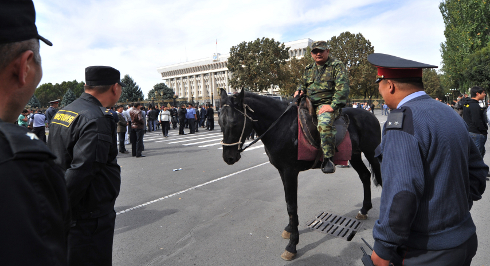
On October 3, at least 2,000 Kyrgyz opposition protesters clashed with police in Bishkek’s central square and made two attempts to storm the parliament. The protests, apparently instigated by two members of the Ata Jurt faction in the Kyrgyz parliament, Kamchibek Tashiyev and Sadyr Japarov, demanded the nationalization of the Kumtor gold mining venture.
Kumtor, the largest gold mine in Kyrgyzstan and one of the largest gold deposits in the world, is owned by Toronto-based Centerra Gold. In 2011, Kumtor accounted for 12 percent of Kyrgzystan’s GDP and more than 50 percent of its exports. While Centerra owns Kumtor and its output, Kyrgyzstan retains a 33 percent stake in Centerra, according to an agreement signed in 2009.
In June 2012, a 300-page report by a Kyrgyz parliamentary commission accused Centerra of stealing gold and damaging local environment. Centerra called the accusations “unfounded” and “without merit.” Nevertheless, the Kyrgyz parliament voted to nationalize the company, but fell short. It settled on directing the government to revise the 2009 agreement and to revoke government decrees and licenses in relation to the project.
According to analysts, if Kumtor is nationalized, the mine’s international investors will undoubtedly file claims for lost revenue. Kyrgyzstan will have to respond to those international arbitration claims, which might cost millions of dollars. It would also damage the country’s reputation in the world and make it much harder to obtain international assistance or attract foreign investment. Earlier this month, Kyrgyz prime minister Zhantoro Satybaldiyev ruled out nationalization of the mine.
The volatile situation around Kumtor is likely being exploited by certain political forces in Kyrgyzstan to advance their own political agendas. Some Kyrgyz experts suggested that the October 3 protests were a well-planned provocation aimed at destabilizing the country, and that Tashiyev, Japarov, and their followers instigated these events in an attempt to demonstrate their political power.
Others argued that the protests had been organized to divert attention from the criminal charges filed against Japarov. In September 2012 the general procurator’s office accused Japarov of participating in fraudulent activities and selling illegally obtained property. As a member of parliament, Japarov has immunity from criminal prosecution, however the general procurator’s office can petition the parliament to have the immunity stripped.
The protests are expected to continue.
About the Author
Ms. Marina Barnett
Former Program Manager, Russia and Eurasia Program
Carnegie does not take institutional positions on public policy issues; the views represented herein are those of the author(s) and do not necessarily reflect the views of Carnegie, its staff, or its trustees.