

{
  "authors": [
    "Alexandros Petersen"
  ],
  "type": "commentary",
  "centerAffiliationAll": "",
  "centers": [
    "Carnegie Endowment for International Peace",
    "Carnegie Russia Eurasia Center"
  ],
  "collections": [],
  "englishNewsletterAll": "",
  "nonEnglishNewsletterAll": "",
  "primaryCenter": "Carnegie Endowment for International Peace",
  "programAffiliation": "",
  "programs": [],
  "projects": [],
  "regions": [],
  "topics": []
}
Source: Getty
The Other Peace Talks
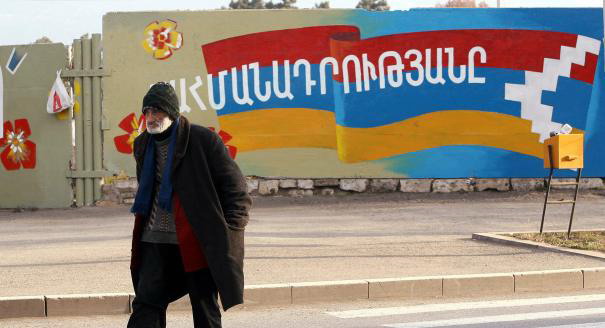
The dispute between Armenia and Azerbaijan over the territory of Nagorno-Karabakh is similar to that in the Middle East in many ways except that it is more likely to be resolved if it is paid some high-level international attention, particularly from the United States.
As Secretary Kerry lavishes the resources of the State Department on bringing Israelis and Palestinians to the table for what is now the thirteenth incarnation of negotiations, another stalemated conflict of equal geopolitical significance is all but ignored. The dispute between Armenia and Azerbaijan over the territory of Nagorno-Karabakh is similar to that in the Middle East in many ways except that it is more likely to be resolved if it is paid some high-level international attention, particularly from the United States.
There are major American interests at stake. Supply and withdrawal routes for U.S. forces and equipment from Afghanistan run only miles to the north of the conflict area. Azerbaijan is a pivotal supplier of energy resources to NATO allies in Europe and to Israel. The conflict zone lies just north of Iran and would almost certainly be embroiled in case of regional conflict. As Armenia’s treaty-bound protector in the dispute, Russia could stoke violence at any moment, causing immediate crisis for Washington.
The United States, along with Russia and France (representing the European Union) is an official sponsor of the Organization for Security and Cooperation in Europe’s (OSCE) peace negotiation mechanism: the so-called Minsk Group. On August 6, U.S. Secretary of State John Kerry filled the long-empty position of the Minsk Group co-chair from the United States, naming Ambassador James Warlick to serve as the point man for moving negotiations forward. Previously deputy special representative for Afghanistan and Pakistan, Warlick has experience with tough negotiations, having led talks with President Karzai’s government on the Bilateral Security Agreement with Kabul. He should also be familiar with the context of the Karabakh conflict as a former director for European Security Affairs.
That said, while Kerry’s designate for the yeoman’s work required to steward the thorny negotiations forward seems capable and is no doubt committed to the job, the contrast with Kerry’s repeated visits to the Middle East and personal handling of the Israeli-Palestinian question is stark. On Russia’s side, the point man for negotiations is Foreign Minister Sergey Lavrov. For a conflict with grave consequences for U.S. interests, this imbalance sends an unfortunate message to Armenia and Azerbaijan before talks even begin.
From the Azerbaijani point of view, the three co-chairs—France, Russia, and the United States—are actually the three countries with the largest and most active Armenian diaspora communities. Unequal and lackluster diplomatic involvement by Washington just reinforces the sense in Baku that negotiations are not worth pursuing.
This is all the more unfortunate because, unlike the Israeli-Palestinian conflict, Karabakh is on the verge of settlement if both sides can get the security guarantees that they seek and that can only be provided by Russia and the United States. Several detailed, well-known plans exist for how the settlement will look. The currently stalled negotiations just need a boost from an engaged American official of adequate stature. This is not to say that Ambassador Warlick is not up to the job, but his position should at least be made a Special Envoy—a post with direct access to the Secretary of State and the White House.
Barring this sort of upgrade, Warlick’s job will consist mainly of the bureaucratic effort of pushing the Nagorno-Karabakh conflict up the list of foreign policy priorities at Foggy Bottom rather than facilitating genuine negotiations and finding pragmatic solutions for the way forward. If his predecessors’ experience serves as any kind of indicator, the inside Washington game will prove more difficult than the presidential-level international diplomacy he is charged with sponsoring.
Dr. Alexandros Petersen is the author of The World Island: Eurasian Geopolitics and the Fate of the West and co-editor of www.chinaincentralasia.com.
About the Author
Alexandros Petersen
Carnegie does not take institutional positions on public policy issues; the views represented herein are those of the author(s) and do not necessarily reflect the views of Carnegie, its staff, or its trustees.