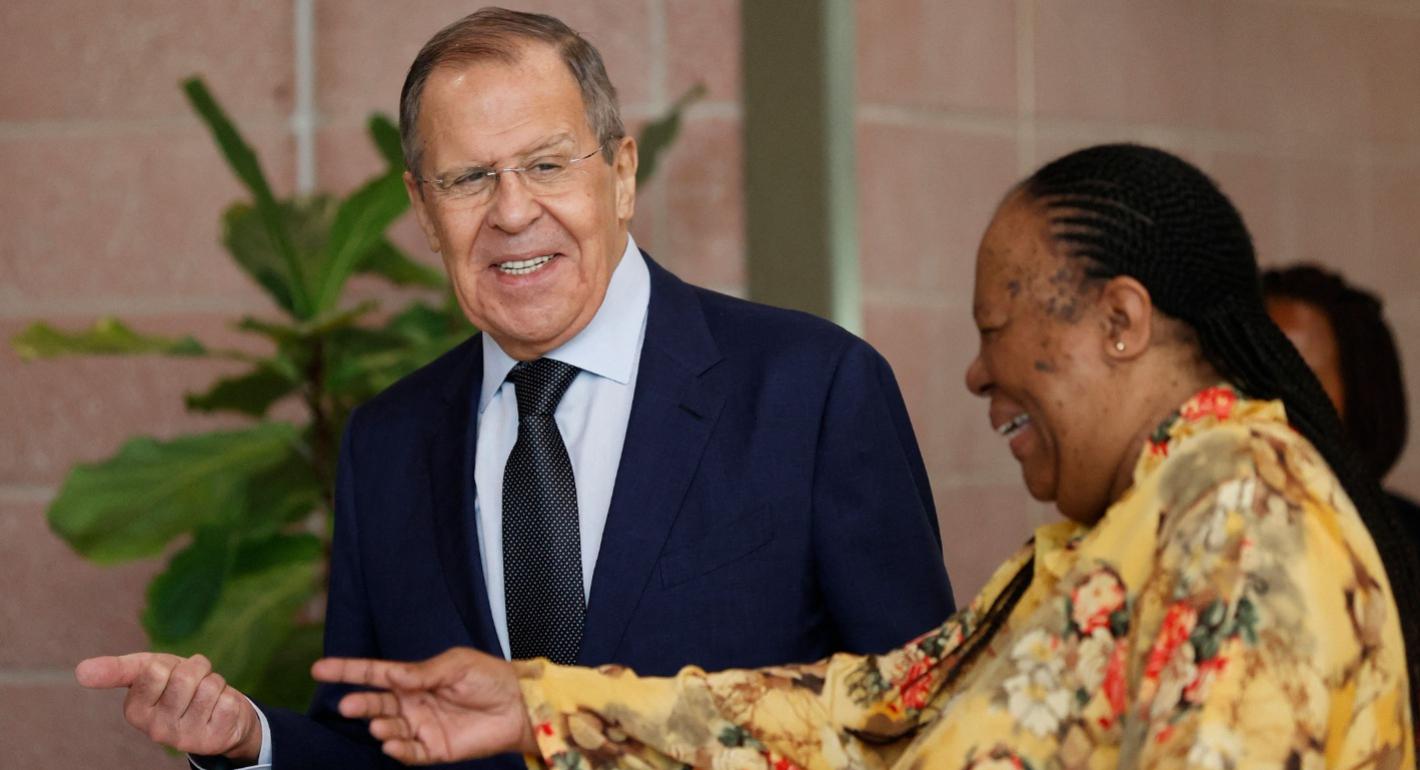
In less than a month, Russian Foreign Minister Sergey Lavrov visited seven African countries in two trips to the continent. With this flurry of diplomatic activity, Moscow has tried to promote its own narrative on the war in Ukraine and related changes on the international stage to the Global South. In reality, these efforts are not as much about creating a “second front” against the West in Africa as they are about Russia seeking to substitute—at least symbolically—the long-standing formats of cooperation with the post-Soviet space decimated by the invasion of Ukraine.
On January 23–26, Lavrov visited South Africa, Eswatini (formerly Swaziland), Angola, and Eritrea. Then, on February 7–9, he added Mali, Mauritania, and Sudan to the list, having met his Egyptian counterpart in Moscow in between the visits. Between them, those countries cover most of the continent’s macro-regions: South and West Africa, the Sahel-Saharan region, and the Horn of Africa.
The range of topics Lavrov discussed with the African leaders is no less interesting, especially when compared with the issues covered during his previous tour of the continent in July 2022. Back then, the foreign minister visited Egypt, the Republic of the Congo, Uganda, and Ethiopia, and wrote a policy article in which, apart from the requisite attacks on “Western colonialism,” he focused on African problems: food and energy security, integrational processes on the continent, and major infrastructure projects involving Russia. Bilateral meetings largely focused on the same issues.
This year, the spotlight was on entirely different topics. In South Africa, the two countries discussed joint naval exercises to be held with China on February 17–27, with the participation of the Russian frigate Admiral Gorshkov, which is armed with a hypersonic Zircon missile: a “wonder weapon,” as Russian President Vladimir Putin likes to refer to it. The missile is slated to be launched during the exercise.
While in Angola, Lavrov alluded to the successful Russia-led launch of the Angolan Angosat-2 satellite back in October. He also expressed pleasure at the growing interest in the Russian language, and discussed creating currencies within the BRICS countries (Brazil, Russia, India, China, and South Africa) and the countries of Latin America and the Caribbean.
In Eritrea, Lavrov stated that Moscow was ready to help the country maintain its defense capability, and mentioned cooperation on military technology, probably referring to negotiations on establishing a Russian Red Sea naval base.
In Mali, he talked about the joint counterterrorism struggle in the Sahel-Saharan region: presumably a reference to the presence of Russia’s Wagner Group mercenaries in the country. Lavrov also spoke of continuing shipments of Russian weapons and military equipment to the country.
In Mauritania, the parties discussed transferring Russian technologies and healthcare cooperation, including educating Mauritanians at Russian medical schools and employing doctors from Russia in the African country.
Finally, in Sudan, Lavrov shed light on the future of a Russian navy supply depot in the country. He said that the agreement on opening the depot had been signed and was in the process of being ratified.
In sum, the Russian foreign minister articulated an all too familiar refrain of security and technology exports, new alternative formats of economic cooperation, and soft power through advancing the Russian language and humanitarian projects.
This is essentially the same toolkit Russia has long been deploying in the post-Soviet space. Now Moscow is being forced to use these instruments in African countries, since they are increasingly less effective in dealing with its neighbors, primarily because of the war in Ukraine.
By 2023, it was abundantly clear that protracted efforts to create economic and political architecture that would integrate the former Soviet republics under the Kremlin’s leadership had failed. Moscow’s integrational platforms, from the Commonwealth of Independent States to the Eurasian Economic Union and Collective Security Treaty Organization, are rapidly becoming empty shells. Against this backdrop, Africa looks like promising terrain to recuperate at least some losses by building new logistical chains, creating routes to circumvent sanctions, and expanding cultural and military cooperation.
There would also appear to be a more sympathetic audience in Africa for Russia’s interpretation of the war. In combination with its anti-imperialist discourse, Russia presents its “special military operation” in Ukraine as part of a global confrontation with the West, aimed at rebuilding the world order around more fair principles. The familiar “anti-colonialism” rhetoric that Russia inherited from the Soviet Union is used to advance this concept.
To better suit its modern-day needs, anti-colonialism and the anti-imperialist struggle are also fused with discussing “illegitimate sanctions barriers,” “the battle for sovereignty,” “inadmissibility of interference in internal affairs,” and even Putin’s favorite narratives of “historical territories” and “falsifying history.” In addition, describing the war in Ukraine as “liberation from oppression” (in this case, oppression by neo-Nazis and “their Western handlers”) appeals to the idea of a struggle for national liberation that many Africans find very relatable.
Nevertheless, the effectiveness of these Russian information campaigns in Africa is debatable. Many of them were launched well before the war, but according to polls, people in Africa still think that the former colonial powers exert a more positive influence on the continent than Russia does, and oppose the war in Ukraine.
The Kremlin is apparently pleased with publications in Western media that portray developments in Africa as a “great-power game” and predict the launching of a “second front” against Ukraine’s Western allies there. In fact, one of the goals of Lavrov’s trips was to demonstrate that Russia remains a great power capable of competing with the United States or China across the Global South. Moscow seeks to show that it still commands enough cutting-edge technologies, advanced medicine, and military might to interest its foreign partners. But this image is far from reality, and the Africans know it.
Moscow chooses to portray the cautious neutrality of most African countries as commitment to a profound partnership, and interprets nonbinding consultations as a breakthrough from international isolation. The African elites will gladly join in condemning neocolonialism, ignoring the colonial nature of the war in Ukraine, but they are hardly likely to risk their ties with the EU or United States to help Russia in any practical way.
To change the situation, Russia would need to complement its verbal effusions with tangible steps like new investment projects, trade agreements, and loans. But for now, Russia’s trade volume and economic penetration on the continent doesn’t come close to that of Italy, India, or Turkey, let alone China, the United States, or former colonial powers.
Against this backdrop, Africa is becoming a battlefield of artificial narratives. The Kremlin pretends it is creating a “second front” and challenging the rules-based order, while the West feigns concern over the consequences of Russia’s chaotic actions, knowing perfectly well that the main threat to its interests in the region is actually posed by China.