

Commentary
Alexandra Prokopenko
{
  "authors": [
    "Alexandra Prokopenko"
  ],
  "type": "commentary",
  "blog": "Carnegie Politika",
  "centerAffiliationAll": "dc",
  "centers": [
    "Carnegie Endowment for International Peace",
    "Carnegie Russia Eurasia Center"
  ],
  "collections": [],
  "englishNewsletterAll": "ctw",
  "nonEnglishNewsletterAll": "",
  "primaryCenter": "Carnegie Russia Eurasia Center",
  "programAffiliation": "russia",
  "programs": [
    "Russia and Eurasia"
  ],
  "projects": [],
  "regions": [
    "Russia"
  ],
  "topics": [
    "Political Reform",
    "Economy"
  ]
}
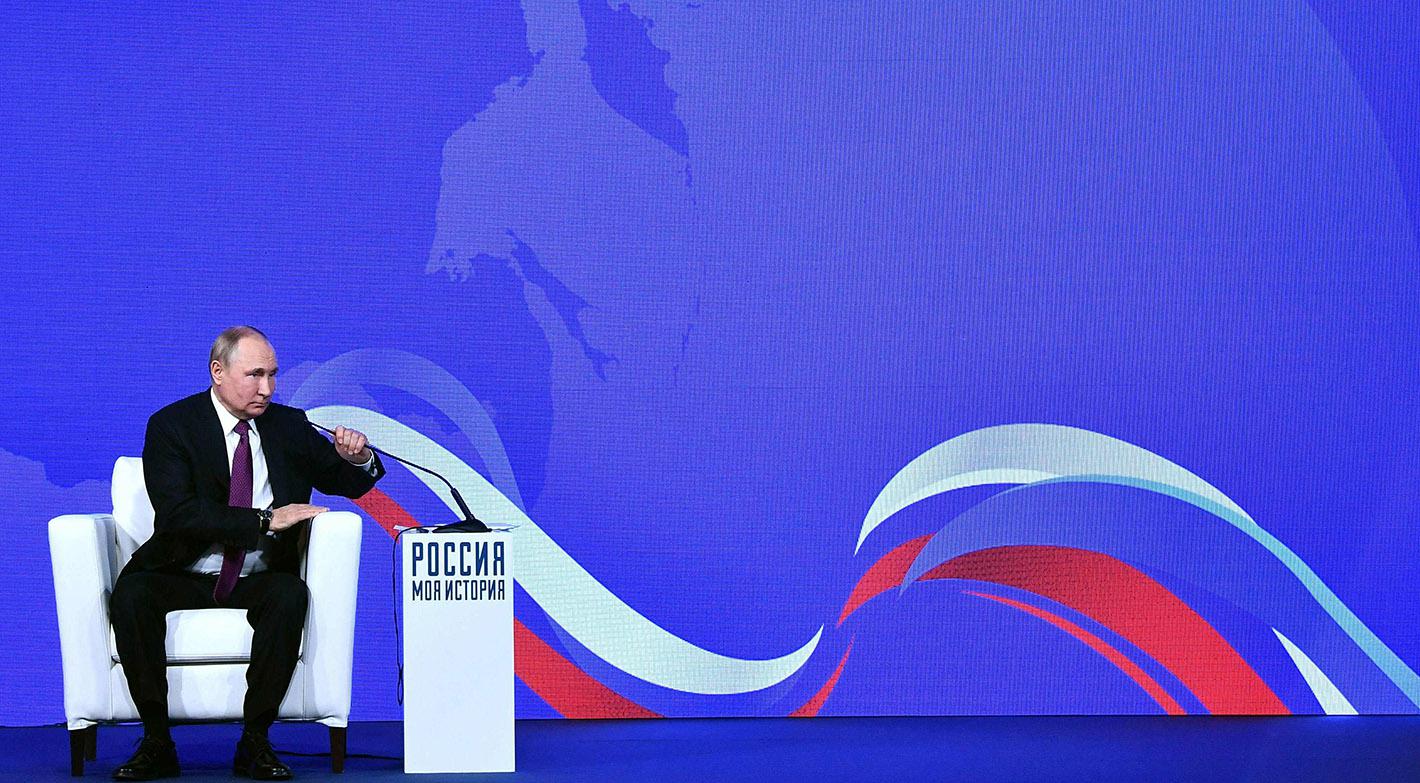
Source: Getty
In the absence of foreign investors, lucrative assets in Russia can be given for safekeeping to anyone who is “one of us.” Those people will owe their wealth to Putin personally, making them directly dependent on the Kremlin to preserve that wealth.
Russia’s elites are unhappy about many things, not least President Vladimir Putin’s decision to unleash a disastrous war against neighboring Ukraine and the sanctions that ensued. Yet this frustration—evident in off-the-record conversations with journalists, leaked telephone calls, and even the televised comments of the staunch propagandist Margarita Simonyan—is not being converted into any kind of action, such as a plot against Putin. Even as the elites grumble, they continue to show loyalty to their boss.
Loyalty is what Putin values above all else—but it’s no longer enough. Having apparently lost faith in the old elites, Putin is forming a new class of proprietors in Russia, doling out the assets of Western companies and Russian entrepreneurs among them. These people will be indebted to Putinism for their position and their fortune, and it will therefore be in their interests to preserve the regime.
Putin’s unique selling point for the oligarchs when he came to power was his willingness to accept the outcome of the controversial wave of privatization in the 1990s. The guarantee given for his first presidential term was that all the riches amassed before his presidency could be kept by their owners, and this has never changed. This pact is the foundation of Russian capitalists’ loyalty, and personal devotion to Putin is handsomely rewarded with extremely lucrative state contracts or control of entire economic sectors.
The Putin regime also hinges on loyal businessmen and the professional technocrats managing the economy. Following Russia’s invasion of Ukraine last February, the technocrats managed to protect the Russian financial system not only from the pressure brought by Western sanctions, but also from that of the country’s wealthiest tycoons, who were desperately trying to get their money out of Russia.
Even so, Russia hemorrhaged a record $243 billion in 2022. Transactions made by private individuals accounted for $47 billion of that: a fifth of the total amount. This outflow of capital is essentially the only form of protest against the war that the Russian elite has adopted.
Sanctions have kindled ressentiment and a feeling of injustice against the West among Russia’s elites. Meanwhile, a spate of mysterious deaths within Russia’s oil industry, have served to boost fears of and submission to the Putin regime. The lack of any real prospect of breaking free from the system has forced the elites to hunker down inside the country, abiding by the Kremlin’s message that only Russia can provide a safe haven.
Any war means a reduction in resources, however, and that includes the political capital distributed by the president. Amid decreasing rents, Putin can’t live on loyalty alone. Should the regime undergo a systemic crisis (which, as the Wagner mercenary leader Yevgeny Prigozhin’s brief mutiny back in June showed, is entirely possible), the devotion of the old elites to Putin and his regime is far from guaranteed. Accordingly, the system needs a new elite.
Back in a January meeting between Putin and the prosecutor general, the return of state control over strategic enterprises was mentioned as being under way. By the summer, a long list of assets had already been requisitioned—including ones previously owned by people loyal to the Kremlin.
The first candidates for nationalization and subsequent redistribution to new owners were the Russian assets of companies from countries declared “unfriendly” by the Kremlin. Under a law passed since Russia’s invasion of Ukraine, foreign companies wishing to leave the Russian market have to sell their assets for half of their value, and also pay one-tenth of the sale proceeds to the state. But the process is constantly getting tougher, and any deal may be blocked by the Russian authorities.
Heineken chose to cut its losses and sell off its vast business for one euro rather than try to find a way to salvage its investment. Ironically, all of these legal impediments have been introduced by the same officials who before the war were responsible for attracting foreign investors, and who had themselves worked in the private sector and at foreign companies before joining the state service.
Putin’s nationalization decree made it legal for the state to appropriate foreign companies’ assets in response to similar measures taken by Western countries. The Russian operations of two foreign energy companies—Finland’s Fortum and Germany’s Uniper—are already under new management linked to Putin associate Igor Sechin, CEO of the Russian oil giant Rosneft. The assets of the French dairy giant Danone, meanwhile, were inherited by the nephew of Chechen leader Ramzan Kadyrov, while Baltika, the Russian subsidiary of Denmark’s Carlsberg, went to Putin’s old friend Taimuraz Bolloyev.
Previously, another businessman close to Kadyrov was given a factory in the destroyed Ukrainian city of Mariupol, as well as shares in OBI hypermarkets and Starbucks coffee shops. Russian officials in Crimea, which Moscow annexed from Ukraine back in 2014, have appropriated 700 real estate assets from Ukrainian oligarchs.
Officially, the Russian authorities continue to insist that they welcome foreign investment. But foreign investors, regardless of where they are from, require predictable terms and conditions and guarantees that their rights of ownership will be upheld. The Kremlin can provide neither—and nor does it need to.
Instead of foreign investors, it has “heroes of the special military operation,” young FSB officers and their associates, the many participants of the Leaders of Russia state management contest, the children of regional governors, and other managers. Anyone who is “one of us” can be given an asset or two for safekeeping, along with the chance to profit from it. Those people will owe their new position and wealth to Putin and his entourage, making them directly dependent on the Kremlin to preserve that new status and wealth.
The calculation, therefore, is simple: when Putinism encounters a crisis, these new asset owners will come out to defend their property—and in doing so, save the regime.

Senior Fellow, Carnegie Russia Eurasia Center
Alexandra Prokopenko is a senior fellow at the Carnegie Russia Eurasia Center.
Recent Work
Alexandra Prokopenko
Alexandra Prokopenko
Carnegie does not take institutional positions on public policy issues; the views represented herein are those of the author(s) and do not necessarily reflect the views of Carnegie, its staff, or its trustees.

The European far right might fail to steer EU policy in the direction Russia wants, but they will create enough chaos inside Europe to benefit the Kremlin.

Dimitar Bechev

If the Russian-speaking community in Latvia cannot articulate their interests without being seen as disloyal, they could end up embracing a pro-Kremlin agenda.

Sergejs Potapkins

Russia’s ruling party would have benefited from Putin appearing as its distant patron, but as an active frontman imposing his views on the public, he has done nothing but harm both the party’s election campaign and the ruling system overall.

Andrey Pertsev

Depleted financial reserves and a shrinking tax base mean it is no longer possible to simultaneously deliver high defense spending, price stability, and economic growth.
Alexandra Prokopenko
Blurring the line between humans and animals is a long-standing tradition in social utopian prose. In his latest novel, Leonid Bershidsky reminds us that in social experiments, people are often treated no differently than animals.

Alexander Baunov