

Commentary
Alexandra Prokopenko
{
  "authors": [
    "Alexandra Prokopenko"
  ],
  "type": "commentary",
  "blog": "Carnegie Politika",
  "centerAffiliationAll": "dc",
  "centers": [
    "Carnegie Endowment for International Peace",
    "Carnegie Russia Eurasia Center"
  ],
  "collections": [],
  "englishNewsletterAll": "ctw",
  "nonEnglishNewsletterAll": "",
  "primaryCenter": "Carnegie Russia Eurasia Center",
  "programAffiliation": "russia",
  "programs": [
    "Russia and Eurasia"
  ],
  "projects": [],
  "regions": [
    "Russia",
    "Caucasus"
  ],
  "topics": [
    "Political Reform",
    "Economy",
    "Domestic Politics"
  ]
}
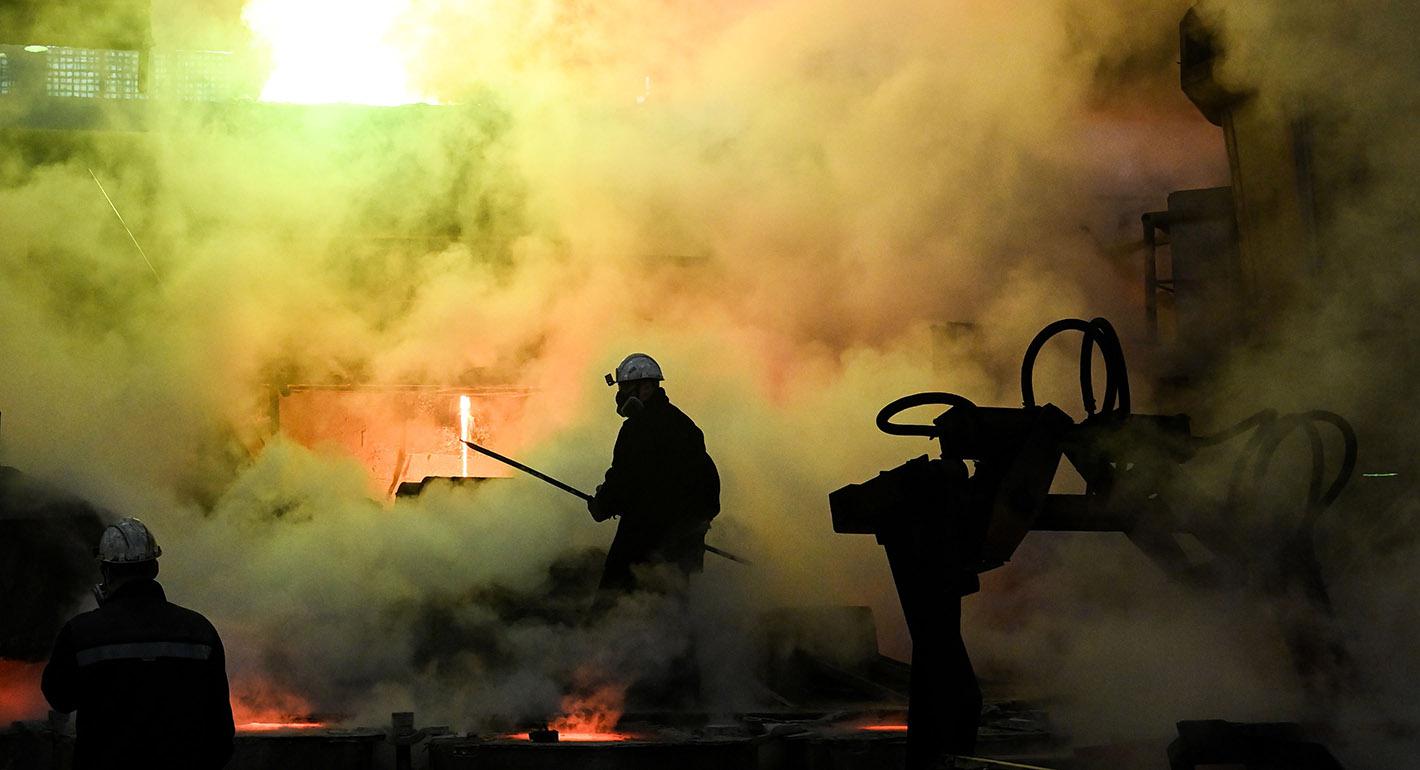
Source: Getty
Forcing exporters to sell their foreign currency earnings should help buoy the ruble and curb price rises ahead of the presidential election in 2024—though there will be a long-term cost.
Russian President Vladimir Putin has ordered Russian exporters working in sectors including energy, metals, agriculture, chemicals, and timber to convert most of their foreign currency earnings into rubles. The Kremlin appears to think that capital controls will help strengthen the Russian currency ahead of the expected start of Putin’s re-election campaign.
Officials prefer not to think about how this sort of measure will also distort market principles shaping the exchange rate, destroy the ruble’s reputation, jeopardize the independence of the central bank, and threaten Russia’s financial system. Along with the recent imposition of export tariffs on oil, such capital controls show that Russia is moving away from a market-based system of state capitalism toward a mobilized wartime economy.
From October 16, exporter companies in forty-three industries will have sixty days to repatriate to Russian accounts 80 percent of any foreign currency they receive. Within a further two weeks, 90 percent of that currency must be exchanged into rubles. The new rules are to be in place for six months.
With no official explanatory document forthcoming, it’s unclear which companies are affected by the capital controls, and whether they only impact Russian exporters, or cover foreign companies, too. It’s also unclear whether financial companies are included. According to some reports, the measures apply to any company earning more than 60 percent of its revenue from exports.
Representatives from the financial monitoring agency Rosfinmonitoring will be assigned to some companies to ensure compliance. Other companies will have to inform the central bank in advance about their plans to sell foreign currency, or they will incur a fine.
Enforcing the sale of foreign currency earnings in this way is an extreme step: it scares off investors, confuses markets, and complicates financial regulation. Russia ditched the tactic back in 2006 after enforcing capital controls in the 1990s due to the state’s desperate need for cash and a general distrust of the ruble. The liberalization of Russia’s currency legislation continued through the 2010s.
Everything changed after Russia’s full-scale invasion of Ukraine in February 2022, when companies were again forced to sell foreign currency earnings for a four-month period. As a result, the ruble strengthened rapidly, dropping to as low as 53 against the U.S. dollar, before gradually weakening.
By July, the ruble was falling toward the psychologically significant level of 100 against the U.S. dollar. There were immediate reasons for this, such as the failed insurrection by the Wagner mercenary army. Long-term reasons included fewer exports, rising imports, more capital transfers within Russia to non-ruble accounts, and a low level of liquidity.
It was the Finance Ministry that first raised the possibility of reimposing capital controls. The central bank was opposed. Initially, the Kremlin was closer to the central bank’s position, and over the summer, it was decided to come to informal agreements with exporters rather than legislating.
In combination with the rising interest rate, this approach yielded some results, and would probably have been sufficient. Indeed, interest rate rises up to 13 percent in both August and September are still being passed on to the ruble. In other words, the ruble was likely set to strengthen over the coming six months. But the Kremlin needed the process to happen much faster, hence the decision to impose capital controls.
Immediately after the announcement, the ruble strengthened to about 97 against the greenback. In other words, the capital controls worked. Yet assessing the true scale of their impact is complicated because it’s not known which companies are affected.
The biggest problem with Putin’s order was the sudden and secretive way in which it was announced. This will create serious difficulties for businesses trying to predict the exchange rate, as well as for the central bank and the government. It also complicates monetary policymaking, annulling years of efforts by the central bank to improve communication with financial markets.
The likely reason for keeping the list of affected companies secret is to avoid giving information about them to Western states, which could then impose sanctions. However, the secrecy also suggests that different obligations have been placed on different companies. That gives the Kremlin another tool to selectively meddle in the private sector, choosing which firms to pressure.
Putin will clearly deploy rhetoric about a resilient economy in his campaign ahead of presidential elections expected next year. That wouldn’t be very convincing if it were coupled with a weak ruble and runaway inflation. Accordingly, the Kremlin calculated that capital controls were needed to rapidly curb price rises while avoiding interest rate hikes.
Annual inflation in September hit 6 percent, the highest monthly rate since spring 2022. Food prices alone jumped 18 percent. The effect of capital controls—a strengthening ruble—will mostly feed through to slow down rising prices in stores within two months. That means that by the end of the year (when Putin is likely to launch his re-election campaign), the ruble will be safely below 100 to the U.S. dollar, and inflation will have fallen, ensuring positive economic data that can be triumphantly broadcast on state-owned television.
At the same time, capital controls are a double-edged sword. Their imposition shows that trust in the ruble has collapsed, which will ultimately fuel further currency devaluation and raise inflation expectations. The destruction of the ruble’s reputation will lead to greater capital outflows. For these reasons, it cannot be excluded that the Kremlin will impose even stricter capital controls, inflicting yet more long-term harm. The authorities are no doubt hoping they can forget about these damaging consequences until after Putin’s re-election.

Senior Fellow, Carnegie Russia Eurasia Center
Alexandra Prokopenko is a senior fellow at the Carnegie Russia Eurasia Center.
Recent Work
Alexandra Prokopenko
Alexandra Prokopenko
Carnegie does not take institutional positions on public policy issues; the views represented herein are those of the author(s) and do not necessarily reflect the views of Carnegie, its staff, or its trustees.

A leak of Russian gas price data helps establish that China is paying Russia far less than Central Asian countries and Gazprom’s former European customers.

Sergey Vakulenko

Japan’s long-term security policy is driven by concerns about China, and there is little appetite for (or interest in) pursuing a confrontation with Moscow.

James D.J. Brown

The truth of the strategic situation is that Europe and Russia are extremely unlikely to be able to “turn the page” on their confrontation within the next two decades.

Arkady Moshes
Russia spent years building a “sovereign internet,” concentrating web infrastructure exclusively within Russian territory. Ukrainian drone attacks have shown how vulnerable that approach has left the Russian internet.

Maria Kolomychenko

Putin’s conservative staffing policies and search for ever greater control have cemented parliament’s transformation into a bureaucratic appendage of the executive branch.

Andrey Pertsev