

Commentary
Tatiana Stanovaya
{
  "authors": [
    "Tatiana Stanovaya"
  ],
  "type": "commentary",
  "blog": "Carnegie Politika",
  "centerAffiliationAll": "dc",
  "centers": [
    "Carnegie Endowment for International Peace",
    "Carnegie Russia Eurasia Center"
  ],
  "collections": [
    "Aso Tavitian Initiative"
  ],
  "englishNewsletterAll": "ctw",
  "nonEnglishNewsletterAll": "",
  "primaryCenter": "Carnegie Russia Eurasia Center",
  "programAffiliation": "russia",
  "programs": [
    "Russia and Eurasia"
  ],
  "projects": [],
  "regions": [
    "Russia",
    "Caucasus"
  ],
  "topics": [
    "Political Reform",
    "Economy",
    "Domestic Politics"
  ]
}
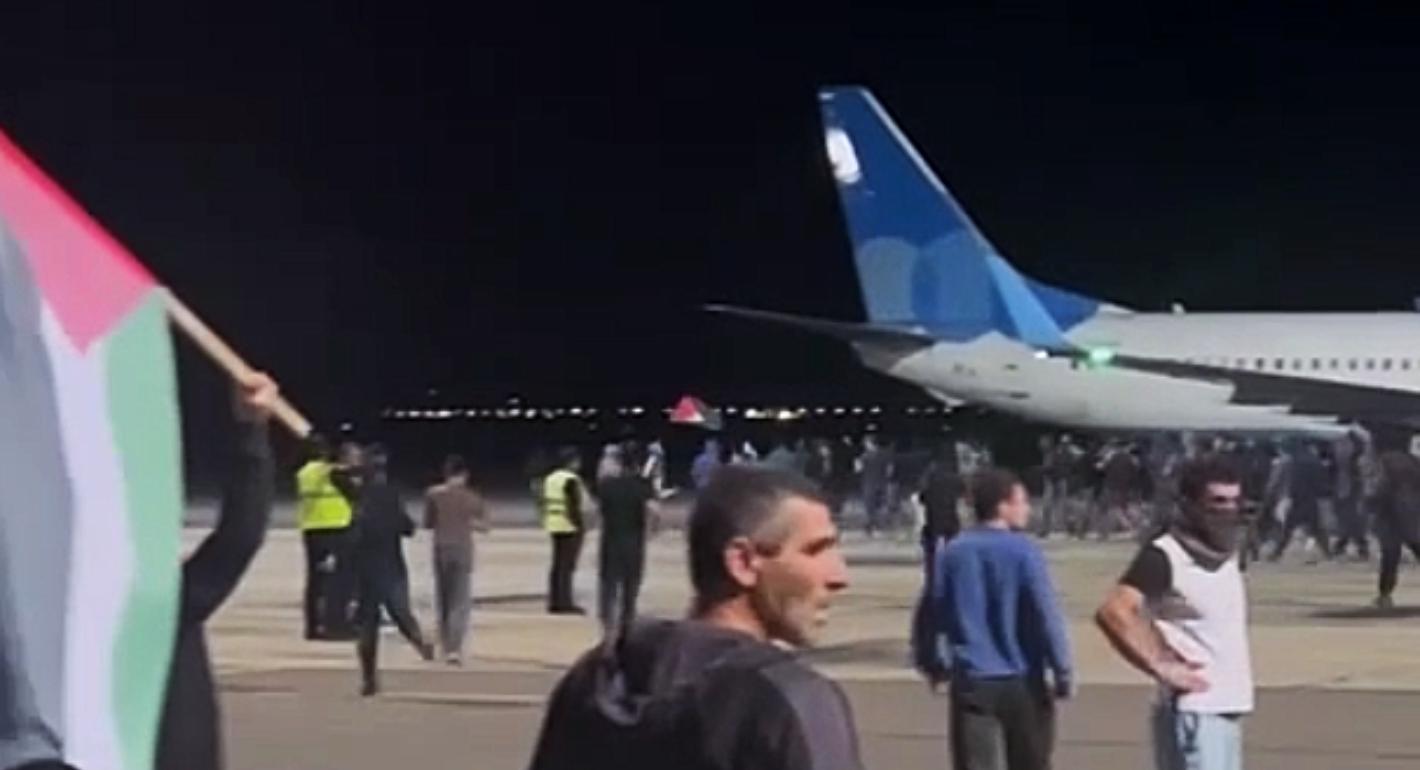
Source: Getty
Both the Prigozhin mutiny earlier this year and now the pogroms in the North Caucasus show that no matter how brutal and impenetrable the Russian regime may seem, it is weak and indecisive when confronted with any non-anti-Putin unrest.
When an angry mob in Russia’s mostly Muslim republic of Dagestan stormed the regional capital of Makhachkala’s airport, hunting for Jews arriving on a flight from Israel, the Russian authorities’ reaction—or lack of—was shocking. The National Guard, Russia’s internal military force—notorious for its harsh dispersal of opposition rallies—only showed up several hours after the rioters had overrun all areas of the airport, including the runway, and even then exercised uncharacteristic restraint.
The pogrom at Makhachkala airport was preceded by other anti-Semitic protests in Russia’s North Caucasus. Over the weekend, another crowd of people searched a hotel in the Dagestani city of Khasavyurt, again hunting for Jews, while several hundred kilometers away, a partially built Jewish center was set on fire in the city of Nalchik, capital of the Russian republic of Kabardino-Balkaria. None of these unlawful events elicited much reaction from the authorities. On the contrary, the inaction of the siloviki, or security forces, and the paralysis of the state apparatus were striking.
Like the armed mutiny led by the now deceased mercenary boss Yevgeny Prigozhin a few months earlier, the airport pogrom laid bare three burning problems faced by President Vladimir Putin’s regime that prevent it from responding promptly to such challenges and indicate that the Russian government is effectively paralyzed in the face of impending (and clearly visible) political danger.
The first problem is the system’s critical bias: it only fights those who do not agree with the geopolitical course plotted by the regime. While repressive mechanisms are constantly being improved, successfully nipping in the bud any form of anti-Putin sentiment, no thought is apparently being given to anything that lies outside of that focus.
Regional officials know perfectly well who the enemies of the regime are: Putin’s critics, supporters of the jailed opposition leader Alexei Navalny, liberals, and anti-war activists. They also know exactly what tools they have to fight them. But when an emergency like the one at Makhachkala airport arises, the rules are unclear: including whether to view the lawbreakers as enemies or supporters of the regime.
After all, Russian officials are as aggressively critical of the West and Israel in public and on television as the people who stormed the airport. In the eyes of a typical regional official, therefore, the mob of people surrounding planes on the runway are representatives of the “real people” who, far from opposing the Putin regime, are actually in their own lawless way trying to express their support for it.
This problem was particularly noticeable when the disgruntled mercenary boss Prigozhin led his Wagner troops in a “march for justice” on Moscow back in June. Confused security officials and regional authorities did not know whether to see the fighters rapidly approaching the capital as criminal insurgents or war heroes seeking justice.
This is one of the most dangerous vulnerabilities of the Russian regime. The carefully constructed vertical of repression is only effective in certain specific cases, but it is far from universal. When crimes are being committed not by political enemies, but by supporters of the regime, it is rendered useless.
The second problem is the crisis of political responsibility. When faced with threatening situations for which the system has not provided instructions, the authorities prefer to simply do nothing. Of course, in theory, those instructions should simply be the law, applied equally regardless of the political context, but the Russian regime has long abandoned even any pretense of that approach.
This second problem was also evident during the Prigozhin mutiny. What many interpreted as the refusal of the security forces to shoot at the Wagner mercenaries was in fact more likely hesitation due to a lack of coherent orders.
In the case of the airport pogrom, brutally suppressing the unrest might have incurred the wrath of the federal center—not so much because of the riot itself, but because of the regional authorities’ inability to resolve the issue quietly. Using force against the mob could have elevated the problem to the federal level, and Putin has made it clear that he does not wish to be bothered with mundane regional issues.
The regional leaders’ fear of using force stems not from an inability to quash unrest, but from a lack of political will to take decisive action. The Dagestani leadership’s initial response was to send two regional ministers—for youth affairs and national policy—to talk to the mob. Neither of them ultimately achieved anything, and several hours later, the National Guard was dispatched.
The head of Dagestan, Sergei Melikov, a tough and experienced security official who served in the First Chechen War, only made some toothless comments on the situation later that night via his Telegram channel. A few hours earlier, Melikov had been equally mild in his condemnation of the other anti-Semitic incidents in Makhachkala and Khasavyurt, coming close to expressing solidarity with the rioters, and merely reproaching some “hotheads” for creating a “misunderstanding,” as he described the witch-hunt for Jews in the Khasavyurt hotel.
Finally, the morning after the airport riot, Melikov proposed that those who had taken part in the disorder could “wash away the shame” by going to fight in Russia’s “special military operation” against Ukraine—but promised not to take any special measures against those detained in the rioting. In other words, choose your own punishment (or none at all).
This paralysis of the authorities when making a decision that should have been blindingly obvious is also caused by the state apparatus’s desire to constantly emphasize complete and universal support for Putin. All the decisions made at the regional level are built around this desire to prove the loyalty of the local elites and population, which in terms of political survival is now far more important than preventing something as serious as an anti-Semitic pogrom.
The third and final problem is Putin himself. When there is no system of coordinates for decision-making, and regional authorities are paralyzed by a crisis of responsibility, everyone is waiting for a reaction from one person: the president.
But in the case of the Makhachkala airport, there was no reaction until the next day, when first the president’s spokesman Dmitry Peskov and then Putin himself blamed “outside interference” for the incident (while providing no evidence).
All of this is very instructive in terms of political forecasting. Both the Prigozhin mutiny and the pogroms in the North Caucasus show that no matter how brutal and impenetrable the Russian regime may seem, it is weak and indecisive as soon as it is confronted with any non-anti-Putin unrest. For regional authorities will look to Moscow, Moscow will expect “responsible behavior” from regional leaders, and Putin and the senior leadership will withdraw on the basis that they consider such routine matters beneath them.
Like Prigozhin’s mutiny, the authorities will not learn any lessons from the pogrom at Makhachkala airport. That means that in the event of truly violent unrest on a massive scale, the reaction of both regional and federal authorities will again be belated, indecisive, and indulgent. And one day, that will inevitably work against the regime itself.

Senior Fellow, Carnegie Russia Eurasia Center
Tatiana Stanovaya is a senior fellow at the Carnegie Russia Eurasia Center.
Recent Work
Tatiana Stanovaya
Tatiana Stanovaya
Carnegie does not take institutional positions on public policy issues; the views represented herein are those of the author(s) and do not necessarily reflect the views of Carnegie, its staff, or its trustees.

The truth of the strategic situation is that Europe and Russia are extremely unlikely to be able to “turn the page” on their confrontation within the next two decades.
Arkady Moshes

Russia spent years building a “sovereign internet,” concentrating web infrastructure exclusively within Russian territory. Ukrainian drone attacks have shown how vulnerable that approach has left the Russian internet.

Maria Kolomychenko

Putin’s conservative staffing policies and search for ever greater control have cemented parliament’s transformation into a bureaucratic appendage of the executive branch.

Andrey Pertsev

Russia’s AI-driven propaganda campaigns operate in a fragmented, chaotic, and often illogical manner. That’s not necessarily a problem for the Kremlin, though: It’s much easier to mimic genuine public debate that way.

Ilya Klishin

Russian strikes are weakening the economy sustaining Ukraine’s war effort. Closing the growing funding gap will require more European support and politically contentious reforms in Kyiv.

Balázs Jarábik