

Commentary
Artyom Shraibman
{
  "authors": [
    "Artyom Shraibman"
  ],
  "type": "commentary",
  "blog": "Carnegie Politika",
  "centerAffiliationAll": "dc",
  "centers": [
    "Carnegie Endowment for International Peace",
    "Carnegie Russia Eurasia Center"
  ],
  "collections": [],
  "englishNewsletterAll": "ctw",
  "nonEnglishNewsletterAll": "",
  "primaryCenter": "Carnegie Russia Eurasia Center",
  "programAffiliation": "russia",
  "programs": [
    "Russia and Eurasia"
  ],
  "projects": [],
  "regions": [
    "Eastern Europe",
    "Belarus"
  ],
  "topics": [
    "Economy"
  ]
}
Source: Getty
Just the appearance of a body like the All-Belarusian People’s Assembly after the elections will legitimize conversations about succession within the ruling elite.
The Belarusian authorities are preparing for elections next year: the first since a disputed presidential vote triggered huge opposition demonstrations and a brutal crackdown three years ago. While there’s little chance of any surprises, the elections are significant because they will usher in major changes to the structure of the regime. In accordance with a new section of the constitution added last year, the All-Belarusian People’s Assembly will become an official organ with immense powers. It’s a step on the path to a Belarus without its contested leader Alexander Lukashenko, even if it’s impossible to say how long that path will be.
Even in freer times, the local and parliamentary elections scheduled for February 25 wouldn’t have generated much interest in Belarus. After three years of unrelenting repression and mass emigration, they are more predictable than ever. There are not even any arguments among the opposition about whether to take part or not: it’s simply too dangerous.
On top of controlling the streets, the media, and the vote count, the authorities have dissolved all true opposition parties, as well as several pro-regime parties. Of fifteen parties, just four remained: the relatively centrist ruling party Belaya Rus; two nominally left-wing parties, including the Communist Party; and a supposedly right-wing party.
The Belarusian opposition will ignore the elections, a tactic they are likely to replicate in the 2025 presidential vote (if nothing changes). The opposition in exile views the elections as illegitimate, because since 2020 they have deemed Lukashenko an usurper.
There is no chance the elections will be honest. Elections in Belarus are increasingly nothing more than an administrative ritual for the regime rather than a stress test or a forum for competing ideas. All the candidates will support Lukashenko to varying degrees.
Still, old habits die hard, and the Belarusian authorities have drawn up a pre-election program of sorts. After all, the upcoming elections are the opening event in an electoral cycle that will include the establishment of the All-Belarusian People’s Assembly and the 2025 presidential election.
There are three ideological pillars for the campaign, of which “armed pacifism” is the main one. This means, on the one hand, constantly claiming that—thanks to Lukashenko—Belarus is at peace. On the other hand, the country is boosting its military capabilities.
Barely an official speech or a Belarusian TV talk show goes by without public thanks for the leader who has stopped the country from being dragged into a conflict. The war engulfing Russia and Ukraine has given the Belarusian regime a convenient way of lowering expectations. There may be a new Iron Curtain, and Western sanctions may be painful, the logic goes, but at least we are safe from bombs and our men are not sitting in dugouts.
At the same time, Belarusian officials believe they need to be prepared, and the country has been steadily militarizing for the last two years. Former security officials have top civilian posts—in areas from museums to special economic zones for high-tech companies—and the defense budget increased 40 percent in 2023 alone. The Defense Ministry has been given greater powers, and punishments have been tightened for “discrediting” the army and evading conscription for compulsory national service.
Military training exercises are constantly under way, with fighters from the Russian mercenary company Wagner who remained in Belarus after their failed insurrection last year passing on their expertise. New units are also being formed, from special forces groups to a people’s militia.
The second pillar of the campaign is an already familiar populist, left-wing narrative. This time, however, the government has decided to go all in. For a year now, Lukashenko has been slowing inflation by forbidding both state and private retailers to raise prices without permission. Offenders are demonstratively punished. The regime is now also poised to introduce several wealth taxes, despite the tiny amount of revenue they will raise.
The third and final pillar consists of taking a page out of Russia’s playbook by highlighting “family values” and assailing LGBT rights. Laws are being drawn up that will ban “LGBT propaganda.” As the authorities seek to justify this by citing demographic concerns, they will also ban the dissemination of the idea of choosing not to have children. Lukashenko has already publicly warned of the risks of a childfree “ideology,” and those warnings are being widely parroted by officials and state-controlled media. Belarusian TV is waging a campaign to get women to have more children, and at a younger age.
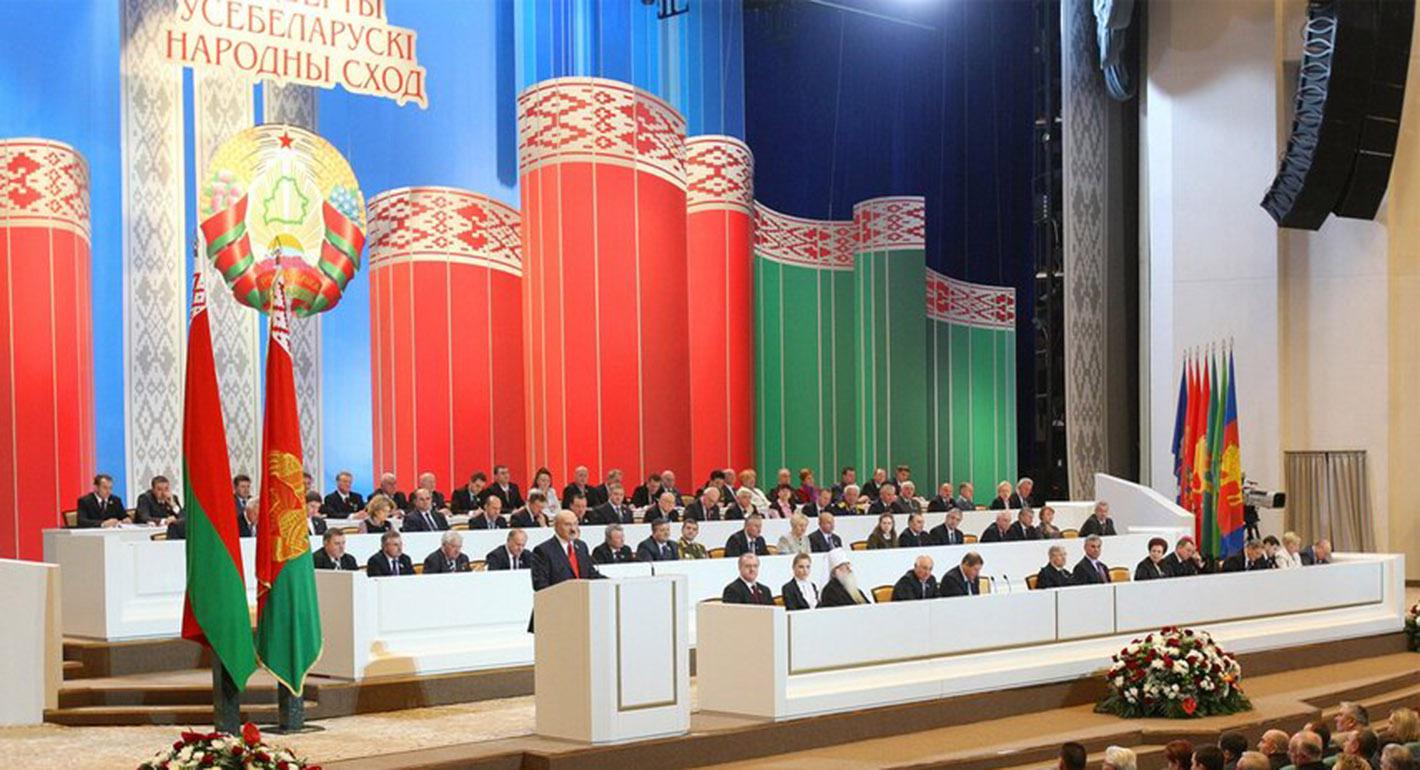
Immediately after the elections, Belarus will activate a section of the constitution added in 2022 that mandates the creation of an All-Belarusian People’s Assembly (ABPA). In total, about 1,200 people will be appointed by regional and national authorities to this pro-regime organ, which is supposed to represent “civil society,” local bureaucracy, and central government bodies.
In reality, it will be a cross between a Soviet plenum of the Communist Party’s Central Committee and China’s National People’s Congress. It will have authority over all branches of government, including the executive. It’s no secret that Lukashenko will be the chairman of the ABPA, as the constitution allows only the first president of Belarus (Lukashenko) to occupy both this post and the presidency until 2035.
No one is hiding the point of the new body: to prepare the system for Lukashenko stepping down as president. The ABPA will be able to introduce martial law, initiate an impeachment, cancel the results of presidential elections, nullify all government decisions (apart from those made by the courts), and sign off on all major political appointments.
The ABPA’s fifteen-person presidium will become a sort of equivalent of the Soviet Union’s Politburo. While Lukashenko is alive, its influence will be limited. But its makeup will be closely studied—like the Politburo’s—as a guide to whose political star is on the rise, and whose is waning.
At the end of the day, it’s likely to be someone from Lukashenko’s inner circle who becomes the next leader of Belarus. Given the regional instability and the advanced age of both Lukashenko and his Russian sponsor, President Vladimir Putin, there are any number of possible triggers for change. Just the appearance of a body like the ABPA will legitimize conversations within the ruling elite about the succession. This means the word “afterward” will be on the lips of even those who prefer not to think about such things.

Nonresident Scholar, Carnegie Russia Eurasia Center
Artyom Shraibman is a nonresident scholar at the Carnegie Russia Eurasia Center.
Recent Work
Artyom Shraibman
Artyom Shraibman
Carnegie does not take institutional positions on public policy issues; the views represented herein are those of the author(s) and do not necessarily reflect the views of Carnegie, its staff, or its trustees.

For every ruble allocated to social policy, health, and education in 2027, double that amount is earmarked for the army, the police, and the security services.

Alexandra Prokopenko

Trump has promised Belarus a massive potash deal. But Minsk is seeking something greater: restored Western transit and greater room for maneuver from Russia.

Balázs Jarábik

Minsk clearly expected the dialogue with Washington to yield more results, in particular the lifting of EU sanctions and permission to export potash.
Artyom Shraibman

If the Russian-speaking community in Latvia cannot articulate their interests without being seen as disloyal, they could end up embracing a pro-Kremlin agenda.

Sergejs Potapkins

Depleted financial reserves and a shrinking tax base mean it is no longer possible to simultaneously deliver high defense spending, price stability, and economic growth.
Alexandra Prokopenko