

Commentary
Andrey Pertsev
{
  "authors": [
    "Andrey Pertsev"
  ],
  "type": "commentary",
  "blog": "Carnegie Politika",
  "centerAffiliationAll": "",
  "centers": [
    "Carnegie Endowment for International Peace",
    "Carnegie Russia Eurasia Center"
  ],
  "englishNewsletterAll": "",
  "nonEnglishNewsletterAll": "",
  "primaryCenter": "Carnegie Russia Eurasia Center",
  "programAffiliation": "",
  "programs": [],
  "projects": [],
  "regions": [
    "Russia"
  ],
  "topics": [
    "Political Reform",
    "Domestic Politics"
  ]
}
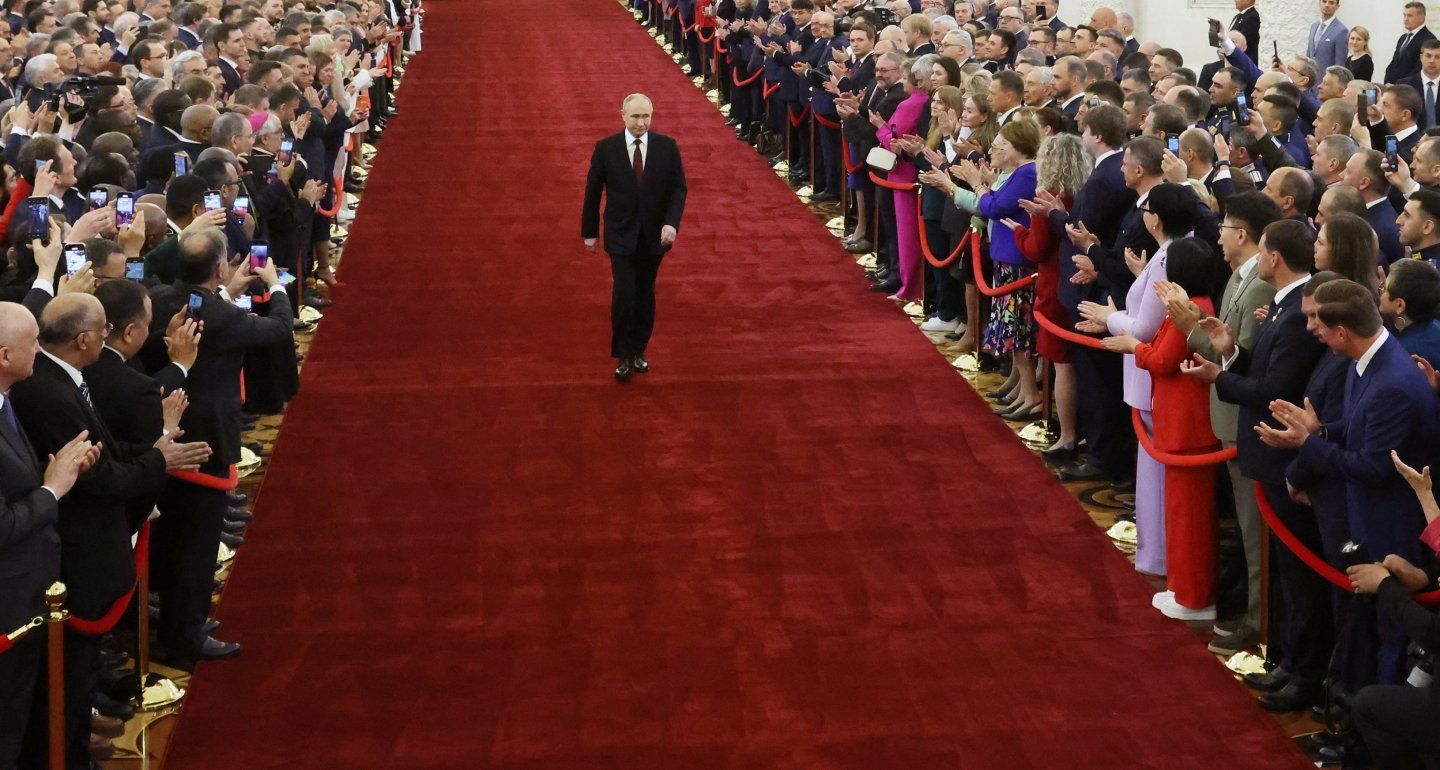
Source: Getty
In Russia’s increasingly monarchical regime, the president surrounds himself with blood relatives, the heirs to influential clans, and those who relay good news.
The makeup of Russian President Vladimir Putin’s inner circle is in constant flux. Where it was once an agglomeration of bureaucrats, bodyguards, and businessmen, in recent years it has come to resemble nothing less than a royal court.
The transformation began in 2008, when Putin went from being president to prime minister to get around a two-term limit: although he stopped being president for four years, he remained the country’s informal leader. Some of the first signs of the emergence of a court-like setup were when those responsible for the president’s personal comfort—bureaucrats looking after Putin on a day-to-day basis, his bodyguards, and businessmen paying for out-of-town residences—began to get prominent roles.
With time, this informal court began to bleed into the apparatus of state management. In 2016, Putin’s head protocol officer Anton Vaino was made chief of staff (a position he holds to this day). Former Putin bodyguards have also risen to high posts: for example, Alexei Dyumin and Dmitry Mironov are Kremlin aides, and Alexander Kurenkov is the emergencies minister.
Putin’s advisers have also become key figures. His former economic adviser Andrei Belousov was made deputy prime minister, then defense minister, while another economic adviser, Maxim Oreshkin, is currently deputy chief of staff.
Sergei Kiriyenko, the Kremlin’s influential deputy chief of staff in charge of domestic policy, is one of the most important figures at Putin’s court. He not only organizes endless events for the president to attend, but also coordinates the elections that reassure Putin he’s supported by the masses. On the one hand, of course, this is all a Potemkin village; on the other, Kiriyenko has created an expanded court that operates as an interface for the president to meet lower-level functionaries.
In addition to the Leaders of Russia staffing competition and training programs for governors and mayors, Kiriyenko has established a whole mini-empire of forums, festivals, and exhibitions. Since the full-scale invasion of Ukraine in 2022, he’s also included current and former soldiers: there are now special veteran staffing competitions, and regular awards ceremonies. These sorts of events are the modern equivalent of jousting tournaments and balls, and they’re an opportunity for Kiriyenko to put Russia’s “new aristocracy” on display.
In this way, Kiriyenko has become nothing less than the marshal of Putin’s expanded court. At youth festivals, handpicked young people interact with members of the government and Kremlin officials; at military awards ceremonies, top security officers meet civilian officials. Arranging these sorts of events allows Kiriyenko to build horizontal ties and boost his informal power.
At the same time, favoritism is becoming more and more pronounced in Putin’s inner circle—something typical for a royal court. Putin has his favorite officials with whom he meets regularly and on whom he lavishes praise.
These men include deputy prime minister Marat Khusnullin, Kiriyenko, Oreshkin, and Belousov. Putin gave Belousov the defense ministry portfolio even though Belousov had no experience in the army or military-industrial complex; Oreshkin feeds the president optimistic economic forecasts; and Khusnullin passes on endless good news about infrastructure projects. Putin is even trying to accelerate the career of his former bodyguard, Dyumin. Such favoritism is a significant departure from the Putin of the mid-2000s, who would not have permitted himself to mete out such preferential treatment.
Influential individuals and clans are also trying to embed their own heirs or “princes” in Russia’s power vertical—a practice commonplace in monarchical systems. The son of the former head of the Security Council, for example, is currently deputy prime minister, and the head of state defense conglomerate Rostec, Sergei Chemezov, has several “princes” he’s seeking to advance, including Deputy Prime Minister Denis Manturov and Trade and Industry Minister Anton Alikhanov.
The heads of clans strive to show off their “princes” to Putin in the best possible light. And even heirs who do not (yet) have posts are included in court circles. Noticeably, this year’s St. Petersburg International Economic Forum saw appearances from Alexander Vaino, the son of Putin’s chief of staff; Ksenia Shoigu, daughter of the current Security Council head Sergei Shoigu; and Roman Rotenberg, son of the influential Boris Rotenberg. These “princes and princesses” may not hold influential positions, but the rules of court mean that they need to be “presented” at major ceremonial events.
Perhaps most significantly, Russia’s modern court has also seen the rise of those related to Putin. Sergei Tsivilev, the husband of Putin’s niece Anna Tsivileva, was made energy minister in May 2024, and there were rumors he was even in the running to be prime minister. At the same time, Anna Tsivileva was made deputy defense minister.
The increasingly monarchical setup has even drawn in business leaders and Russia’s bureaucrats, who have been obliged to take part in order to stay relevant. Top bureaucrats and executives join court events so as to be noticed by Putin.
For the moment, Putin’s favorites are more or less competent when it comes to administration and management. But inevitably, their ranks will begin to include those who are only good at sycophancy. Putin’s jokes—which must be greeted with laughter and applause—are already noticeably overused at ceremonial events. Largely meaningless forums, festivals, and exhibitions have long overshadowed events with real agendas. But these ceremonies, and the codes of behavior they embed, are now an integral part of the etiquette of Russia’s court.
Going forward, ambitious professionals will find it harder and harder to progress. The only new appointments in a full-fledged court will be Putin’s favorites. Heirs apparent will cling on to their positions and influence, while the aging president will embrace gerontocracy by retaining familiar faces. The logic of a court means that both formal and informal positions will gradually become nothing more than aristocratic titles.
Until now, Russia’s political system has largely been run by professionals who were promoted because of their expertise—not because they were adept at navigating a royal court. But that looks set to change. Inevitably, the process of aristocratization will result in a deterioration in the quality of management.

Andrey Pertsev is a journalist with Meduza website.
Recent Work
Andrey Pertsev
Andrey Pertsev
Carnegie does not take institutional positions on public policy issues; the views represented herein are those of the author(s) and do not necessarily reflect the views of Carnegie, its staff, or its trustees.
The truth of the strategic situation is that Europe and Russia are extremely unlikely to be able to “turn the page” on their confrontation within the next two decades.
Arkady Moshes

Russia spent years building a “sovereign internet,” concentrating web infrastructure exclusively within Russian territory. Ukrainian drone attacks have shown how vulnerable that approach has left the Russian internet.

Maria Kolomychenko

Putin’s conservative staffing policies and search for ever greater control have cemented parliament’s transformation into a bureaucratic appendage of the executive branch.
Andrey Pertsev

Russia’s AI-driven propaganda campaigns operate in a fragmented, chaotic, and often illogical manner. That’s not necessarily a problem for the Kremlin, though: It’s much easier to mimic genuine public debate that way.

Ilya Klishin

Russian strikes are weakening the economy sustaining Ukraine’s war effort. Closing the growing funding gap will require more European support and politically contentious reforms in Kyiv.

Balázs Jarábik