

Book
Dimitar Bechev
{
  "authors": [
    "Dimitar Bechev"
  ],
  "type": "commentary",
  "blog": "Carnegie Politika",
  "centerAffiliationAll": "",
  "centers": [
    "Carnegie Endowment for International Peace",
    "Carnegie Russia Eurasia Center"
  ],
  "englishNewsletterAll": "",
  "nonEnglishNewsletterAll": "",
  "primaryCenter": "Carnegie Russia Eurasia Center",
  "programAffiliation": "",
  "programs": [],
  "projects": [],
  "regions": [
    "Russia",
    "Türkiye",
    "Middle East",
    "Syria"
  ],
  "topics": [
    "Foreign Policy",
    "Security",
    "Global Governance"
  ]
}
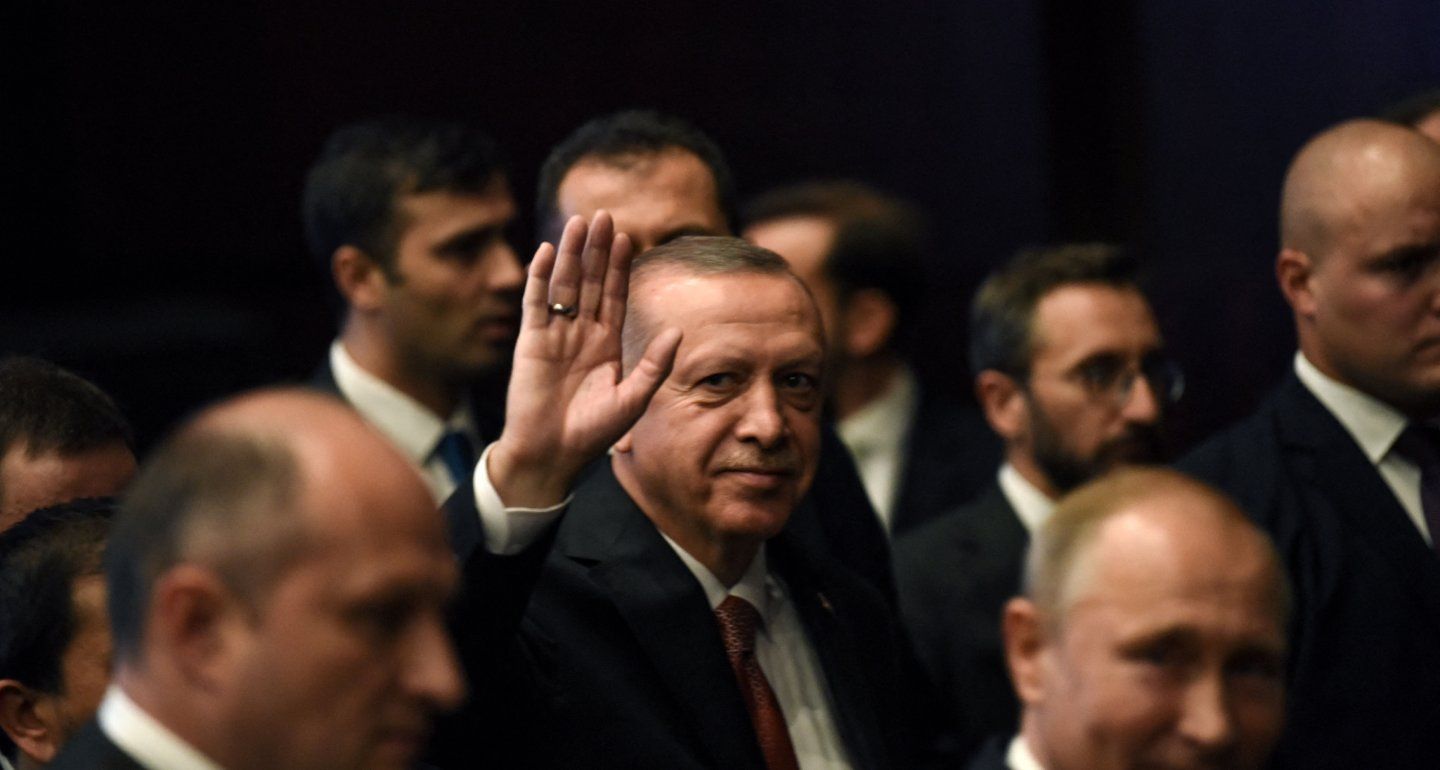
Source: Bulent Kilic / AFP via Getty Images
With the fall of Syria’s Moscow-supported regime, a large chunk of Russia’s leverage over Türkiye is gone. But Erdoğan will not take the risk of challenging Russia. Rather, he will continue acting as an intermediary between Putin and the West.
Russia has reportedly asked Türkiye for assistance in withdrawing its troops from Syria. Mere weeks ago, such a headline would have been hard to imagine. Yet in the wake of the jaw-dropping collapse of Bashar al-Assad’s regime, the report by CNN Türk has a credible ring to it. Russian troops stationed in various parts of Syria, such as the central desert and the Kurdish-populated northeast, appear to have returned to Russia’s military bases in Latakia province, and according to GUR, Ukraine’s military intelligence, Russia has been airlifting military personnel and equipment back home.
The fate of those bases—Russia’s Khmeimim airfield and naval facility at Tartus—is a matter of speculation. The Russians may well have no choice but to abandon them, unless they are able to secure a deal with Hayat Tahrir al-Sham (HTS) allowing them to stay on. Russian media have overnight rebranded the Islamist militia that toppled Assad from “terrorists” to “armed Syrian opposition.”
Whatever scenario materializes, one thing is beyond doubt. The power dynamic between Russia and Türkiye has shifted. Now Ankara clearly has the upper hand.
This is a sharp turnaround from the previous state of affairs. When Russia intervened in Syria together with Iran and Hezbollah, they thwarted Türkiye’s ambitions to orchestrate regime change in Damascus.
The Syrian deployment was just one part of the puzzle, as Russian President Vladimir Putin piled geopolitical pressure on his Turkish counterpart, Recep Tayyip Erdoğan. After the Turkish air force shot down a Russian Su-24 ground attack jet in November 2015, Russia imposed economic sanctions against Türkiye, thereby further tightening the screws. At the same time, Russia built up its presence in Armenia—a country hostile to Türkiye—and the militarization of annexed Crimea, described by Putin as an “unsinkable aircraft carrier” just across the Black Sea from Türkiye, continued apace.
Erdoğan and Turkish policymakers more broadly were jittery. They felt vulnerable with regard to Russia, yet did not trust the West either. The U.S. partnership with the Syrian Kurds affiliated with the Kurdistan Workers’ Party (PKK), outlawed in Türkiye and the EU (and the United States too), was—and still is—a particularly acute irritant.
For that reason, Erdoğan reconciled himself with Assad’s survival in power, along with Russia’s entrenchment south of Türkiye’s border. In return, Türkiye obtained a buffer zone in Syria and a seat—alongside the Russians and Iranians—in the Astana process aimed at resolving the conflict in Syria.
Occasionally the deal was tested, such as during the 2019–2020 regime onslaught against Idlib province, the most significant pocket of land the anti-Assad forces controlled at that point. A Turkish intervention headed off the offensive, which had been backed by Russian troops.
Overall, however, the equilibrium between Moscow and Ankara proved stable. Both parties learned to coexist on the ground and even do each other favors. As recently as this summer, Putin was calling on Assad to engage with Erdoğan at a time when the Turkish president was keen to strike a deal with Damascus on repatriating at least some of the 3.9 million Syrian refugees in Türkiye.
Now that Russia has largely lost Syria, a large chunk of its leverage over Türkiye is gone too. Ankara’s interlocutor is no longer Assad but HTS, with which it has a history of cooperation. Instead of Putin, Erdoğan must talk to Donald Trump—because of the U.S. sponsorship of the Kurdish-dominated Syrian Democratic Forces (SDF) that controls much of northeastern Syria—as well as to the Gulf countries and possibly the EU, which will be supporting the country’s reconstruction.
Russia’s stock vis-a-vis Türkiye is down on other flanks too. The Ukrainian military has driven the Russian Black Sea fleet out of Crimea to the port of Novorossiysk, meaning Ankara now has less reason to fear the sea turning into a “Russian lake”—a phrase Erdoğan himself used in 2016 at a NATO meeting.
Moscow’s relations with Armenia, meanwhile, are in crisis as a result of Azerbaijan’s success in the Karabakh war. Yerevan has frozen its participation in the Moscow-led Collective Security Treaty Organization (CSTO) and looked to the West for defense contracts, a reflection of its disappointment with Russia’s failure to protect its ally. The Armenian government has started talks on normalizing relations with Türkiye in parallel with the negotiations on a peace deal with Azerbaijan. Though no breakthrough is yet in sight, Ankara appears to be making gains in the South Caucasus—at Russia’s expense.
Türkiye is often seen as dependent on Russian energy supplies and therefore susceptible to strongarm tactics. Now that might be changing too. With Gazprom’s transit contract with Ukraine’s Naftogaz expiring on January 1, TurkStream will be the only pipeline export route from Russia to the rest of Europe.
Türkiye will use its role as a conduit to extract better terms from the Russian side, including the ability to buy extra volumes of Russian gas to reexport (and mark up) as its own: a crucial part of the conversation around establishing a “gas hub” on Turkish soil.
With Syria out of the picture, Russian-Turkish relations will pivot back to their natural geographic fulcrum: the Black Sea region. Erdoğan’s choice will not be to take a risk and challenge Russia. Rather, he will continue to act as an intermediary between Putin and the West. Prospective negotiations on Ukraine spearheaded by Trump could be a golden opportunity.
Erdoğan may even remind the Kremlin of the lessons of Assad’s hubris: that by shunning Türkiye, the former strongman sealed his own fate, and that a political deal is better than an open-ended conflict.

Senior Fellow, Carnegie Europe
Dimitar Bechev is a senior fellow at Carnegie Europe, where he focuses on EU enlargement, the Western Balkans, and Eastern Europe.
Recent Work
Dimitar Bechev
Carnegie does not take institutional positions on public policy issues; the views represented herein are those of the author(s) and do not necessarily reflect the views of Carnegie, its staff, or its trustees.

Russian strikes are weakening the economy sustaining Ukraine’s war effort. Closing the growing funding gap will require more European support and politically contentious reforms in Kyiv.

Balázs Jarábik

Despite a new textbook, an influx of Russian teachers and managers, and an end to the teaching of Ukrainian, the Kremlin is unlikely to have “reprogrammed” locals.

Konstantin Skorkin

For every ruble allocated to social policy, health, and education in 2027, double that amount is earmarked for the army, the police, and the security services.

Alexandra Prokopenko

Cargo traffic through Russia’s Northern Sea Route has increased because of the disruption caused by the conflict in the Middle East, the Ukraine war, and U.S.-China tensions.

Mikhail Korostikov
An analysis of traffic accident data suggests that Ukrainian drone attacks caused a material but not disastrous fall in Russian gasoline consumption over the summer.

Sergey Vakulenko