

Commentary
Artyom Shraibman
{
  "authors": [
    "Artyom Shraibman"
  ],
  "type": "commentary",
  "blog": "Carnegie Politika",
  "centerAffiliationAll": "",
  "centers": [
    "Carnegie Endowment for International Peace",
    "Carnegie Russia Eurasia Center"
  ],
  "collections": [
    "Politika: The Best of 2025"
  ],
  "englishNewsletterAll": "",
  "nonEnglishNewsletterAll": "",
  "primaryCenter": "Carnegie Russia Eurasia Center",
  "programAffiliation": "",
  "programs": [],
  "projects": [],
  "regions": [
    "Belarus",
    "United States",
    "Ukraine",
    "Russia"
  ],
  "topics": [
    "Foreign Policy",
    "Global Governance",
    "Civil Society",
    "Security"
  ]
}
Source: Getty
Lukashenko is using the same approach in his dealings with Trump that has long proven successful with Putin.
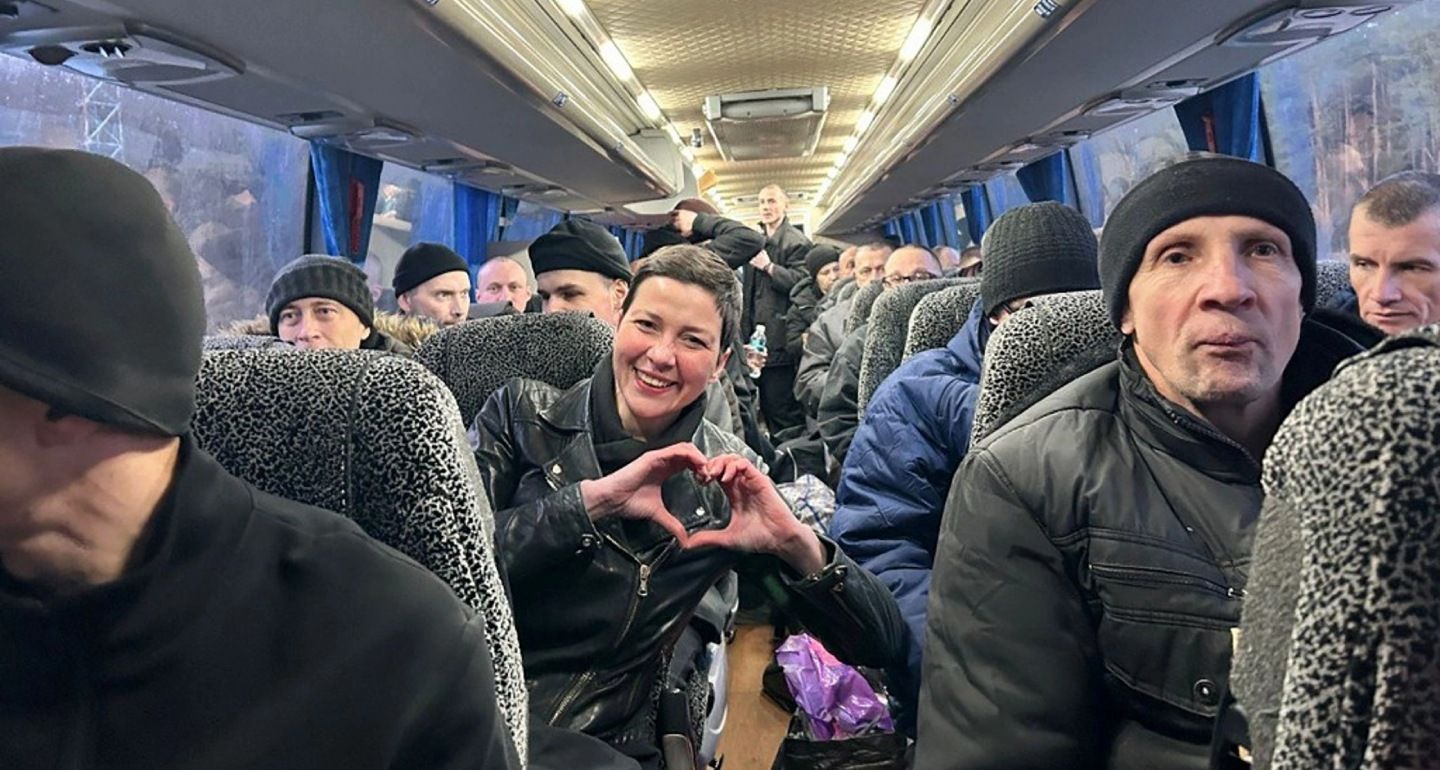
Following negotiations with the United States, contested Belarusian leader Alexander Lukashenko released another group of political prisoners on December 13. A total of 123 people were released from prison and immediately deported, including the leaders of the 2020 protests against Lukashenko—presidential candidate Viktar Babaryka and the face of his campaign, Maria Kalesnikava—as well as Nobel Peace Prize laureate and human rights activist Ales Bialiatski and Maryna Zolatava, editor-in-chief of the once leading Belarusian media outlet Tut.by.
In exchange, Washington lifted sanctions on the producer of Belarus’s main export—potash fertilizer—and has promised to lift the remaining U.S. sanctions against Belarus if Minsk makes further concessions.
The dialogue with Minsk isn’t the main focus of Washington’s Eastern Europe policy, but the stakes aren’t as high as they are over the Russia–Ukraine war, so there’s no particular hurry, and the U.S. side has delegated the actual diplomacy to professionals. All Donald Trump is required to do is periodically pat Lukashenko on the shoulder via the U.S. president’s social media posts, sign whatever his aides put on his desk when they talk to Minsk, and bask in the glory of becoming the first Western leader to have secured the release of several hundred Belarusian political prisoners.
In early November, Trump appointed his former lawyer, John Coale, as special envoy for Belarus. The U.S. president only has about a dozen such special envoys, so Belarus’s inclusion on this list is a significant step in institutionalizing dialogue between the two countries.
The U.S. readiness to make concessions on Belarusian potash exports meant that Minsk would have to offer up something really substantial, and the release of nearly all of Belarus’s internationally renowned political prisoners—another presidential candidate, Siarhei Tsikhanouski, in the summer, and now Bialiatski, Babaryka, and Kalesnikava—shows that Minsk, too, is ready to play its aces. Lukashenko sees Trump’s policies as a rare opportunity to end what had looked set to be lifelong isolation.
The December exchange of concessions between Minsk and Washington raises two unanswered questions. The first is how the Belarusian opposition will reform itself—as it now must. For the last five years, the universally recognized leader in exile has been Sviatlana Tsikhanouskaya, who stepped into her husband Siarhei’s shoes and ran for president as a unified opposition candidate in 2020 when he and Babaryka were jailed in the middle of their own campaigns.
Since Tsikhanouski was released back in the summer, his blunt style and ambition have already led to several conflicts with his wife’s inner circle. Now the other leaders for whom Tsikhanouskaya stepped up as a placeholder in 2020 have been released, the structure of the opposition must inevitably become more polyphonic.
Just as they did in 2020, Babaryka and Kalesnikava are already taking more moderate positions than Tsikhanouskaya, calling on Europeans not to cling to their sanctions, but to join Trump’s diplomacy and negotiate with Lukashenko. At the same time, the personal capital in the West that Tsikhanouskaya has amassed over the past five years is not easy to pass on to someone else, even if she wanted to do so.
The second question is how the logistics of potash exports will be resolved. The lifting of U.S. sanctions simplifies transactions for previously risk-averse buyers such as India, Brazil, and other non-Western countries. But without a transit corridor to a nearby port, Belarusian potash exports remain economically unviable: there is a corridor to Russia’s northern ports, but the distances involved mean it is too expensive to transport the potash to them by rail.
It’s unlikely, therefore, that Lukashenko released the country’s main political prisoners in exchange for the promised lifting of U.S. sanctions on potash alone. Minsk appears to be expecting Washington to help with export logistics, too.
Until 2021, Belarusian potash was sold through the Lithuanian port of Klaipeda. But Belarus’s relations with its neighbor are in crisis: a steady flow of helium balloons carrying contraband cigarettes entering Lithuanian airspace from Belarus has forced Vilnius airport to close repeatedly. When Lithuania responded by closing its border, Lukashenko left over a thousand Lithuanian trucks stranded in Belarus. And when Vilnius reopened the border, Minsk refused to make concessions, instead demanding high-level political contacts.
As a result, Lithuania is not only unwilling to open its border to Belarusian potash, it is actively lobbying for new EU sanctions. There are admittedly proposals in Vilnius that it should agree to the transit of Belarusian potash on condition that U.S. troops are stationed in Lithuania, but that doesn’t yet appear to be a mainstream idea.
Among the possible options for circumventing the remaining EU sanctions, one scenario sometimes floated involves U.S. companies purchasing potash within Belarus and then exporting it as their own. But it’s not clear whether such a scheme would be in keeping with the letter and spirit of EU sanctions.
A theoretical alternative to Klaipeda could be the Polish port of Gdansk, but Lukashenko appears to be in no hurry to curry favor with Warsaw. Poland unilaterally opened two border crossings with Belarus in November, and naturally expected reciprocal steps. However, the political prisoners whose release is most sought by Warsaw—the journalist Andrzej Poczobut and Polish monk Grzegorz Havel—were not among those freed in the latest release, despite high expectations.
Finally, one of the most far-fetched yet increasingly discussed routes is via the Ukrainian port of Odesa. It’s hard to imagine this route being used before a ceasefire is agreed: Ukraine considers Lukashenko complicit in Russia’s invasion, since the Belarusian leader allowed Russian troops to enter Ukraine via Belarusian territory. But that is precisely what could make it a tempting option for the United States.
The economic entanglement of former enemies after the war, especially for the purposes of exporting cheap fertilizer to U.S. farmers, fits perfectly with Trump’s approach to the region. To top things off, it woudn’t require any coordination with the EU, making it a triumph of realpolitik and Trump’s “art of the deal.”
Minsk is not just looking to reprise its former role in the region; it wants to expand the horizon of its ambitions. In the latest deportation of political prisoners, only the Nobel laureate Bialiatski and eight foreign nationals were sent along the usual route to Vilnius. The rest were transferred to Ukraine in an unexpected turn of events for Lithuania and the Belarusian opposition, who had prepared to receive the released prisoners in Vilnius as usual.
There are two apparent motives for this change. The first is to exclude Lithuania and the Belarusian opposition-in-exile from the proceedings, thereby demonstrating that Minsk is more comfortable negotiating with pragmatic countries like the United States and Ukraine.
The second is a blatant attempt by Minsk to insert itself into the Russia–Ukraine peace process. Lukashenko’s press secretary, Natalya Eismont, said the operation was part of an exchange for Belarusian prisoners of war who had fought for Russia, and for “wounded Russians.”
By framing his negotiations with the United States within the context of the Russia–Ukraine talks, Lukashenko is demonstrating his full support for Washington’s peace initiatives and his willingness to contribute as much as possible to them. Lukashenko also began his meeting with Coale on December 12 by praising Trump’s latest efforts to end the war and expressing his support for them.
His message is that while Kyiv and Moscow are dragging their feet and finding fault with Washington’s ideas, Minsk is unequivocally on the U.S. side. Knowing how Trump values loyalty—especially from unexpected partners—Minsk is trying to score points as best it can.
Moreover, Lukashenko isn’t just limiting himself to his region. In recent weeks, Minsk has apparently been offering itself as a possible place of refuge for Venezuelan leader Nicolás Maduro, whom Trump wants to see ousted. The Venezuelan ambassador to Russia visited Lukashenko on November 25 and December 11. Then, following the U.S. delegation’s visit on December 12, Lukashenko gave an interview to Coale’s wife, Greta Van Susteren, a journalist for the pro-Trump channel Newsmax, in which he openly stated his readiness to host Maduro in Minsk.
Minsk’s diplomatic blitzkrieg on the U.S. front may appear wildly ambitious, but in fact, Lukashenko is simply using the same approach in his dealings with Trump that has long proven successful with Putin. That consists of identifying the senior partner’s soft spots and then massaging them with flattery, demonstrative loyalty, and unexpected offers of crisis management services.
In Putin’s case, that meant Belarus offering to take in the Russian mercenary leader Yevgeny Prigozhin after his failed mutiny. In Trump’s case, it means offering to take in Maduro. Putin got decades of integration and fraternal rhetoric from Lukashenko; Trump may well get the credit for having rescued hundreds of hostages in support for his Nobel Peace Prize bid. One wants support for the war, another wants support for negotiations to end it. Even if some ideas are not ultimately needed, the enthusiasm and desire to be helpful will not be forgotten.

Nonresident Scholar, Carnegie Russia Eurasia Center
Artyom Shraibman is a nonresident scholar at the Carnegie Russia Eurasia Center.
Recent Work
Artyom Shraibman
Artyom Shraibman
Carnegie does not take institutional positions on public policy issues; the views represented herein are those of the author(s) and do not necessarily reflect the views of Carnegie, its staff, or its trustees.

Trump has promised Belarus a massive potash deal. But Minsk is seeking something greater: restored Western transit and greater room for maneuver from Russia.

Balázs Jarábik

The European far right might fail to steer EU policy in the direction Russia wants, but they will create enough chaos inside Europe to benefit the Kremlin.

Dimitar Bechev

Minsk clearly expected the dialogue with Washington to yield more results, in particular the lifting of EU sanctions and permission to export potash.
Artyom Shraibman

If the Russian-speaking community in Latvia cannot articulate their interests without being seen as disloyal, they could end up embracing a pro-Kremlin agenda.

Sergejs Potapkins

Russia’s ruling party would have benefited from Putin appearing as its distant patron, but as an active frontman imposing his views on the public, he has done nothing but harm both the party’s election campaign and the ruling system overall.

Andrey Pertsev