

Commentary
Vladislav Gorin
{
  "authors": [
    "Vladislav Gorin"
  ],
  "type": "commentary",
  "blog": "Carnegie Politika",
  "centerAffiliationAll": "",
  "centers": [
    "Carnegie Endowment for International Peace",
    "Carnegie Russia Eurasia Center"
  ],
  "collections": [
    "Politika: The Best of 2025"
  ],
  "englishNewsletterAll": "",
  "nonEnglishNewsletterAll": "",
  "primaryCenter": "Carnegie Russia Eurasia Center",
  "programAffiliation": "",
  "programs": [],
  "projects": [],
  "regions": [
    "Russia",
    "Ukraine",
    "United States"
  ],
  "topics": [
    "Civil Society",
    "Domestic Politics",
    "Foreign Policy"
  ]
}
Source: Getty
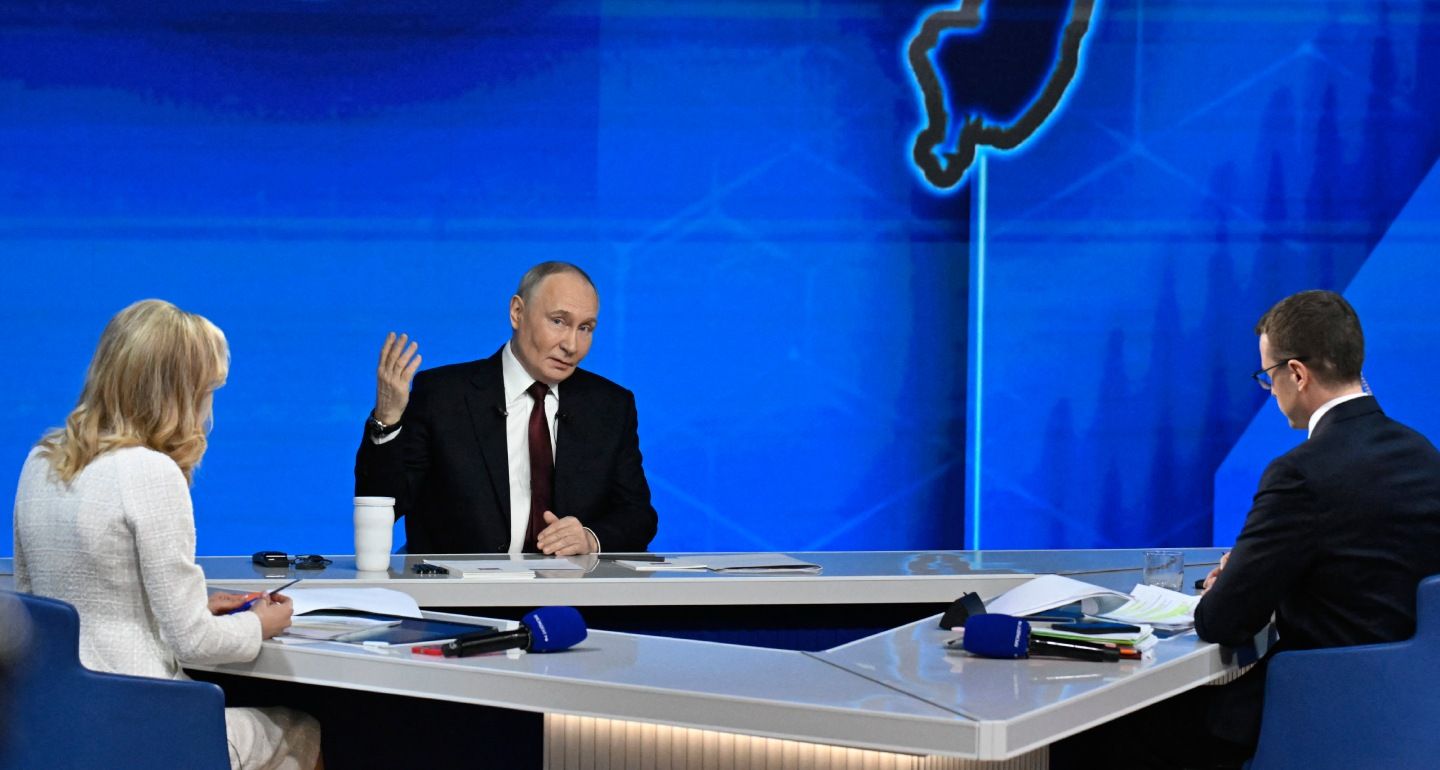
Putin used his annual Q&A to make it perfectly clear: he will not agree to an end to the war until he at least gets control of the entire Donbas.
Russian President Vladimir Putin’s annual end-of-year press conference has long been a way for him to demonstrate to the Russian public that he remains fully in control of the country. This year, however, the target audience clearly included U.S. President Donald Trump.
Putin has used nearly every public appearance in recent months to engage in a virtual dialogue with his U.S. counterpart and try to convince him of the strength of Russia’s position in its war with Ukraine. The lengthy end-of-year press conference, in which the president answers questions from both media organizations and the Russian public, was no exception.
This year’s Q&A lasted four and a half hours, which is not unusual for the event and serves the purpose of demonstrating to the Russian public that their president is fit and well and capable of answering questions coherently for hours on end. As usual, Putin peppered his answers with figures, sudden bursts of sentimentality, and salty language, and this year’s overall message was unchanged: Russian soldiers are fighting bravely and Russia is winning in Ukraine.
He also mentioned, of course, that the Russian economy is growing and the budget is balanced, and took the opportunity to say that if the EU goes ahead with tentative plans to appropriate Russian state assets currently frozen in Europe, Moscow will take action, including in the form of international lawsuits.
No one raised any issues that were even remotely uncomfortable for Putin, with the exception of the U.S. news organization NBC (which questioned the president’s willingness to end the war) and the U.K.’s BBC (which brought up the persecution of dissenters and the authoritarian nature of the government in Russia).
Putin devoted a special place to the war in Ukraine in his event. At the very beginning of it, he introduced Naran Ochir-Goryayev, a senior lieutenant in the Russian army and commander of an assault company fighting for the area around the cities of Slavyansk and Kramatorsk: the last large part of the Donbas still under Ukrainian control. Judging by the draft peace agreement, this is the territory whose surrender Russia is demanding in order to end the fighting.
When discussing the war, Putin appealed to Ochir-Goryayev for his input several times when discussing the war (as well as, somewhat unexpectedly, children: the senior lieutenant apparently has four). Without the inclusion of this foil for Putin, there would have been little new in the statements made about the war.
The president said that Russian troops are advancing along the entire line of contact—“in some places faster than others,” and that there would be more “significant successes” for the Russian army before the end of the year. “Due to the active and effective operations of our troops, it seems the enemy has exhausted its strategic reserves … there are practically none left,” Putin said, adding that the Ukrainian army’s “desperate attempts to regain lost ground” were failing. All of this, Putin asserted, “should encourage the Ukrainian regime in Kyiv to resolve all disputes and end this conflict by peaceful means.”
Putin trotted out once again his well-worn formulas about Russia’s intention to regain its “historical lands” and its desire to conclude a long-term peace, meaning that it will only sign a peace agreement if the “root causes” of the conflict are eliminated.
Putin has said the same thing about developments at the front and the prospects for ending the conflict on numerous occasions, most recently during his increasingly frequent public meetings with military personnel.
This spike in the regularity of meetings with the military is clearly linked to the talks over a peace agreement with Ukraine, which have recently reached an intensity not seen since the beginning of the war. Unable to meet with the American side as frequently as the European and Ukrainian leaders do, Putin is attempting to compensate by repeating his talking points over and over again on camera. His goal is to convince Trump, who is accelerating the negotiation process and putting pressure on both sides in the conflict, that Russia has an incomparably stronger position than Ukraine.
Time and time again in his speeches, Putin expresses the same idea: Russia will in any case win on the battlefield and is capable of achieving its goals by force, but is also prepared to compromise for humanitarian reasons and out of respect for Trump personally, while Ukraine is the party that is putting obstacles in the way of peace.
The extent of compromise acceptable to Putin can be gauged by his references to his August meeting with the U.S. president in Alaska. The Russian leader presents that summit as a near-idyllic moment of mutual agreement between Moscow and Washington, although in reality it clearly didn’t go as planned, ended more quickly than expected, and didn’t lead to the progress the Americans had anticipated.
Judging by media leaks, the only concessions Putin was willing to make were to limit his territorial claims against Ukraine to the Donbas and the Azov coast—already controlled by Russian troops—and to renounce his claims to the uncaptured parts of the Kherson and Zaporizhzhia regions, despite having already declared them to be within Russia’s borders. He also agreed to exchange the small areas of the Kharkiv and Sumy oblasts captured by the Russian army for much larger parts of the Donbas that Russia has been unable to capture.
As the recent discussion of the peace plan demonstrated, for Ukraine and its president Volodymyr Zelensky, the demand that it simply abandons the fight for part of its territory remains unacceptable. In the version of the document revised with European participation, that issue has effectively been removed. But in his lengthy press conference, Putin made it perfectly clear: he will not agree to an end to the war until he at least gets control of the entire Donbas.
Journalist, host of "What Happened?" podcast from Russian independent media Meduza
Recent Work
Vladislav Gorin
Vladislav Gorin
Carnegie does not take institutional positions on public policy issues; the views represented herein are those of the author(s) and do not necessarily reflect the views of Carnegie, its staff, or its trustees.

Cargo traffic through Russia’s Northern Sea Route has increased because of the disruption caused by the conflict in the Middle East, the Ukraine war, and U.S.-China tensions.

Mikhail Korostikov
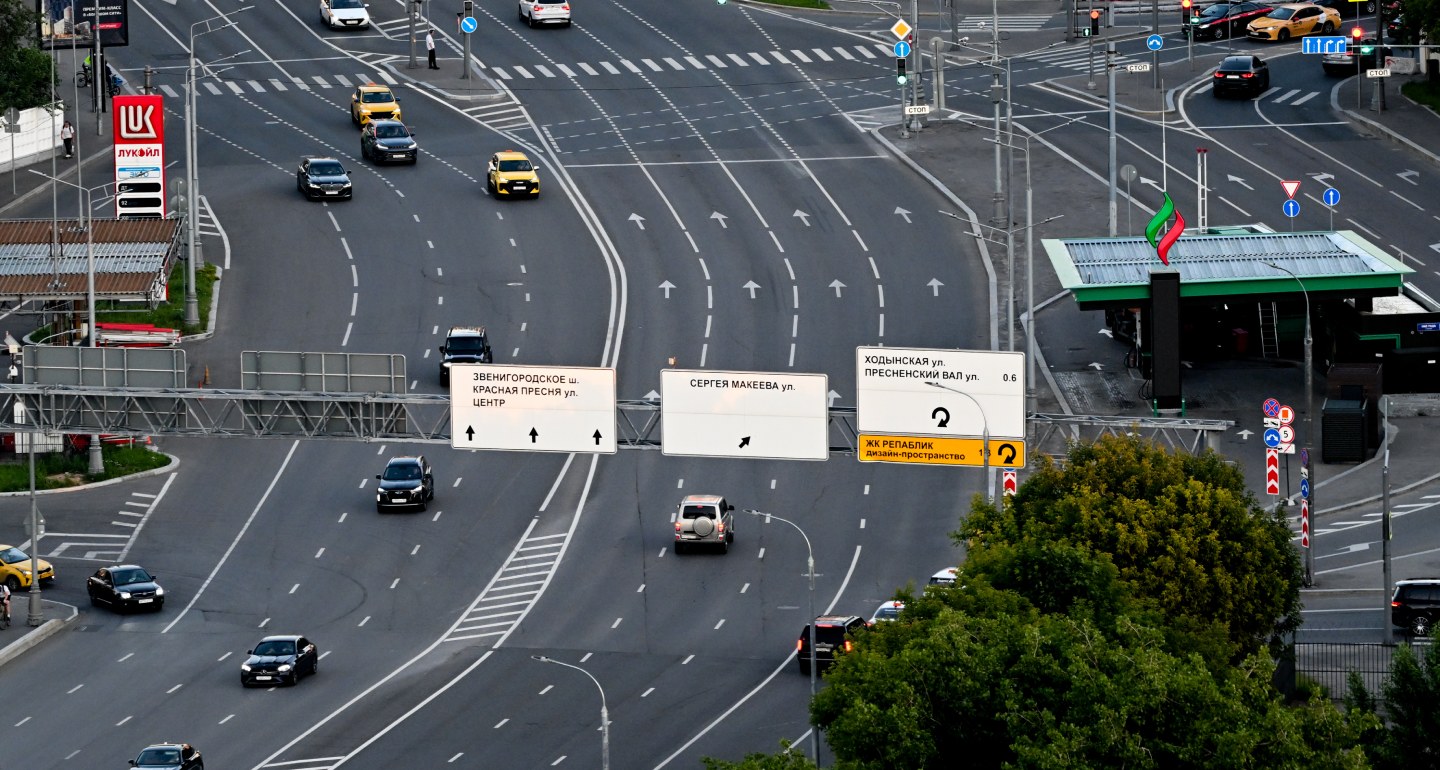
An analysis of traffic accident data suggests that Ukrainian drone attacks caused a material but not disastrous fall in Russian gasoline consumption over the summer.

Sergey Vakulenko

Sergei Kiriyenko used Russia’s parliamentary vote to further hone his strategy of corporate mobilization that is designed to maximize votes for United Russia.

Andrey Pertsev

Trump has promised Belarus a massive potash deal. But Minsk is seeking something greater: restored Western transit and greater room for maneuver from Russia.

Balázs Jarábik

The European far right might fail to steer EU policy in the direction Russia wants, but they will create enough chaos inside Europe to benefit the Kremlin.

Dimitar Bechev