

Commentary
Konstantin Skorkin
{
  "authors": [
    "Konstantin Skorkin"
  ],
  "type": "commentary",
  "blog": "Carnegie Politika",
  "centerAffiliationAll": "",
  "centers": [
    "Carnegie Endowment for International Peace",
    "Carnegie Russia Eurasia Center"
  ],
  "englishNewsletterAll": "",
  "nonEnglishNewsletterAll": "",
  "primaryCenter": "Carnegie Russia Eurasia Center",
  "programAffiliation": "",
  "programs": [],
  "projects": [],
  "regions": [
    "Ukraine"
  ],
  "topics": [
    "Domestic Politics",
    "Political Reform",
    "Civil Society"
  ]
}
Source: Getty
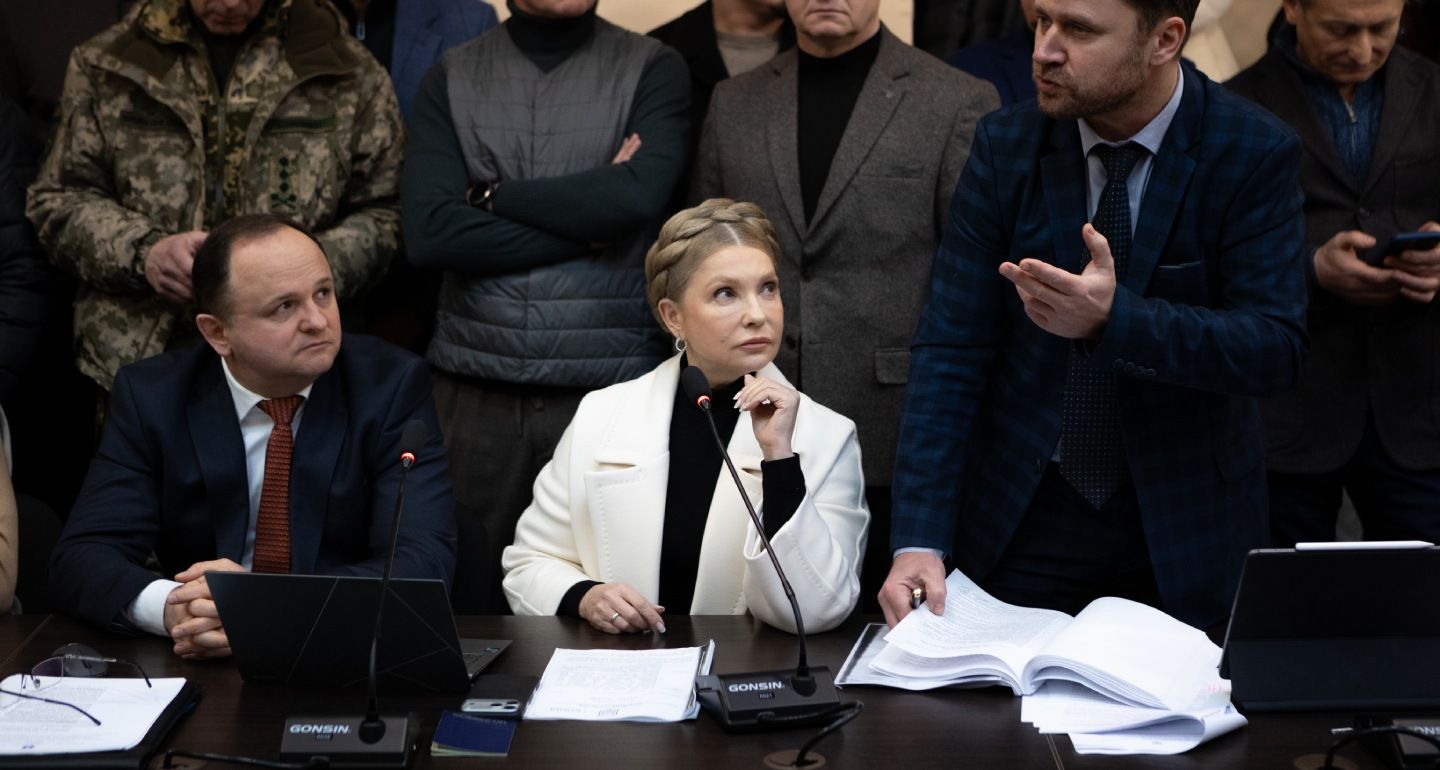
The story of a has-been politician apparently caught red-handed is intersecting with the larger forces at work in the Ukrainian parliament.
The veteran Ukrainian politician Yulia Tymoshenko appeared to have retired from the fray once and for all, spending her final years on the fringes of key events. But unexpected accusations against her of bribing parliamentary deputies have propelled her to the heart of the country’s political life once again.
The Tymoshenko scandal reflects the fact that the center of Ukrainian politics is once again shifting to parliament. The fight for parliamentary deputies’ votes is heating up again, and Ukraine’s domestic political crisis is entering a new phase, opening a window of opportunity for even half-forgotten politicians.
To detail Tymoshenko’s career would be to recap the political history of Ukraine’s first twenty-five years of independence. Very briefly, she was a prominent figure in the new world of Ukrainian business in the 1990s, dubbed the “gas princess.” She entered politics through her connections to then prime minister and now convicted criminal Pavlo Lazarenko, becoming an equally prominent representative of the opposition to then president Leonid Kuchma. She was first imprisoned in 2001, serving forty days in a pretrial detention center.
In the mid-2000s, Tymoshenko became one of the icons of the Orange Revolution, after which she reached the pinnacle of her career, twice serving as prime minister and running for president. After her opponent Viktor Yanukovych emerged victorious in the 2010 presidential election, Tymoshenko again became an opposition leader and also a victim of political persecution, spending more than two years in prison. Following the second Maidan revolution in 2014, she was triumphantly freed, but lost the presidential election again—this time to Petro Poroshenko.
After this, Tymoshenko’s political career waned, as she had become too closely associated with the past. The final nail in the coffin came with the 2019 presidential election: until that point, she had still been considered a viable alternative to Poroshenko, but then actor-turned-presidential hopeful Volodymyr Zelensky upended all the old elites’ plans.
Tymoshenko came third in that election (behind Zelensky and Poroshenko), and parliamentary elections held that same year resulted in a modest faction for her Batkivshchyna (Fatherland) party. Marginalized, she assumed the mantle of a socially conservative populist appealing to rural voters in agricultural regions.
With Russia’s full-scale invasion, Tymoshenko faded into the background, unable to find a place in the new patriotic consensus. She became critical of the government, condemning the new mobilization law and the restrictions on consular services for Ukrainians abroad. At the same time, she cultivated her image as a Ukrainian Trumpist: she fought against the legalization of cannabis, a “gender agenda,” and other apparent challenges to patriarchal Ukraine.
Tymoshenko occasionally found herself embroiled in minor political scandals, such as over her luxury vacation in Dubai at the height of the fighting. In the summer of 2025, she took part in a campaign to limit the powers of the independent anti-corruption agencies NABU and SAP, calling them instruments of “external control” and plans to curtail their authority an act of “decolonization.” That was all perfectly in keeping with her new image as a socially conservative anti-globalist.
Even after President Zelensky rolled back the attack on NABU, Tymoshenko’s faction stubbornly refused to vote in favor of restoring the agency’s powers. But Tymoshenko’s reaction came across as a case of sour grapes among the old elites, unhappy with real efforts to fight the corruption that had long plagued the country.
Tymoshenko’s supporters insist that the charges she is facing of bribing parliamentary deputies, as well as searches of her office, are NABU’s revenge for her role in the attack on anti-corruption institutions last summer. In reality, it’s more likely that she is simply the latest victim of a large-scale purge of the elites that began in Ukraine last fall with the publication of the Mindich tapes. Following the initial revelations and resignations—even the seemingly all-powerful head of the presidential administration, Andriy Yermak, was forced to step down—NABU is feeling increasingly confident.
Now anti-corruption investigators have turned their sights to parliamentary deputies. Several weeks ago, a group of corrupt parliamentary deputies was exposed. The group’s alleged leader, Zelensky’s friend Yuriy Kisel, and other members hail from Kryvyi Rih, the president’s hometown.
Now Tymoshenko’s turn has come. Given how deeply unpopular she is among many Ukrainians, the accusations of vote-buying don’t seem out of the question. After all, back at the height of her political career, such practices were essentially the norm. In recordings released by NABU, a voice that sounds like Tymoshenko’s openly promises to pay deputies $10,000 a month in exchange for voting “the right way.”
Another interesting revelation made by the person purported to be Tymoshenko in recordings is that her goal is to “overthrow the majority.” In other words, the likely targets of bribery were deputies from the pro-presidential Servant of the People faction. This is where the story of a has-been politician seemingly caught red-handed intersects with the larger forces at work in the Ukrainian parliament.
After several years of being all but directly subordinate to the presidential administration, the Verkhovna Rada is regaining the subjectivity assigned to it by the constitution. While a couple of years ago, deputies were voluntarily resigning their mandates because they saw no prospects, now their influence and the value of their votes are once again growing.
The single-party majority is the main pillar of Zelensky’s power, so the ruling party and its ambitious faction leader, David Arakhamia, want full influence over decision-making. As a reminder of this, Servant of the People deputies recently demonstratively failed to vote in big enough numbers for the president’s proposed reshuffle. The opposition wants to drive a deeper wedge into this cracked monolith: the person in the NABU recordings alleged to be Tymoshenko was urging her counterparts not to vote for the new appointments.
For several months now, there have been rumors in Kyiv of a possible “parliamentary coup” that would result in the formation of a new majority that could appoint a new Cabinet, limit Zelensky’s powers, or even remove him from office, replacing by the parliamentary speaker. Amid this increased parliamentary activity, Tymoshenko appears to have decided to bolster her forces in readiness for battle. Since the start of the Mindich scandal, she has been calling for the government’s resignation and the creation of a “national unity” parliamentary coalition that would include members of the opposition.
Tymoshenko has been ordered to post bail of 33 million hryvnia (about $760,000) and is prohibited from traveling outside of the Kyiv region and from communicating with sixty-six deputies. True to form, the former prime minister made use of her court hearing to attract maximum public attention, defend her position, and criticize the authorities. After all, trials and imprisonment have helped Tymoshenko rise to the top of Ukrainian politics on more than one occasion.
It will be difficult to repeat those past successes given how much time has passed and how much the country has changed since then. Still, the Tymoshenko case demonstrates that the anti-corruption earthquake last fall has sent such powerful shock waves through Ukrainian politics that it has brought to the surface those who dwelt in its depths—those who may yet play a role in a battle in which they had already been written off.

An independent journalist.
Recent Work
Konstantin Skorkin
Konstantin Skorkin
Carnegie does not take institutional positions on public policy issues; the views represented herein are those of the author(s) and do not necessarily reflect the views of Carnegie, its staff, or its trustees.

For every ruble allocated to social policy, health, and education in 2027, double that amount is earmarked for the army, the police, and the security services.

Alexandra Prokopenko
An analysis of traffic accident data suggests that Ukrainian drone attacks caused a material but not disastrous fall in Russian gasoline consumption over the summer.

Sergey Vakulenko

Sergei Kiriyenko used Russia’s parliamentary vote to further hone his strategy of corporate mobilization that is designed to maximize votes for United Russia.

Andrey Pertsev

The European far right might fail to steer EU policy in the direction Russia wants, but they will create enough chaos inside Europe to benefit the Kremlin.

Dimitar Bechev

If the Russian-speaking community in Latvia cannot articulate their interests without being seen as disloyal, they could end up embracing a pro-Kremlin agenda.

Sergejs Potapkins