

Commentary
Sergey Vakulenko
{
  "authors": [
    "Sergey Vakulenko"
  ],
  "type": "commentary",
  "blog": "Carnegie Politika",
  "centerAffiliationAll": "",
  "centers": [
    "Carnegie Endowment for International Peace",
    "Carnegie Russia Eurasia Center"
  ],
  "englishNewsletterAll": "",
  "nonEnglishNewsletterAll": "",
  "primaryCenter": "Carnegie Russia Eurasia Center",
  "programAffiliation": "",
  "programs": [],
  "projects": [
    "The Future of Russian Power"
  ],
  "regions": [
    "Venezuela",
    "United States",
    "Russia",
    "South America"
  ],
  "topics": [
    "Trade",
    "Energy",
    "Global Governance",
    "Foreign Policy",
    "Climate Change"
  ]
}
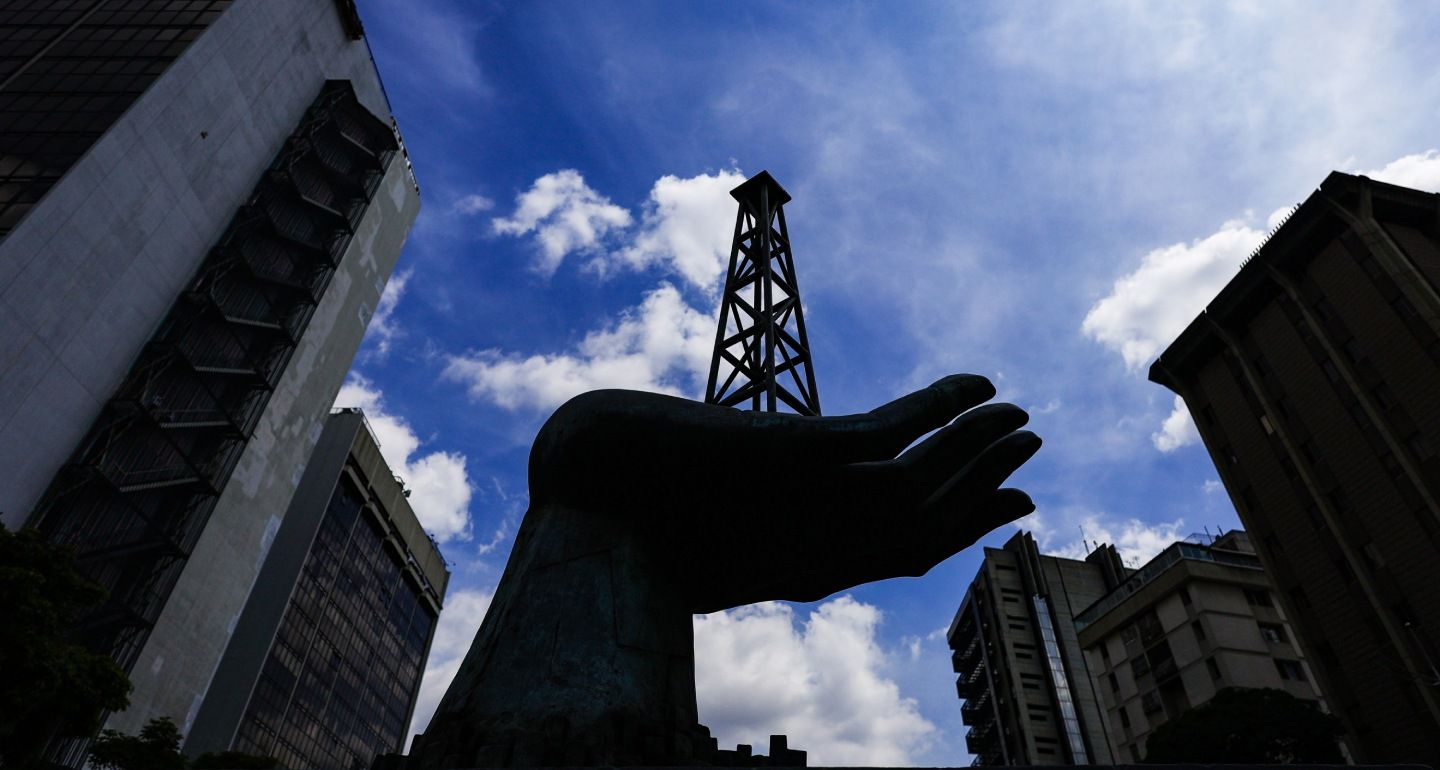
Source: Getty
Geological complexity and years of mismanagement mean the Venezuelan oil industry is not the big prize officials in Moscow and Washington appear to believe.
In discussions about the goals of the United States’ intervention in Venezuela, it’s often argued that the South American country’s oil reserves are the biggest in the world. President Donald Trump himself has said U.S. companies will be able to increase their oil production in Venezuela to compensate for the multi-billion-dollar losses they suffered as a result of earlier nationalization. Russian billionaire Oleg Deripaska has warned that control of Venezuelan oil could allow Washington to dictate international prices—and thus influence the Russian economy. However, both statements are an overestimation of Venezuela’s oil sector.
It’s true that Venezuela has been one of the most important players on the oil market since its inception. But to better understand the economics of the Venezuelan oil sector, it’s essential to look at the country’s geology. The bulk of Venezuela’s reserves lie in the Orinoco Belt, arguably the world’s biggest oil deposit. The problem is that they have been biodegraded by bacteria that feed on oil, consuming the lighter fractions, leaving extra-heavy, extra-viscous crude that’s hard to extract using conventional methods.
The technology used to extract heavy oil is constantly evolving, but the process remains expensive. Even if heavy oil is fluid when it’s underground, the changes in temperature and pressure when it reaches the surface mean that it solidifies. For that reason, light hydrocarbon fractions must be added to it to be able to transport it on tankers or through pipelines.
In addition, the oil often has to be heated in the ground—for example, by drilling horizontal wells in pairs and pumping steam into one of them and collecting oil in the other. All this makes production very expensive, and the oil that results is sold at a discount of up to 20 percent. Heavy oil can be processed by an upgrader, which breaks some of it into lighter hydrocarbon fractions —thus increasing the value and sales price. But that is not cheap either.
The El Furrial oil field and its satellites to the north of the Orinoco Belt were discovered in 1986. In 2007, El Furrial was providing about a third of Venezuela’s production.
Today, officials claim that Venezuela has oil reserves of 300 billion barrels. But until the middle of the 2000s, that figure was estimated to be much lower (80 billion barrels—about the same as both the United States and Russia) because the geologically proven but economically dubious reserves of the Orinoco Belt were counted more conservatively. However, when oil prices entered triple-figures at the start of the 2010s, there was a reassessment—and, on paper, Venezuela’s reserves almost quadrupled in size.
Since the United States is the main market for Venezuela and Mexico, which have been pumping large quantities of heavy oil for many years, oil refineries specially equipped to process heavy oil have sprung up on the Gulf of Mexico in Texas and Louisiana. Their business model was designed to save money on the purchase of raw materials (heavy oil grades are cheaper) and use advanced technologies to streamline the refining process. Nevertheless, these refineries are not dependent on Venezuelan oil. They can also process ordinary crude (although it’s less profitable because refineries lose their technical advantage). And heavy oil production has increased significantly in Canada in recent years—an obvious substitute.
Hugo Chavez rose to power in Venezuela in 1999 on a promise to use the country’s oil wealth to improve living standards for the poor. However, Chavez’s policies were unpopular with much of the middle class and elite, including PdVSA staff. In the early 2000s, oil workers went on strike regularly, and Chavez responded by sending in his commissars to manage the sector. About half of PdVSA’s 40,000 staff were fired and replaced by Chavista loyalists. The government also began to siphon away more and more of PdVSA’s free cash flow, as well as forcing the company to fund more social projects.
Like Russian President Vladimir Putin, Chavez was lucky. His ascent to power coincided with the start of a long period of sustained oil price rises, and an increase in production from newly discovered fields. For these reasons, PdVSA was largely able to meet the government’s growing demands.
Nevertheless, in 2007, the government decided to squeeze more from the foreign companies that had signed up to joint projects in the 1990s. The new law imposed additional taxes on such projects, stipulated that PdVSA should have bigger equity shares, and gave it the right to partially buy out foreign companies at book value.
Of the three big U.S. companies working in Venezuela back then, Chevron acquiesced to this arrangement, while Conoco and Exxon protested—filing cases in the United States and at international arbitration courts. These legal processes are still ongoing, but it appears the Venezuelan authorities have a strong case.
Nicolas Maduro, who succeeded Chavez after the latter died in 2013, was not so lucky. His rule coincided with a period of lower oil prices. For a while, PdVSA was able to maintain production at 2.5 million barrels a day, but, after 2015, this became steadily harder. Eventually, PdVSA found itself caught between a rock and a hard place. The government was in desperate need of cash, which meant the oil company had less and less money for capital investment. Skilled employees left to work in Colombia, Ecuador, Mexico, the United States, and Canada, and were replaced by growing numbers of political appointees. The number of PdVSA staff almost doubled to 80,000.
The solution Venezuela found was to use Western service companies. For example, instead of spending capital on a reservoir pressure maintenance system at El Furrial, without which production would have plummeted, PdVSA contracted U.S. companies to build and operate it for a running fee. A lot of drilling was also carried out by foreign contractors.
However, after 2015, hiring contractors was more and more often financed via debt. PdVSA even asked the foreign investors in the still-functioning joint projects to cover its share of expenses from future profit. The crisis peaked in 2017 when oil prices hit rock bottom, the U.S. administration imposed sanctions that cut PdVSA’s access to the U.S. debt markets, and there was no money left to repair upgraders in the Orinoco Belt.
Accident rates at Venezuelan refineries were rising due to severe cost-cutting, reduced maintenance, declining standards, and vanishing safety culture that disappeared with the exodus of experienced engineers and technicians, leading to a permanent loss of refining capacity. Rising debts made it harder to come to new agreements with contractors. And a systematic lack of capital investment meant the productivity of the whole sector began to fall, further impoverishing PdVSA—in other words, the country was caught in a vicious spiral, while the government tried to mitigate a deepening socio-economic crisis by squeezing yet more money from the oil industry, making things even worse.
Relations between Washington and Caracas have been strained since Chavez’s time. Despite close economic ties between the two countries, Chavez’s revolutionary politics went hand-in-hand with anti-American rhetoric, warm relations with Cuba, and other demonstrative gestures. The United States began to impose sanctions on Venezuela for human rights violations under President Barack Obama, and the standoff escalated further under Trump.
The United States imposed financial sanctions on Venezuela in 2017, and PdVSA was deprived of the ability to borrow on the U.S. dollar market. From 2019—when Maduro managed to remain in office despite losing elections—the United States limited trade of Venezuelan oil and restricted purchases of the substance necessary to dilute heavy oil for export.
As a result, Venezuela’s oil industry began to come apart at the seams. Production fell to 1 million barrels a day: 2.5 times lower than it had been in the mid-2010s. For almost a decade, El Furrial has been worked to exhaustion: the extracted oil was not replaced by the necessary quantities of water and gas, leading to a drop in reservoir pressure and formation of asphaltene flakes around well bores, leaving much of the remaining reserves unproducible. It is currently at just 10 percent of its peak production level.
Given the nature of Venezuela’s oil industry, such a decline in production might end up being irreversible. All this helps to explain why a country with such huge reserves and a well-developed oil industry does not have the bright future one might assume.
There are various theories about how production could be increased if U.S. companies were to return. In 2022, Chevron told the administration of then-president Joe Biden that it could double Venezuelan production from its level of 800,000 barrels a day if it were exempted from sanctions. Chevron returned to Venezuela at the end of 2022, and production did begin to rise (albeit not that significantly). Estimates of annual production growth of between 200,000 and 250,000 barrels a day over four to five years given investment of $10 billion a year seem more realistic.
However, this primarily applies to conventional oil. The prospects are much less clear when it comes to heavy crude (particularly given that Brent is currently trading at the relatively low level of between $50 and $55 per barrel). Heavy oil projects would need the price of Brent to rise by at least $20 a barrel in order to be profitable. In addition, to achieve a growth in production, a whole series of old fields would need to be brought online, requiring large amounts of equipment, drilling, workover crews, and other specialists. These do not exist in Venezuela today.
Iraq is a good example of how long it might take to resurrect the Venezuelan oil industry. After the end of the Second Iraq war, that process took about a decade—and that was despite the U.S. occupation of the country. It’s possible the Trump administration might impose an agreement bestowing big tax breaks for U.S. oil companies on Caracas similar to the rare earth metals agreement made with Ukraine. But modern business is only too aware that unfair deals are extremely vulnerable when the political situation changes.
The rebirth of the Venezuelan oil industry would not immediately deliver massive profits. And that means U.S. oil companies have a difficult decision. Even without Venezuela, they have projects lined up and waiting, and their resources—technical, human, and financial—are usually allocated many years in advance.
Pivoting toward Venezuela would mean pulling investment from elsewhere. And such a pivot would have to take place while oil prices are low—usually a time when companies have lower risk appetite and are more focused on financial discipline. The only sensible approach is not to hurry an investment decision on Venezuela, particularly given the ongoing lack of clarity about the political risks.
In the final analysis, neither Washington’s enthusiasm nor Moscow’s concerns are borne out by the state of the Venezuelan oil industry. This is not a country that could suddenly start selling significant additional quantities of oil on the world market. Any new oil will be relatively expensive to produce and will not generate significant profits. And it would be impossible for a puppet administration controlled by the United States to produce enough to keep global prices below $50 a barrel.

Senior Fellow, Carnegie Russia Eurasia Center
Sergey Vakulenko is a senior fellow at the Carnegie Russia Eurasia Center.
Recent Work
Sergey Vakulenko
Sergey Vakulenko
Carnegie does not take institutional positions on public policy issues; the views represented herein are those of the author(s) and do not necessarily reflect the views of Carnegie, its staff, or its trustees.

With the growth in points of friction between the great powers, organizations like the SCO will continue to play a role in the strategic adaptation of the smaller powers caught between them.

Temur Umarov

The war in Ukraine and a change in ownership led VK to neglect its commercial ventures in favor of implementing the Kremlin’s online agenda. Now it’s been sanctioned by the EU.

Maria Kolomychenko

A regime founded on force, coercion, and repression does not want its propaganda, with all its flaws of logic, omissions, and outright lies, to be competing with the most simple of all messages: Thou shalt not kill.

Leonid Bershidsky
Political pressure and economic headwinds are closely intertwined problems for Russian publishers and booksellers. Together, they risk propelling Russia into a “post-literate” era.

Galina Yuzefovich

In the discussions made possible by the State Duma election campaign, one question is being asked more and more loudly. “What next?”

Andrey Pertsev