

Commentary
Judy Dempsey
{
  "authors": [
    "Judy Dempsey"
  ],
  "type": "legacyinthemedia",
  "centerAffiliationAll": "",
  "centers": [
    "Carnegie Endowment for International Peace",
    "Carnegie Europe"
  ],
  "collections": [],
  "englishNewsletterAll": "",
  "nonEnglishNewsletterAll": "",
  "primaryCenter": "Carnegie Europe",
  "programAffiliation": "",
  "programs": [],
  "projects": [],
  "regions": [
    "Europe",
    "Western Europe",
    "Germany"
  ],
  "topics": [
    "EU",
    "Security",
    "Military"
  ]
}
Source: Getty
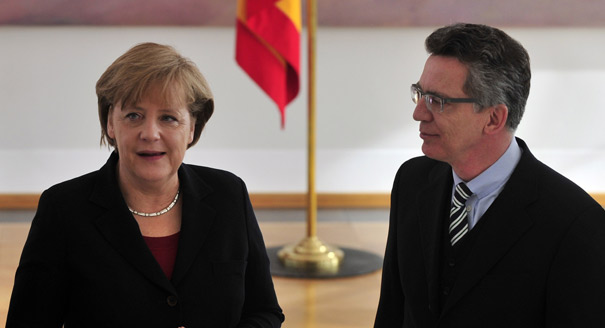
Angela Merkel’s long-time friend, Defense Minister Thomas de Maizière, is fighting for his political survival because of a deepening scandal over the expense of Germany’s failed effort to develop a surveillance drone.
Source: New York Times
This is not going to be an easy week for Chancellor Angela Merkel. Her trusted and long-time friend, Defense Minister Thomas de Maizière is fighting for his political survival because of a deepening scandal over Germany’s development of surveillance drones.
The controversy is inconvenient ahead of President Barack Obama’s visit to Berlin next week, which I discuss in my Page Two column.
The curious thing is that it is not the idea of Germany having drones that has upset the opposition parties. It is the fact that Mr. de Maizière allegedly allowed work on the project to continue at enormous cost despite the fact that the drones would never fly.
Germany had been investing in the Euro Hawk drone, a trans-Atlantic project between Northrop Grumman of the United States and the European aerospace company EADS. The drone was designed to do for the Bundeswehr, Germany’s armed forces, what the high altitude, long endurance surveillance drone Global Hawk does for the United States military.Last month, Mr. de Maizière acknowledged that the Euro Hawk would never fly. After spending more than €500 million, or $661 million, on the project, Germany plans to abandon it. Mr. de Maizière cited safety concerns. “Better an end with horror than a horror without end,” he told the Bundestag.
Euro Hawk cannot fly because it does not meet the standards of the European Aviation and Safety Agency. High altitude drones need sophisticated equipment that will prevent them from colliding with conventional aircraft, losing control, or becoming lost. For Germany, this would have meant spending an additional €600 million on equipment and experts, in addition to spending more for the certification.
To make things even more difficult for Mr. de Maizière, Norththrop Grumman was not prepared to provide certain technical documents for the certification process — despite the long cooperation between Norththrop Grumman, EADS and the German Defense Ministry. Mr. de Maizière said he knew nothing of the program until 2012, even though it had been under development for several years by that time.
The opposition, which is struggling in the opinion polls ahead of federal elections in September, is latching onto the drone scandal to dent Mrs. Merkel’s popularity and target her closest advisor. The longer the scandal continues the more Mrs. Merkel could be put into the uncomfortable position of taking a stand over Mr. de Maizière’s future.

Nonresident Senior Fellow, Carnegie Europe
Judy Dempsey is a nonresident senior fellow at Carnegie Europe
Recent Work
Judy Dempsey
Judy Dempsey
Two divergent trends—Putin’s hardline vision of how to prosecute the war in Ukraine, and a growing desire for change in Russia—could tear the regime apart.

Tatiana Stanovaya
Andrey Melnichenko’s essay offers no answer to the fundamental question of how, under any kind of negotiated settlement, Europe can protect itself from the Russian ressentiment that is inevitable in all scenarios except for an outright victory for Putin.

Leonid Bershidsky
Whether PAS can refocus on the unfinished business of state-building may ultimately prove more consequential for Moldova’s European future than the pace of its accession negotiations.

Balázs Jarábik
The recent damage inflicted by Ukrainian drones and missiles on Russia has made Belarus aware of its own vulnerabilities—and surprisingly amenable to Kyiv’s demands.

Artyom Shraibman
It is not a phenomenon unique to Russia that the public of a country at war (even the aggressor) enduring airstrikes will not overturn its government but rather show solidarity with it and blame its woes on the enemy.
Vladislav Gorin