

Commentary
Bayram Balci
{
  "authors": [
    "Bayram Balci"
  ],
  "type": "commentary",
  "centerAffiliationAll": "",
  "centers": [
    "Carnegie Endowment for International Peace",
    "Carnegie Russia Eurasia Center"
  ],
  "collections": [],
  "englishNewsletterAll": "",
  "nonEnglishNewsletterAll": "",
  "primaryCenter": "Carnegie Endowment for International Peace",
  "programAffiliation": "",
  "programs": [],
  "projects": [],
  "regions": [
    "Caucasus",
    "Azerbaijan"
  ],
  "topics": [
    "Political Reform",
    "Democracy"
  ]
}
Source: Getty
It has been two decades since post-Soviet states gained independence, but democracy fails to emerge and shake autocratic regimes, although they have the educated and intellectual elites it takes to develop it.
President Aliyev won reelection with more than 85 percent of the polls, while the opposition candidate, Jamil Hansali, supported by an unprecedented unified opposition front, got only 5 percent in these elections which parodied democracy and pluralism. It has been two decades since post-Soviet states gained independence, but democracy fails to emerge and shake autocratic regimes, although they have the educated and intellectual elites it takes to develop it. Yet it is in our Western interest that these countries keep a close watch on their natural resources, especially when it comes to oil and gas.
In arranged elections in 2003, the incumbent president succeeded his father Heydar Aliyev, who had run the country since 1993 and before that had run Soviet Azerbaijan between 1969 and 1982. Reelected the first time in 2008, his son, Ilham Aliyev, proved the first-ever post-Soviet dynasty to be enduring.
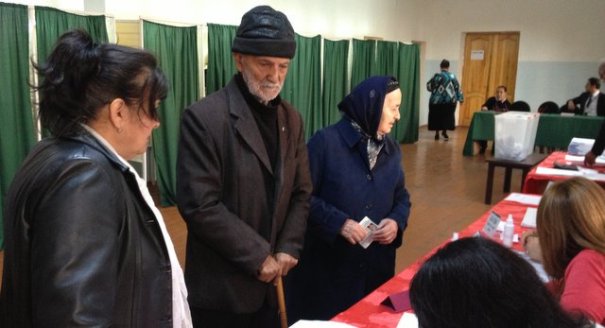
In this year’s October 9 elections, Organization for Security and Cooperation in Europe deployed observation missions in a fourth of all polling places. The preliminary assessment has contained harsh criticism and concern over the electoral process itself, irrespective of human rights and basic democratic principles. The pan-European institution is well-known for issuing mild assessments so as to encourage more democracy and pluralism in these countries. This time they inform that in 58 percent of the polling places the counting of all voting ballots occurred in highly suspicious conditions. They also condemned the regime’s political pressure and acts of intimidation against candidates, opposition supporters, and voters before and during the poll.
The election clearly showed the decline in freedom rights in Azerbaijan, although the country has everything that it takes to establish a more democratic political system. The country is rich in natural resources and has a thriving economy. An extraordinarily large part of the society is educated, and its intellectual elites are ready to rise to the challenge of power in a post-Soviet globalized modern world. However, despite its assets, the country seems doomed to long years of dictatorship and international isolation. Azerbaijanis particularly regret to be cut off from the rest of Europe, where they believe they belong.
The actual nature of the regime prevents all political reform. The whole archaic system is based on the fragile balance between several rival clan groups, engaged in a fierce competition for power and influence behind the scenes. The monolithic appearance of the Aliyev regime is nothing but a façade. President Aliyev’s real power is more fragile than we think, or than Karimov’s power in Uzbekistan and Nazarbayev’s in Kazakhstan.
Besides, the country lives on oil and gas exports to the rest of the world, and somehow oil revenues and the country’s consequent economic boost weigh negatively on democracy. The people more or less indirectly benefit from the economic growth. And we, oil demanding Western democracies, prefer predictable political environments to insure steady oil and gas supply. We will not support change should it bring instability and harm our national interests. Oil revenues doom local democratic change twice more when combined to geostrategic considerations. Lying at the crossroads of the Turkish, Iranian, and Russian worlds, Azerbaijan is a traditional ally of the Western democracies. Americans and Europeans indirectly support the Aliyev’s regime because it helps us to in reducing our dependence on Russian gas and in isolating Iran on the international scene. As long as this lasts, we shall never be able to utter an outcry against violations of human rights in Azerbaijan.
Moreover, it is also in Russia’s interest to keep warm relations with Baku’s regime. Indeed, Moscow does not appreciate much political change in its so-called “near abroad” sphere of influence. So up until 2011, Aliyev did not seem to be concerned about his regime’s stability. Things have changed since the Arab Spring. Worried at first by a potential impact these people’s revolutions might have on his country’s domestic scene, Azerbaijani authorities have taken all possible measures to prevent the turmoil from spreading. But the counterrevolution in Egypt and the stalemate reached in Syrian civil war have discredited democratic but disruptive revolutionary ideas. Even the sectarian turn the Syrian war took failed to revive confessional claims in Azerbaijani secularized society consisting of both Sunni and Shia Muslims.
Aliyev’s autocratic rule over Azerbaijan is still poised for a bright future. Repression of the opposition voices is brutal but occurs less than in most other post-Soviet states. Partly because there is not much hope in opposing a regime, which has the indirect support of both its Western oil clients and its Russian neighbor obsessed with Caucasian political stability.
In last week’s election, Azerbaijani opposition made a big progress. They unified as a front and had one candidate against the incumbent president. They did not make much of a difference on the outcome of the polls, but they proved they could play the game according to the rules however biased these may be; and the Azerbaijani people should be praised for their patient and nonviolent thirst for pluralism and democracy.
Former Nonresident Scholar, Russia and Eurasia Program
Balci was a nonresident scholar in Carnegie’s Russia and Eurasia Program, where his research focuses on Turkey and Turkish foreign policy in Central Asia and the Caucasus.
Recent Work
Bayram Balci
Bayram Balci, Daniyar Kosnazarov
Carnegie does not take institutional positions on public policy issues; the views represented herein are those of the author(s) and do not necessarily reflect the views of Carnegie, its staff, or its trustees.
By fueling the arguments of both supporters and opponents of Armenian Prime Minister Nikol Pashinyan, Azerbaijan wants to ensure he is re-elected with a weaker mandate.

Bashir Kitachaev
Azerbaijan’s relations with the EU appear to be going from strength to strength after several years in the deep freeze following the military escalation in Karabakh in 2023 and Azerbaijan’s bitter fallout with France and several other EU member states.
Shujaat Ahmadzada
Anger over online restrictions has led to a surge in support for the New People party, which has replaced the Communists as Russia’s second most popular political party.

Andrey Pertsev
The Russian regime is now visibly motivated by fear.

Alexander Baunov
Baku’s backing for Ukraine is less about confronting Russia than about quietly broadening the mix of partners it relies on.
Zaur Shiriyev