

Commentary
Alexey Malashenko
{
  "authors": [
    "Alexey Malashenko"
  ],
  "type": "legacyinthemedia",
  "centerAffiliationAll": "",
  "centers": [
    "Carnegie Endowment for International Peace",
    "Malcolm H. Kerr Carnegie Middle East Center",
    "Carnegie Russia Eurasia Center"
  ],
  "collections": [],
  "englishNewsletterAll": "",
  "nonEnglishNewsletterAll": "",
  "primaryCenter": "Carnegie Russia Eurasia Center",
  "programAffiliation": "",
  "programs": [],
  "projects": [],
  "regions": [
    "Gulf",
    "Levant",
    "Middle East",
    "Iraq",
    "Syria",
    "Caucasus",
    "Russia"
  ],
  "topics": [
    "Political Reform",
    "Security",
    "Religion"
  ]
}
Source: Getty
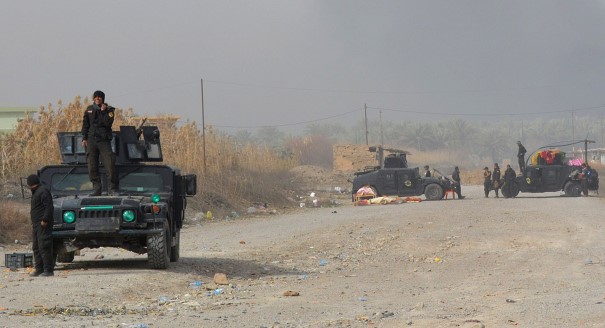
Many North Caucasus natives have joined the Islamic State, and some are returning home. If the socioeconomic and political situation in the region deteriorates and popular discontent increases, this may lead former Islamic State fighters to join the armed struggle.
Source: Mark News
In September 2014, the terrorist organization known as the Islamic State in Iraq and Syria (ISIS) announced that it was ready “to start a war in Chechnya” and even “liberate Chechnya” and the entire Caucasus. Its ambitions clearly exceeded its capabilities, however, as this has not yet happened.
In fact, rather than ISIS bringing the war to the Caucasus, many Caucasus fighters have joined the war in the Middle East. While it is hard to determine exactly how many Caucasus natives – and Chechens specifically – are fighting for ISIS, many suggest there could be close to 2,000.Well-known Chechen dissident Mairbek Vatchagaev, who was once former Chechen President Aslan Maskhadov’s special envoy, puts the total number of Chechens fighting for ISIS at 1,500, but claims that only 150 of them came directly from Chechnya. The rest, he believes, came from the Middle East and Europe. (France is home to 35,000 Chechens, and it is estimated that Norway is home to close to 10,000). Some reports also suggest that 200 fighters from Dagestan have joined ISIS.
Members of the Caucasus Emirate, an extremist organization established in 2007 in the North Caucasus, have also started moving to the Middle East to fight for ISIS. Ali Abu Mukhammad, leader of the Caucasus Emirate, expressed his dismay with this development, saying that although the decision on where to wage jihad – in the Middle East or Russia – is up to individual fighters, “brothers” ought to return to the North Caucasus “to start a war in Russia’s southern regions.”
Some Caucasus natives will return home. Some are returning already. They are not, however, doing so at Abu Mukhammad’s request – they are returning due to increased tensions within ISIS. Ethnic conflicts have recently flared up, including clashes between Chechen and Uzbek militants, and the position of ISIS leadership is quite incoherent. Many in ISIS also fear that the U.S.-led international coalition may start a large-scale military operation against the group in March.
The return of a few dozen fighters is unlikely to have a material effect on the already aggravated violent situation in the Caucasus anyway. The daring assault on Grozny perpetrated by a group of militants on December 4 remains the most high-profile terrorist attack in the last two months, but there have been many other incidents involving the members of the terrorist underground in the North Caucasus in that period: Police forces killed three militants in Ingushetia at the end of December, two militants implicated in the Grozny attack were killed in Chechnya a month after, and several police officers died in clashes with militants in Dagestan in January.
Going forward, a lot will depend on the socioeconomic and political situation in the North Caucasus. Its rapid deterioration is bound to increase popular discontent, which may lead more people, including returning ISIS fighters, to join the armed struggle.
Former Scholar in Residence, Religion, Society, and Security Program
Malashenko is a former chair of the Carnegie Moscow Center’s Religion, Society, and Security Program.
Recent Work
Alexey Malashenko
Alexey Malashenko
Carnegie does not take institutional positions on public policy issues; the views represented herein are those of the author(s) and do not necessarily reflect the views of Carnegie, its staff, or its trustees.

A leak of Russian gas price data helps establish that China is paying Russia far less than Central Asian countries and Gazprom’s former European customers.

Sergey Vakulenko

Japan’s long-term security policy is driven by concerns about China, and there is little appetite for (or interest in) pursuing a confrontation with Moscow.

James D.J. Brown

The truth of the strategic situation is that Europe and Russia are extremely unlikely to be able to “turn the page” on their confrontation within the next two decades.

Arkady Moshes

Russia spent years building a “sovereign internet,” concentrating web infrastructure exclusively within Russian territory. Ukrainian drone attacks have shown how vulnerable that approach has left the Russian internet.

Maria Kolomychenko

Putin’s conservative staffing policies and search for ever greater control have cemented parliament’s transformation into a bureaucratic appendage of the executive branch.

Andrey Pertsev