

Q&A
- +1
Amr Hamzawy, Andrew Leber, Eric Lob, …
{
  "authors": [
    "Marwan Muasher"
  ],
  "type": "legacyinthemedia",
  "centerAffiliationAll": "dc",
  "centers": [
    "Carnegie Endowment for International Peace",
    "Malcolm H. Kerr Carnegie Middle East Center"
  ],
  "collections": [
    "Arab Awakening"
  ],
  "englishNewsletterAll": "menaTransitions",
  "nonEnglishNewsletterAll": "",
  "primaryCenter": "Malcolm H. Kerr Carnegie Middle East Center",
  "programAffiliation": "MEP",
  "programs": [
    "Middle East"
  ],
  "projects": [],
  "regions": [
    "Middle East",
    "North Africa",
    "Egypt",
    "Tunisia",
    "Iraq",
    "Lebanon",
    "Syria",
    "Levant",
    "Maghreb",
    "Gulf"
  ],
  "topics": [
    "Political Reform",
    "Education",
    "Democracy",
    "Security"
  ]
}
Source: Getty
The Arab World now stands at a crossroads where it could head toward a more pluralistic society or toward more extremism and violence.
Source: Globe and Mail
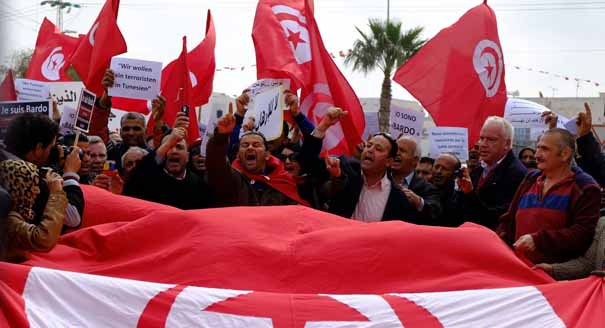
The fact that this year’s Nobel Peace Prize has been awarded to the Tunisian National Dialogue Quartet – a group of four organizations that played a key role in Tunisia’s attempts to build a pluralistic democracy after its 2011 revolution – demonstrates how important inclusive policies are to the building of a strong democracy.
Despite major differences between its secular and religious forces, the Tunisians were able, in three short years after the revolution, to agree on a constitution that ensured a place in society for all groups – upholding the peaceful rotation of power, granting full rights to women and ensuring protections for freedoms of speech and belief.
So far, Tunisia has been a rare exception in the region. In Egypt, exclusionist policies by both Islamist forces and so-called liberal secular forces have meant the country is still mired in a deep economic crisis and political stagnation. In the Gulf, countries are behaving as if the problem were purely economic, and in Syria and Iraq, the Islamic State is targeting the cultural and religious diversity of the region, and threatening centuries of co-existence.The Arab world is a diverse region that has not respected diversity. The last several decades have been characterized by an almost total absence from Arab discourse of diversity and pluralism. After decades of neglecting good governance and economic development, it is no wonder the region finally erupted.
The principal fight in the Arab world, as Tunisia has shown, should be a fight for pluralism – not simply one against despotic rule. This commitment to pluralism – a prerequisite to a sustainable political and economic renewal of the Middle East – must be expected of Islamists and secularists alike. If there is hope for democracy in the region, the fight needs to be waged on two simultaneous fronts. The fight must be for the universal right to peaceful political participation and against the monopolization of truth or power.
With the exception of Tunisia, no country has emerged as the torchbearer of this challenge. Arab states that have undergone transition as well as those that haven’t have yet to internalize that if they want to keep power, they must share it.
Yet sectarian tensions today are ripping Arab countries apart. From Syria to Lebanon to Iraq, states are increasingly being defined by what divides them. These tensions are most glaring in countries that were shaped by colonial powers and stem from the famous Sykes-Picot Agreement of 1916 that divided the Arab Levant between France and Britain. Even though nearly a century has passed since that agreement, governments in these countries have maintained stability through force rather than investing in building a sense of citizenship where national identities would trump other allegiances.
The Arab world must chart a different course if it is to be stable and prosperous. Its cultural, ethnic and religious diversity must be regarded as a strength rather than a weakness. Governments must foster a sense of citizenship that values diversity rather than a narrow nationalism that emphasizes the pre-eminence of certain groups over others.
Educational systems need to be reinvented. Respect for the “other” is lacking in Arab school systems. The freedom to be different must be legally protected. Enshrining freedoms of speech and belief in new social contracts between citizens and their states will ensure a smoother transition process and reassure all citizens that their basic rights will be protected by the government. As a result, a stronger identification with the state will be promoted.
The Arab world has two stark choices: the pluralistic, inclusionist process of Tunisia, which has won it a Nobel Prize and a ticket toward a stable, prosperous society, or the exclusionist, barbaric practices of the Islamic State, which has resulted in the destruction of people and values. The Arab world can, and must, wage a battle for pluralism.

Vice President for Studies
Marwan Muasher is vice president for studies at Carnegie, where he oversees research in Washington and Beirut on the Middle East. Muasher served as foreign minister (2002–2004) and deputy prime minister (2004–2005) of Jordan, and his career has spanned the areas of diplomacy, development, civil society, and communications.
Recent Work



Amr Hamzawy, Andrew Leber, Eric Lob, …
Marwan Muasher
Carnegie does not take institutional positions on public policy issues; the views represented herein are those of the author(s) and do not necessarily reflect the views of Carnegie, its staff, or its trustees.

Russian strikes are weakening the economy sustaining Ukraine’s war effort. Closing the growing funding gap will require more European support and politically contentious reforms in Kyiv.

Balázs Jarábik

Ex-president Gurbanguly Berdimuhamedov remains interested in politics, but his son Serdar, Turkmenistan’s current president, is becoming increasingly independent and willing to break with his father’s legacy. If their covert rivalry goes too far, both risk losing power.

Galiya Ibragimova

Despite a new textbook, an influx of Russian teachers and managers, and an end to the teaching of Ukrainian, the Kremlin is unlikely to have “reprogrammed” locals.

Konstantin Skorkin

Sergei Kiriyenko used Russia’s parliamentary vote to further hone his strategy of corporate mobilization that is designed to maximize votes for United Russia.

Andrey Pertsev

The European far right might fail to steer EU policy in the direction Russia wants, but they will create enough chaos inside Europe to benefit the Kremlin.

Dimitar Bechev