

Q&A
Matt Ferchen
{
  "authors": [
    "Matt Ferchen"
  ],
  "type": "legacyinthemedia",
  "centerAffiliationAll": "",
  "centers": [
    "Carnegie Endowment for International Peace",
    "Carnegie China"
  ],
  "collections": [
    "China and the Developing World",
    "China’s Foreign Relations"
  ],
  "englishNewsletterAll": "",
  "nonEnglishNewsletterAll": "",
  "primaryCenter": "Carnegie China",
  "programAffiliation": "",
  "programs": [],
  "projects": [],
  "regions": [
    "North Africa",
    "Southern, Eastern, and Western Africa",
    "East Asia",
    "China"
  ],
  "topics": [
    "Economy"
  ]
}
Source: Getty
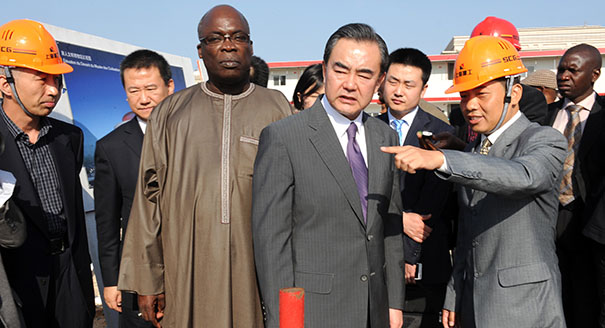
China’s relationship with Africa is becoming increasingly more complex as the country continues to invest and send workers across 54 countries on the continent.
Source: China-Africa Project
Depending on who you speak with, China’s engagement in Africa is often described in extreme terms as either the best thing to happen to the continent in the post-colonial era or just the latest foreign predator coming to pillage Africa of its resources. With China’s presence in Africa now stretching across nearly all 54 countries where an estimated one million Chinese immigrants now live and hundreds of billions of dollars in annual trade/investment, the relationship between these two regions is extremely complicated.
Beijing’s commitment to African infrastructure development is a central part of the government’s “win-win development” agenda, also a key message in its propaganda campaign that emphasizes China’s “peaceful rise” to superpower status.
So is China’s a partner or predator? The short answer, according to numerous leading Sino-African scholars, is that this vast complex relationship is not binary and cannot be reduced to either “good” or “bad.” It is the same in Africa as it is for China’s relations with other regions: “Both approaches offer oversimplified understandings of the complex interaction among the economic, geopolitical, and security dimensions of China’s relations with the rest of the world,” said Dr. Matt Ferchen from the Beijing-based Carnegie-Tsinghua Center for Global Policy in a new paper on the perception gaps surrounding China’s economic and military rise.
Matt joins Eric and Cobus to explain why he thinks views about the Chinese are so polarized in Africa and elsewhere and what impact the Trump revolution in the United States will have on China’s engagement in Africa.
This podcast was originally published by the China-Africa Project.

Former Nonresident Scholar, Carnegie-Tsinghua Center for Global Policy
Ferchen specializes in China’s political-economic relations with emerging economies. At the Carnegie–Tsinghua Center for Global Policy, he ran a program on China’s economic and political relations with the developing world, including Latin America.
Recent Work
Matt Ferchen
Matt Ferchen, Anarkalee Perera
Carnegie does not take institutional positions on public policy issues; the views represented herein are those of the author(s) and do not necessarily reflect the views of Carnegie, its staff, or its trustees.

Russian strikes are weakening the economy sustaining Ukraine’s war effort. Closing the growing funding gap will require more European support and politically contentious reforms in Kyiv.

Balázs Jarábik

For every ruble allocated to social policy, health, and education in 2027, double that amount is earmarked for the army, the police, and the security services.

Alexandra Prokopenko

Depleted financial reserves and a shrinking tax base mean it is no longer possible to simultaneously deliver high defense spending, price stability, and economic growth.
Alexandra Prokopenko

With the growth in points of friction between the great powers, organizations like the SCO will continue to play a role in the strategic adaptation of the smaller powers caught between them.

Temur Umarov

A much-discussed disagreement over internet restrictions in Russia was never an existential threat for Putin: It was about elite groups protecting their interests.
Alexandra Prokopenko