

Commentary
If the Russian-speaking community in Latvia cannot articulate their interests without being seen as disloyal, they could end up embracing a pro-Kremlin agenda.
Sergejs Potapkins
{
  "authors": [
    "Ananth Padmanabhan",
    "Madhav Khosla"
  ],
  "type": "other",
  "centerAffiliationAll": "",
  "centers": [
    "Carnegie Endowment for International Peace",
    "Carnegie India"
  ],
  "collections": [],
  "englishNewsletterAll": "",
  "nonEnglishNewsletterAll": "",
  "primaryCenter": "Carnegie India",
  "programAffiliation": "",
  "programs": [],
  "projects": [],
  "regions": [
    "South Asia",
    "India"
  ],
  "topics": [
    "Domestic Politics",
    "Political Reform",
    "Democracy"
  ]
}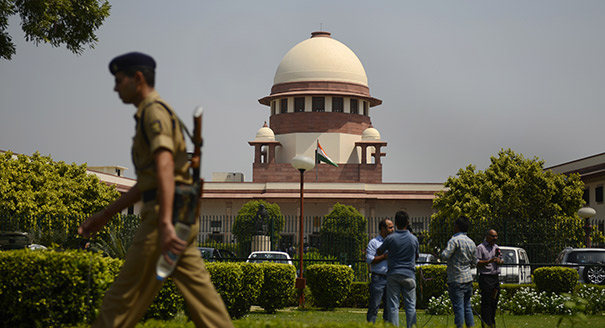
Source: Getty
Over time, the Supreme Court of India has evolved from being a court of law to a major institutional actor in the political arena.
Source: Rethinking Public Institutions in India
Over time, the Supreme Court of India has evolved from being a court of law to a major institutional actor in the political arena. The present chapter analyses this transition by directing external and internal lenses on the court’s functioning. The external lens reveals engagement by the Court with legislative and executive domains of governance, and the current concerns of transparency and accountability that it faces. The internal lens scrutinizes the Court’s success as a court of law and its capability to streamline the judicial process such that the judicial system lives up to the legitimate expectations of the litigant public. Using the insights offered from these dual perspectives, the authors suggest important changes to the court’s functioning and a reorientation of its priorities that can render it a more effective public institution.
Former Fellow, Carnegie India
Ananth Padmanabhan was a fellow at Carnegie India, based in New Delhi. His primary research focus is technology, regulation, and public policy, and the intersection of these three fields within the Indian context.
Madhav Khosla
Carnegie does not take institutional positions on public policy issues; the views represented herein are those of the author(s) and do not necessarily reflect the views of Carnegie, its staff, or its trustees.

If the Russian-speaking community in Latvia cannot articulate their interests without being seen as disloyal, they could end up embracing a pro-Kremlin agenda.

Sergejs Potapkins

Russia’s ruling party would have benefited from Putin appearing as its distant patron, but as an active frontman imposing his views on the public, he has done nothing but harm both the party’s election campaign and the ruling system overall.

Andrey Pertsev

Depleted financial reserves and a shrinking tax base mean it is no longer possible to simultaneously deliver high defense spending, price stability, and economic growth.

Alexandra Prokopenko

Blurring the line between humans and animals is a long-standing tradition in social utopian prose. In his latest novel, Leonid Bershidsky reminds us that in social experiments, people are often treated no differently than animals.

Alexander Baunov

In the tenth year of his presidency, President Mirziyoyev’s system is becoming even more personalized than that of his predecessor Karimov.

Galiya Ibragimova