

Commentary
Evan A. Feigenbaum
{
  "authors": [
    "Evan A. Feigenbaum"
  ],
  "type": "legacyinthemedia",
  "centerAffiliationAll": "dc",
  "centers": [
    "Carnegie Endowment for International Peace",
    "Carnegie China"
  ],
  "collections": [
    "Belt and Road Initiative"
  ],
  "englishNewsletterAll": "asia",
  "nonEnglishNewsletterAll": "",
  "primaryCenter": "Carnegie Endowment for International Peace",
  "programAffiliation": "AP",
  "programs": [
    "Asia"
  ],
  "projects": [],
  "regions": [
    "East Asia",
    "China",
    "Central Asia",
    "Turkmenistan"
  ],
  "topics": [
    "Economy",
    "Foreign Policy"
  ]
}
Source: Getty
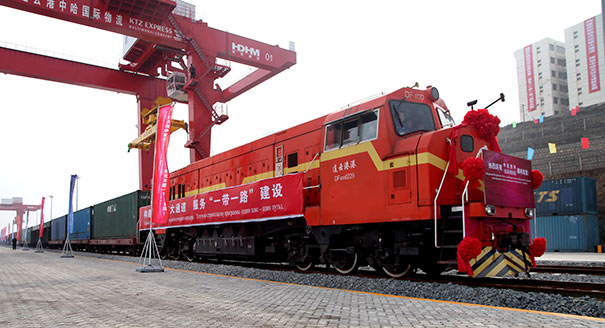
China hopes to use three strengths to make the Belt and Road Initiative a success: its large foreign exchange reserves, dominance in certain infrastructure fields, and unique forms of state backed project finance.
Source: CNBC
Speaking on CNBC, Carnegie’s Evan Feigenbaum explained that China already had major projects underway in Central Asia even before announcing its “One Belt One Road” (OBOR) plan. He noted that China has “upped the game,” in terms of connectivity, but it did not invent the concept of Asian connectivity. This idea, he said, has a long history; it did not begin in 2013 nor, he added, did it spring from the mind of Xi Jinping like Athena emerging from Zeus’s head. Instead, he argued, it needs to be looked at organically as the product of the actions and choices of many players in Asia, including Japan, India, and the international financial institutions.
Feigenbaum argued that China hopes to leverage three main strengths to make its OBOR strategy a success. First, he said, the government has access to a “huge pile” of foreign exchange reserves that it hopes to leverage by ploughing it into direct investments and infrastructure projects; thus vehicles like the Chinese Silk Road Fund are capitalized in part or in whole by the state foreign exchange administrator. Second, Chinese companies dominate certain areas of infrastructure, for example hydropower. Finally, he said, China can employ unique forms of state backed project finance—a model that Beijing knows few other countries or banks can compete with. One area to watch, he noted, is the degree to which China uses OBOR projects to export its indigenous engineering standards and thus make them de facto global standards.
The United States, Feigenbaum continued, is missing in action on connectivity in Asia; it is reactive instead of proactive and on defense instead of offense. He contended that Washington needs to think about how to better deploy its strengths rather than an apples to apples approach to China’s initiatives. The United States has a different model, distinct strengths, more leverage than it thinks, he continued, and doesn’t do state-backed China-style project finance. But ultimately, he said, the inevitably more integrated Asia is making the United States less relevant in large swathes of the region except as a security provider. So Washington had better figure out how to get more skin in the game, and quick, he concluded.

Vice President for Studies
Evan A. Feigenbaum is vice president for studies at the Carnegie Endowment for International Peace, where he oversees work at its offices in Washington, New Delhi, and Singapore on a dynamic region encompassing both East Asia and South Asia. He served twice as Deputy Assistant Secretary of State and advised two Secretaries of State and a former Treasury Secretary on Asia.
Recent Work
Evan A. Feigenbaum
Evan A. Feigenbaum
Carnegie does not take institutional positions on public policy issues; the views represented herein are those of the author(s) and do not necessarily reflect the views of Carnegie, its staff, or its trustees.
A leak of Russian gas price data helps establish that China is paying Russia far less than Central Asian countries and Gazprom’s former European customers.

Sergey Vakulenko

Japan’s long-term security policy is driven by concerns about China, and there is little appetite for (or interest in) pursuing a confrontation with Moscow.

James D.J. Brown

Without a ceasefire with Ukraine on attacking each other’s energy infrastructure—to which the Kremlin is unlikely to agree—the diesel agreement between Putin and Trump is largely for show, rather than representing a genuine increase in the volumes of Russian diesel on the global market.
Sergey Vakulenko

Russian strikes are weakening the economy sustaining Ukraine’s war effort. Closing the growing funding gap will require more European support and politically contentious reforms in Kyiv.

Balázs Jarábik

Ex-president Gurbanguly Berdimuhamedov remains interested in politics, but his son Serdar, Turkmenistan’s current president, is becoming increasingly independent and willing to break with his father’s legacy. If their covert rivalry goes too far, both risk losing power.

Galiya Ibragimova