

Paper
Douglas H. Paal
{
  "authors": [
    "Douglas H. Paal"
  ],
  "type": "legacyinthemedia",
  "centerAffiliationAll": "dc",
  "centers": [
    "Carnegie Endowment for International Peace",
    "Carnegie China"
  ],
  "collections": [],
  "englishNewsletterAll": "asia",
  "nonEnglishNewsletterAll": "",
  "primaryCenter": "Carnegie China",
  "programAffiliation": "AP",
  "programs": [
    "Asia"
  ],
  "projects": [],
  "regions": [
    "North America",
    "United States",
    "East Asia",
    "North Korea",
    "South Korea"
  ],
  "topics": [
    "Security",
    "Foreign Policy",
    "Nuclear Policy",
    "Arms Control"
  ]
}
Source: Getty
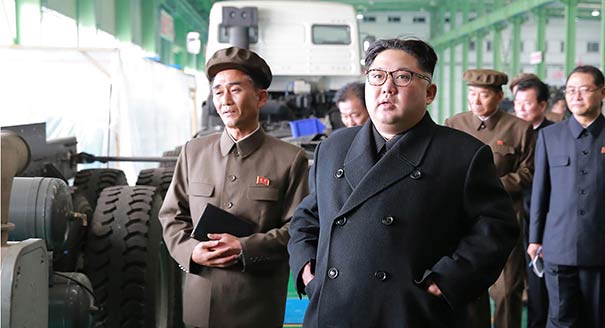
The circumstances of the meeting between Kim and Pompeo are far less significant than its consequences. Despite the odd timing and public exposure, the Trump administration has used a proven channel to attempt an extraordinary mission.
Source: Hill
The revelation that CIA director Mike Pompeo met secretly in North Korea with dictator Kim Jong Un raised a lot of eyebrows this week. Why a spy and not a diplomat? Why Pompeo when he is in the midst of a confirmation battle to be the next secretary of State? Why not someone less senior and more expert, therefore less risky?
A lot had to do with circumstances. At the time, the secretary of State position was not yet filled following Rex Tillerson’s departure. The position of national security adviser was in early transition. Moreover, the U.S. government’s active duty Korea experts are depleted by resignations and lack of promotions within the State Department and other agencies. But North Korea is a special case.
There is only one official there worth talking to: Kim Jong Un. The American sent to meet him and set terms for the upcoming leader-to-leader summit had to be senior and close to President Trump. There are other murky places in the world where the United States has no official diplomatic relations that CIA directors have flown in on special missions, and they are almost never publicly reported. There is a track record of successful contacts between CIA officials and North Koreans, where Pyongyang treated the emissaries well, respected confidentiality, and in some cases produced results.
The circumstances of the meeting between Kim and Pompeo are far less significant than its consequences. Despite the odd timing and public exposure, the Trump administration has used a proven channel to attempt an extraordinary mission. Previous intelligence communications around the time of the Pyeongchang Olympics led to the surprising decision by Kim offer to meet with President Trump, the man who berated him on Twitter last year and threatened to rain down fire on his country.
The real question is if the results of this effort will be different than the past. Does Kim really mean to surrender his hard-won nuclear and missile capabilities in exchange for relief from the tough sanctions orchestrated by Trump? Or is this just another chapter in the North Korean dictator’s old bait-and-switch playbook? Is Kim luring Trump into a trap to demand an end to the U.S. alliance with South Korea and more?
This is what Pompeo had to probe with a preliminary meeting. We do not know the results, and communications between the United States and North Korea are reportedly continuing over at least the venue of the summit, and probably much more. Trump, who likes to be disruptive, has turned the diplomatic table upside down once again.
By offering a meeting with the president of the United States with no preconditions, he is playing the strongest card in the American hand before extended negotiations roughly determine what each side wants and how to verify and enforce any agreement. Pompeo needed to judge whether the risks outweigh the possible benefits, and so far he seems to have concluded they do not.
Kim has already won some marginal victories here by using diplomacy and the offer of negotiations to transform his image from the most reviled and isolated leader on earth into an improbable but promising peacemaker. In short order, he reframed the media spotlight by sending his sister to the Olympics, prepared for an inter-Korean summit next week that many suspect is intended to weaken the U.S. alliance, and traveled to China to show he was not so isolated after all.
South Korean opinion is divided about the prospects for next week’s inter-Korean meeting and the Trump-Kim summit. Progressive advisers to President Moon Jae In include people long suspicious of the U.S. relationship, an attitude that Kim may seek to use to make daylight between the United States and South Korea.
Conservatives, swept out of power after the previous president of South Korea was impeached last year, are concerned but disunited, fearing that either Moon or Trump will seek to win short term public approval at the expense of long-term security. The stakes could not be higher in one of the tensest corners of the earth.
Distinguished Fellow, Asia Program
Paal previously served as vice chairman of JPMorgan Chase International and as unofficial U.S. representative to Taiwan as director of the American Institute in Taiwan.
Recent Work
Douglas H. Paal

Douglas H. Paal, Tong Zhao, Chen Qi, …
Carnegie does not take institutional positions on public policy issues; the views represented herein are those of the author(s) and do not necessarily reflect the views of Carnegie, its staff, or its trustees.

Japan’s long-term security policy is driven by concerns about China, and there is little appetite for (or interest in) pursuing a confrontation with Moscow.

James D.J. Brown
The truth of the strategic situation is that Europe and Russia are extremely unlikely to be able to “turn the page” on their confrontation within the next two decades.
Arkady Moshes

Russia’s AI-driven propaganda campaigns operate in a fragmented, chaotic, and often illogical manner. That’s not necessarily a problem for the Kremlin, though: It’s much easier to mimic genuine public debate that way.

Ilya Klishin

Without a ceasefire with Ukraine on attacking each other’s energy infrastructure—to which the Kremlin is unlikely to agree—the diesel agreement between Putin and Trump is largely for show, rather than representing a genuine increase in the volumes of Russian diesel on the global market.

Sergey Vakulenko

Russian strikes are weakening the economy sustaining Ukraine’s war effort. Closing the growing funding gap will require more European support and politically contentious reforms in Kyiv.

Balázs Jarábik