

Commentary
Cornelius Adebahr
{
  "authors": [
    "Cornelius Adebahr"
  ],
  "type": "other",
  "centerAffiliationAll": "dc",
  "centers": [
    "Carnegie Endowment for International Peace",
    "Carnegie Europe"
  ],
  "collections": [
    "Europe’s Southern Neighborhood"
  ],
  "englishNewsletterAll": "ctw",
  "nonEnglishNewsletterAll": "",
  "primaryCenter": "Carnegie Europe",
  "programAffiliation": "EP",
  "programs": [
    "Europe"
  ],
  "projects": [],
  "regions": [
    "Middle East",
    "Europe",
    "Iran"
  ],
  "topics": [
    "EU",
    "Economy"
  ]
}
Source: Getty
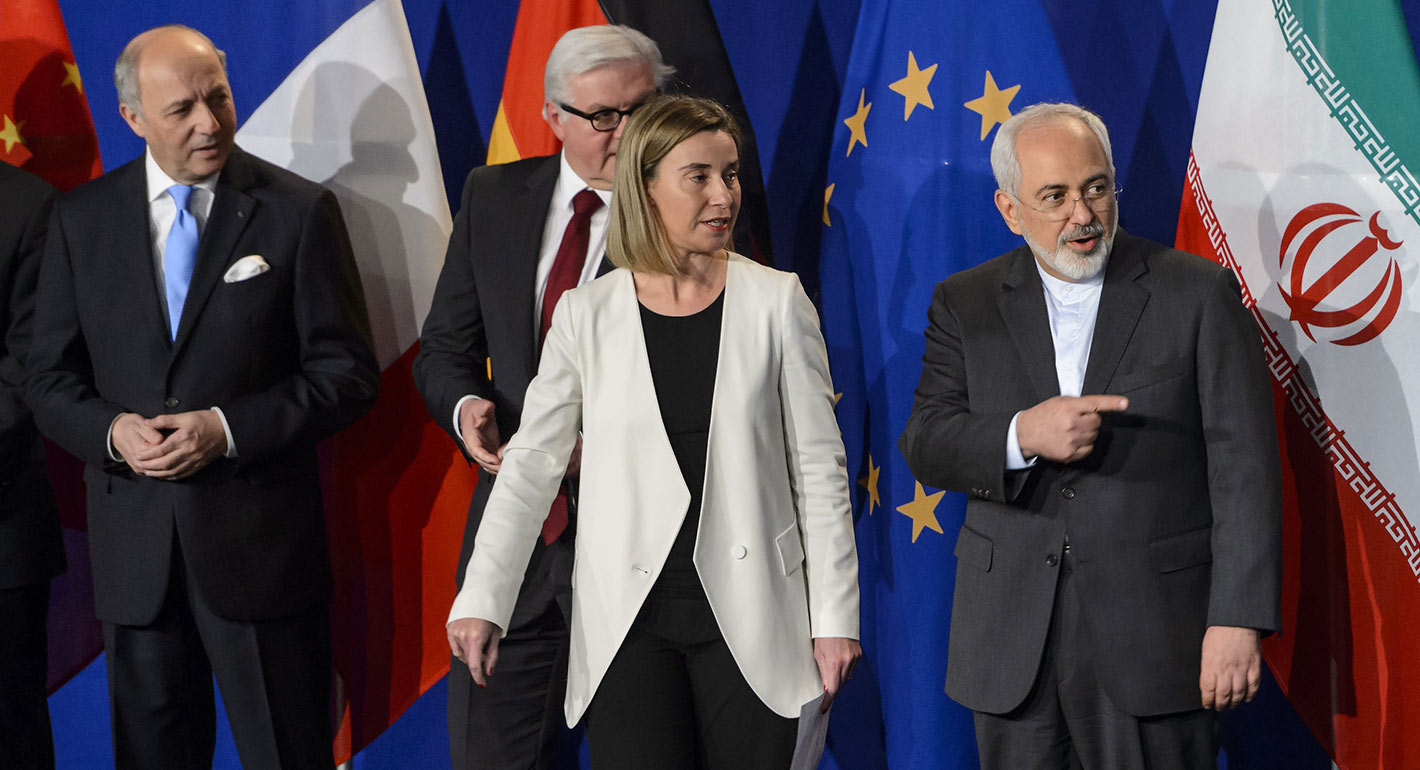
Following Washington’s withdrawal from the Iran nuclear deal and the reimposition of U.S. sanctions, the prospects for EU economic relations with Tehran turned from promising to imperilled.
Source: Italian Institute for International Affairs (IAI)
In merely two years, the prospects for EU–Iran economic relations turned from promising to imperilled. The US presidential election of November 2016 dealt a first blow to the euphoria following the signing of the nuclear deal in July 2015. Already at that point, the Islamic Republic’s volatile business environment and the reluctance of European banks to provide finance had prevented many companies from following through on their deals. To this was added the increased uncertainty about whether and when the new US president would fulfil his election promises to tear the deal apart. The scale of business activity consequently was less than anticipated, or hoped for.
With Washington pulling out of the deal in May 2018 and fully re-imposing its sanctions by November, the EU’s approach aiming to salvage implementation of the nuclear deal has hit a stone wall. That is because various US sanctions now effectively prevent any economic activity by European companies in Iran. Washington’s so-called “primary sanctions” had legitimately remained under the deal, banning US companies, including banks, from engaging in nearly all nonhumanitarian trade (i.e., excluding food and drugs) with Iran and in particular in any business relation with the Islamic Revolutionary Guards Corps (IRGC). Most importantly, US “secondary sanctions” are also in force again, threatening the companies of third countries – from Europe to India to South Korea and Japan – with considerable fines or a ban on access to the US market should they fail to cease their activities in Iran. What was thus considered a “warming up” period of European companies (re-)establishing relations with their Iranian counterparts soon turned decidedly cool again.
This article was first published in the IAI Papers series in the framework of a joint research project run by the Foundation for European Progressive Studies (FEPS) and the Istituto Affari Internazionali (IAI) entitled “Europe and Iran in a Fast-changing Middle East: Confidence Building Measures, Security Dialogue and Regional Cooperation.”. FEPS and IAI retain copyright over the article.

Former Nonresident Fellow, Carnegie Europe
Cornelius Adebahr was a nonresident fellow at Carnegie Europe. His research focuses on foreign and security policy, in particular regarding Iran and the Persian Gulf, on European and transatlantic affairs, and on citizens’ engagement.
Recent Work
Cornelius Adebahr

Cornelius Adebahr, Barbara Mittelhammer
Carnegie does not take institutional positions on public policy issues; the views represented herein are those of the author(s) and do not necessarily reflect the views of Carnegie, its staff, or its trustees.

For every ruble allocated to social policy, health, and education in 2027, double that amount is earmarked for the army, the police, and the security services.

Alexandra Prokopenko

The European far right might fail to steer EU policy in the direction Russia wants, but they will create enough chaos inside Europe to benefit the Kremlin.

Dimitar Bechev

If the Russian-speaking community in Latvia cannot articulate their interests without being seen as disloyal, they could end up embracing a pro-Kremlin agenda.

Sergejs Potapkins

Depleted financial reserves and a shrinking tax base mean it is no longer possible to simultaneously deliver high defense spending, price stability, and economic growth.
Alexandra Prokopenko
Andrey Melnichenko’s essay offers no answer to the fundamental question of how, under any kind of negotiated settlement, Europe can protect itself from the Russian ressentiment that is inevitable in all scenarios except for an outright victory for Putin.

Leonid Bershidsky